🇰🇷 South Korea · City Guide

BUSAN

Korea's laid-back second city — beach towers, working fish markets, and mountains meeting the sea, where rent runs about half of Seoul's and English gets you a lot less far.

🌡 86°F · 21m elevation · wet season Late June–early August (jangma monsoon), plus real typhoon exposure August–September as a coastal city
✦ Move-in intel

What you need
before you go

📋Visa
F-2-7 Points-Based Long-Term Residency (via E-7 work visa)

The same national visa ladder applies in Busan as everywhere in Korea: an E-7 skilled-worker visa (employer-sponsored, 2026 minimum salary roughly 31.1 million KRW/year for professional roles) or E-2 teaching visa first, then an upgrade to F-2-7 points-based residency after 3 years (80 of 170 possible points clears the bar, scored on education, income, Korean ability, and age). Busan's own job market for Americans outside teaching is thin, so most Americans here arrive already on E-7 sponsorship from a Seoul- or Gyeonggi-headquartered employer willing to place them regionally, on F-4 heritage status (parent or grandparent held Korean nationality), or as English teachers working toward F-2-7 over time. National Health Insurance doesn't activate until 6 consecutive months of residence regardless of visa type.

Visa guides →
🗣Languages
KoreanEnglish (spoken in Haeundae hotels/restaurants and university areas; minimal elsewhere)
Best For
  • remote workers on a budget
  • retirees seeking mild winters
  • English teachers
  • beach lifestyle seekers
👥Expat Community
~1.5% of population (approximately 49,000 registered foreign residents as of 2023) expats

Smaller and more scattered than Seoul's; concentrated near university language programs and English-teaching hubs in Haeundae and Seomyeon

✦ Living here

What it's like to live in Busan

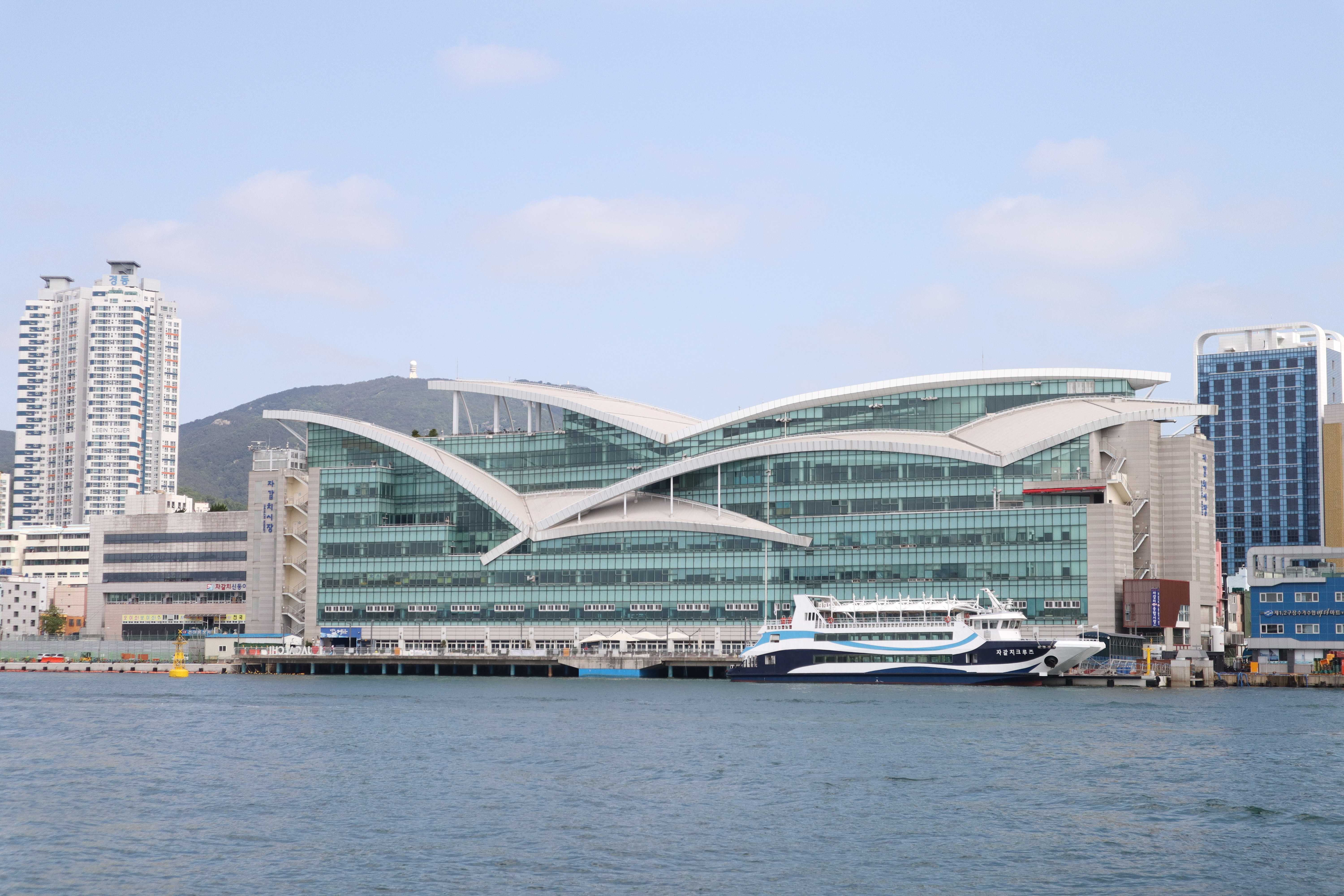
Busan is South Korea's second-largest city and its main port, strung along a dramatic coastline where high-rise beach towers (Haeundae, Gwangalli) sit a short subway ride from a working fish market (Jagalchi) and colonial-era alleyways (Nampo-dong). At 3.3 million people it's a real city with four subway lines, a light rail, and a coastal commuter train, but it moves at a noticeably slower pace than Seoul — locals joke that Busan people are warmer and louder, Seoul people colder and faster. Winters are the mildest of any major Korean city (rarely below freezing), and the Busan International Film Festival, APEC-legacy convention infrastructure, and a genuinely excellent seafood scene give it a cultural identity distinct from just being 'Seoul but smaller.'

Busan's foreign community is modest — about 49,000 registered foreign residents as of 2023, roughly 1.5% of the population, concentrated around university language programs and a handful of English-teaching hubs, nowhere near Seoul's infrastructure of English-speaking services. Landlords here are, if anything, more cautious about foreign tenants than in Seoul, and the same wolse deposit-plus-monthly-rent system applies everywhere — expect $3,000-$10,000 down in cash for an unremarkable one-bedroom near Seomyeon or Gwangalli before signing, since jeonse (Korea's alternative lump-sum, no-monthly-rent deposit system) is effectively unreachable for foreigners without Korean bank financing. Job opportunities for Americans outside English teaching are thin; most professional and corporate roles are still headquartered in Seoul or Gyeonggi Province. Spring yellow dust reaches Busan too, if slightly less severe than inland cities, and the city's older housing stock (much of it built pre-2000) means spotty insulation and window-unit heating/cooling rather than central systems in cheaper apartments.

✦ Monthly costs

What it actually
costs to live here

🏙1BR apartment in center
$489/mo
Busan
vs
$1,850/mo
US avg
74% cheaper than US

Wolse deposits in Seomyeon or Gwangalli run $3,000–$7,000 for an unremarkable one-bedroom — roughly half what the same wolse deposit costs in Seoul. Haeundae's beach towers push that toward $8,000–$10,000 for anything with an ocean view. Jeonse (no monthly rent, giant lump sum) is effectively off-limits without Korean bank financing.

🏡1BR outside center
$270/mo
Busan
vs
$1,450/mo
US avg
81% cheaper than US

Neighborhoods like Nampo-dong or Jeonpo, a short subway ride from the center, bring the wolse deposit down to $2,000–$5,000. Much of this stock is pre-2000 construction with window-unit heating and cooling rather than central systems, so insulation is weaker.

🛒Groceries
$420/mo
Busan
vs
$470/mo
US avg
11% cheaper than US

Homeplus and Lotte Mart are the default big-box stops; Jagalchi fish market and Bupyeong Kkangtong Market undercut them badly on seafood and produce. Imported goods carry the same premium as everywhere in Korea, just with fewer Western grocery options than Seoul.

💡Utilities
$91/mo
Busan
vs
$200/mo
US avg
55% cheaper than US

Busan's mild winters (rarely below freezing) mean lower heating bills than Seoul, but coastal humidity pushes hard summer AC use through July–August. Older buildings near Nampo-dong often run window units rather than central air.

📶Internet
$23/mo
Busan
vs
$72/mo
US avg
68% cheaper than US

Same nationwide fiber infrastructure as Seoul — gigabit plans from KT or SK Broadband run around $20–25/mo, fast enough anywhere in the city including Haeundae's high-rises.

🍽Meal out
$6
Busan
vs
$25
US avg
76% cheaper than US

A local dwaeji gukbap or milmyeon bowl runs $5–7 — some of the cheapest sit-down meals in urban Korea. Haeundae's beachfront restaurants and tourist-facing Western spots run noticeably higher, $12–20.

Busan prices sourced from livingcost.org South Korea cost data (June 2026), cross-referenced with Numbeo Busan (updated June 2026); 3-bedroom estimated at ~2.2x the 1-bedroom center rate · last verified 2026-07-20
US averages from Numbeo US Cost of Living (national median, May 2025)
5 neighborhoods

Where to
actually live

Haeundae Beach and high-rise towers
$$$
Haeundae

Busan's flagship beach district — high-rise towers, luxury hotels, and Marine City's expat cluster; the most convenient (and priciest) address for Western restaurants and English-speaking services

Upscale
Gwangalli Beach with Gwangan Bridge
$$
Gwangalli (Gwangan)

A calmer, more residential beach neighborhood than Haeundae, with a young cafe-and-bar scene facing the illuminated Gwangan (Diamond) Bridge

Mid-range
$$
Seomyeon

Busan's dead-center hub — dense nightlife, shopping, and transit connections without the beach-town price tag; often called the city's 'hipster' district

Mid-range
$$
Jeonpo (Jeonpo Café Street)

A dense strip of specialty coffee shops and small boutiques on Seomyeon's eastern edge; trendy, walkable, popular with younger renters

Mid-range
Jagalchi fish market in Nampo-dong
$
Nampo-dong

The old cultural core — Jagalchi fish market, Gukje traditional market, and BIFF Square; the cheapest of the central neighborhoods and the most unmistakably Korean

Budget-friendly
80 listings

Real homes in Busan

Updated July 2026 · From local South Korea portals · No sponsored placement

80 Listings in Busan

No listings match this filter.
12 real sources

Where this all
comes from

We don't make any of this up. Every number, neighborhood, and living-here detail traces back to one of these — government sites, cost-of-living databases, expat forums, and actual humans on Reddit who've lived in Busan.

Content last updated: 2026-07-20 · Data verified from local sources
✦ Ready to explore?

Ready to explore moving
to South Korea?

Read the South Korea Guide →Browse All South Korea Homes