🇰🇷 South Korea · City Guide

SEOUL

Korea's neon-and-glass megacity where 9.4 million people run on kimchi, Wi-Fi, and impossibly punctual subways — Seoul is where most Americans land first, and where the jeonse/wolse deposit system will empty your bank account before you've unpacked a box.

🌡 85°F · 38m elevation · wet season Late June–July (jangma monsoon), with occasional typhoon remnants in August–September
✦ Move-in intel

What you need
before you go

📋Visa
F-2-7 Points-Based Long-Term Residency (via E-7 work visa)

Most Americans arrive on an E-7 skilled-worker visa (employer-sponsored; 2026 minimum salary is roughly 31.1 million KRW/year for E-7-1 professional roles) or an E-2 teaching visa, then after 3 years of legal residence apply to upgrade to F-2-7 — Korea's points-based long-term residency, scored out of 170 across education, income, Korean-language ability (TOPIK/KIIP), and age. 80 points clears the bar and unlocks the right to work for any employer without sponsorship; the 3-year residence requirement is waived if your most recent annual income was 40 million KRW or above. Americans of Korean descent can skip most of this via the F-4 Overseas Korean visa (a parent or grandparent held Korean nationality), which grants nearly unrestricted work rights without the points test. The D-10 job-seeker visa (extendable up to 3 years) lets you search for E-7 sponsorship in-country, often via a paid D-10 internship that converts to a permanent E-7 offer. None of these visas cover you medically on arrival — National Health Insurance is mandatory but only activates after 6 consecutive months of residence.

Visa guides →
🗣Languages
KoreanEnglish (widely spoken in Itaewon, corporate offices, and international schools; limited elsewhere)
Best For
  • corporate transferees
  • English teachers
  • tech and finance professionals
  • students
  • digital nomads
👥Expat Community
~4.8% of population (450,888 registered foreign residents as of Nov 2024 — the largest foreign community of any Korean city) expats

Concentrated in Itaewon/Yongsan-gu (a historic international district that grew up around the former US military garrison) and increasingly in Mapo-gu's Hongdae/Yeonnam area for younger arrivals; corporate expats cluster in Gangnam near multinational offices

✦ Living here

What it's like to live in Seoul

Seoul is the capital and undisputed center of gravity for South Korea — 9.4 million people packed into a river valley ringed by granite mountains, split by the Han River into an older, tradition-heavy north (Jongno, Jung-gu) and a glass-tower south (Gangnam, Seocho). The subway system (23 lines, English signage, trains every 2-4 minutes) makes car ownership genuinely unnecessary, and the city runs on convenience: 24-hour delivery apps, coin laundries on every block, and a level of public safety that lets you leave a laptop on a cafe table to hold a seat. Roughly 450,000 registered foreign residents live in Seoul as of late 2024 — the largest concentration in the country — clustered around Itaewon and Yongsan-gu, with a growing professional class in Gangnam and a younger, cheaper contingent in Mapo-gu's university neighborhoods.

The catch is the housing system. Korean apartments almost never rent month-to-month the way Americans expect — you'll be quoted either jeonse (a lump-sum deposit worth 50-80% of the unit's value, refunded in full when you leave, no monthly rent) or wolse (a smaller deposit plus monthly rent, the version nearly every foreigner ends up using, since jeonse requires bank financing Korean landlords won't extend to non-residents). Even wolse deposits routinely run $8,000-$25,000 for an unremarkable one-bedroom, due in cash before you get keys. Landlords can and do reject foreign tenants outright, or demand a Korean guarantor; agents who work with foreigners charge extra for the service. Layer on: apartments are small by American standards (a 'spacious' one-bedroom is 25-30 square meters), the National Health Insurance Service won't cover you until you've been resident six months, spring brings weeks of yellow-dust pollution blown in from the Gobi Desert, and Korean work culture still runs long hours with weekend calls the norm at most local employers. English gets you through Itaewon and international-business meetings; it does not get you through a landlord dispute or a hospital intake form anywhere else in the city.

Scenes from Seoul

Daily life,
up close

Seoul at night along the Han River
Deoksugung Palace in downtown Seoul
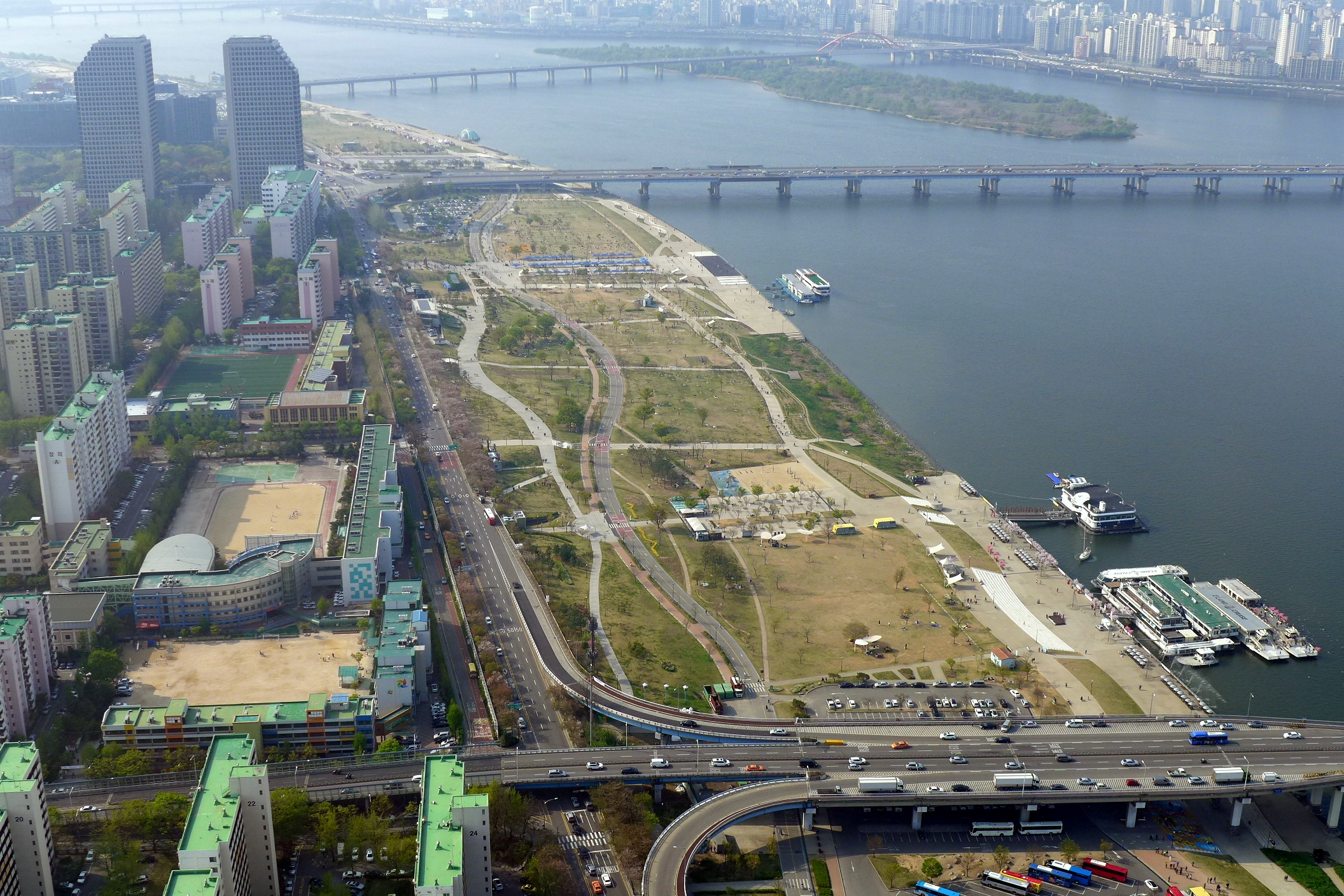
Hangang (Han River) Park, Seoul's riverside green space
Seoul City Hall and plaza
✦ Monthly costs

What it actually
costs to live here

🏙1BR apartment in center
$717/mo
Seoul
vs
$1,850/mo
US avg
61% cheaper than US

Wolse (deposit + monthly rent) is what nearly every foreigner signs — expect $8,000–$15,000 down in cash for a one-bedroom in Mapo or Jongno, more in Gangnam or Itaewon/Hannam. Jeonse (a $150,000+ lump sum, no monthly rent, refunded on move-out) is cheaper long-term, but Korean banks won't finance it for non-residents, so it's rarely an option.

🏡1BR outside center
$459/mo
Seoul
vs
$1,450/mo
US avg
68% cheaper than US

Same wolse deposit-plus-rent structure a subway stop or two further out — Seongsu before its recent gentrification spike, or outer Mapo and Eunpyeong. Deposits drop to roughly $5,000–$10,000, and the subway keeps 'outside center' a 20–30 minute ride from Gangnam or City Hall.

🛒Groceries
$438/mo
Seoul
vs
$470/mo
US avg
7% cheaper than US

E-Mart and Homeplus cover the basics at reasonable prices; imported cheese, wine, and US-brand cereal from Kim's Club or the Foreign Food Mart in Itaewon roughly double the bill. Traditional markets like Gwangjang and Mangwon are the cheapest source for produce and banchan.

💡Utilities
$99/mo
Seoul
vs
$200/mo
US avg
51% cheaper than US

Gas-fired ondol underfloor heating runs the winter bill up fast in older, poorly insulated buildings; central AC is rare under $1,500/mo rent, so summer cooling usually means a window or standing unit running through the humid months.

📶Internet
$15/mo
Seoul
vs
$72/mo
US avg
79% cheaper than US

Korea's fiber is genuinely excellent — KT, SK Broadband, and LG U+ all sell gigabit plans for $15–20/mo with same-week installation. Speed and reliability are a non-issue anywhere in the city, including Itaewon and Mapo's co-working-heavy blocks.

🍽Meal out
$7
Seoul
vs
$25
US avg
72% cheaper than US

A bowl of kimchi jjigae or a gimbap-and-soup combo runs $6–8 at any local spot. Western food (brunch, pizza, a real burger) in Itaewon or Gangnam jumps to $15–25 — Chicago prices for the same plate.

Seoul prices sourced from livingcost.org South Korea cost data (June 2026), cross-referenced with Numbeo Seoul (updated July 2026); 3-bedroom estimated at ~2.3x the 1-bedroom center rate · last verified 2026-07-20
US averages from Numbeo US Cost of Living (national median, May 2025)
5 neighborhoods

Where to
actually live

Itaewon food street, Yongsan-gu
$$$
Itaewon & Hannam-dong

Seoul's most international quarter — halal restaurants, dive bars, embassies, and Yongsan-gu's expat backbone since the US military base era; Hannam's hillside villas draw diplomats and executives

Upscale
Teheran-ro in Gangnam, Seoul's business district
$$$
Gangnam

Glass towers, hagwons, and Seoul's wealthiest district south of the Han; a five-minute subway hop to finance and tech HQs, though noticeably more sterile than the older north-side neighborhoods

Upscale
Hongdae street scene, Mapo-gu
$$
Mapo (Hongdae & Yeonnam-dong)

University nightlife around Hongik, calmer cafe streets in Yeonnam just north; the default landing zone for young remote workers, students, and English teachers

Mid-range
Evening street in Seongsu-dong
$$
Seongsu

A former shoe-factory district turned 'Seoul's Brooklyn' — converted warehouses, third-wave coffee roasters, and gallery spaces; rents climbing fast as it gentrifies

Mid-range
Gyeongbokgung Palace in Jongno district
$$
Jongno

Palace walls, hanok villages, and government ministries; surprisingly affordable studios in older low-rises despite sitting in the dead center of the city

Mid-range
2,232 listings

Real homes in Seoul

Updated July 2026 · From local South Korea portals · No sponsored placement

2,232 Listings in Seoul

No listings match this filter.
12 real sources

Where this all
comes from

We don't make any of this up. Every number, neighborhood, and living-here detail traces back to one of these — government sites, cost-of-living databases, expat forums, and actual humans on Reddit who've lived in Seoul.

Content last updated: 2026-07-20 · Data verified from local sources
✦ Ready to explore?

Ready to explore moving
to South Korea?

Read the South Korea Guide →Browse All South Korea Homes