Things To Do in Canada: The Ultimate Guide for 2025
Canada is the world's second-largest country by land area, and it fills that space with a variety of geography and culture that's genuinely staggering. You can ski world-class powder in the morning and eat excellent Vietnamese food in the afternoon (Vancouver), stand at the edge of the world's most powerful waterfall (Niagara), eat your way through one of North America's great food cities (Montréal), watch the Northern Lights dance over subarctic wilderness (Yukon, Manitoba), or walk a 500-year-old fortified city whose streets are still largely intact (Québec City). Canada also has the significant advantage, for American visitors, of being a short flight away and an easy cultural adjustment — with the useful twist that it's actually quite different from the US in ways that become more obvious the longer you stay.
Vancouver and Whistler: Mountains Meet Ocean
Vancouver is one of the world's most liveable cities — consistently ranking at the top of global quality-of-life surveys — and after a day skiing at the North Shore mountains in the morning and walking along the seawall at sunset with the skyline behind you and the Pacific in front, the ranking is self-evident. The city is also increasingly excellent at food, coffee, and the kind of outdoor-urban lifestyle combination that other cities try to replicate without achieving.
Stanley Park (free, 400 hectares of old-growth forest on a peninsula almost entirely surrounded by the harbor) contains the Seawall — 22 km of paved waterfront path around the park's perimeter — and the Lost Lagoon, Beaver Lake, 17 km of forest trails, and the famous Totem Poles at Brockton Point. For Vancouver and Whistler trip planning, canada.travel (Destination Canada's official tourism site) and r/canada are both helpful. Rent a bike at the park entrance (C$8–$12/$5.90–$8.84 USD/hour) and do the seawall circuit in 2 hours. The Second Beach pool (outdoor, seawater, heated June–September) and the views north to the North Shore mountains from Prospect Point are both excellent.
Granville Island (free to enter, parking C$3–$5/$2.21–$3.68 USD/hour or take the False Creek Aquabus ferry, C$5.50/$4.05 USD) holds the best public market in western Canada — the Granville Island Public Market (open daily, free to browse) has local salmon, BC oysters, excellent cheese, prepared foods, artisan bread, and farmers from the Fraser Valley all in one covered hall. The surrounding island also has galleries, studios, a brewing company (Granville Island Brewing, tours and tasting room), and the Emily Carr University of Art and Design.
Whistler is 2 hours north of Vancouver on the Sea-to-Sky Highway (one of North America's great drives — the highway hugs the coast of Howe Sound before climbing into the mountains, passing Shannon Falls and the Sea to Sky Gondola in Squamish). Whistler-Blackcomb is North America's largest ski resort — 3,307 hectares of skiable terrain, 200+ marked runs, 37 lifts, and the famous PEAK 2 PEAK Gondola (the highest and longest unsupported lift span in the world) connecting the two mountains. Winter lift passes: C$200–$250 ($147–$184 USD) per day; buy in advance for significant discounts, or an Epic Pass if you'll ski multiple resorts that season.
In summer, Whistler's Valley Trail (40 km paved network connecting the village to the lake areas), mountain biking in the Whistler Mountain Bike Park (7 lift-accessed trails, C$60/$44.18 USD all-day), and the Lost Lake park (free swimming and paddling) make it an excellent warmer-season destination as well.
Banff and Lake Louise: The Jewels of the Canadian Rockies
Banff National Park is Canada's oldest national park (established 1885) and the reason the Canadian Pacific Railway built the original Banff Springs Hotel — they needed a destination grand enough to justify the transcontinental railroad ticket. The park remains extraordinary: 6,641 square km of glaciated peaks, alpine lakes in colors that seem chemically enhanced, elk grazing casually through town, and 1,600 km of hiking trails.
Lake Louise is the park's most famous sight — a glacially-fed lake at 1,731 meters elevation, its water a startling turquoise-blue that comes from rock flour (finely ground mineral particles) suspended in glacial meltwater. The iconic Fairmont Chateau Lake Louise (C$600–$1,500/$441–$1,103 USD/night, book months ahead in summer) sits directly on the lakefront; you don't need to stay to walk the Lake Louise Lakeshore Trail (3.8 km return, free, paved, stroller-accessible) or to hike to the Plain of Six Glaciers Tea House (14.4 km return, free with park pass). The tea house — a wooden cabin at 2,135 meters operated since 1927 — serves sandwiches, baked goods, and hot drinks; arrive by 1 PM for seating.
Moraine Lake, 14 km from Lake Louise village on a winding mountain road, is Canada's most photographed view — ten glacier-draped peaks rise behind a vivid lake with a 30-meter rockpile (the Valley of the Ten Peaks moraine, natural landslide debris) at its inlet. The road access is by shuttle only in peak season (late May–mid-October), requiring advance reservation or use of the Parks Canada reservation system (C$10/$7.36 USD/person shuttle). The Rockpile Trail (1.5 km return, free with park pass) climbs 30 meters for the canonical view.
Banff town (population 7,000, the only incorporated town within a Canadian national park) has good restaurants, a walkable main street, and the Banff Upper Hot Springs (C$10–$17/$7.36–$12.50 USD, open year-round) — a mineral hot pool at 1,585 meters with mountain views. The Banff Gondola (C$65/$47.80 USD, 8-minute ride to 2,281 meters on Sulphur Mountain) provides the best view across the Bow Valley — also accessible by the 5.5 km Sulphur Mountain Trail (free hike up, gondola ride down for C$25/$18.39 USD).
Parks Canada day pass: C$10.50/$7.72 USD per adult, or C$21/$15.45 USD per vehicle. An Annual Discovery Pass (C$75.25/$55.35 USD per adult or C$145.25/$106.88 USD per vehicle) covers all 80+ Parks Canada national parks and historic sites and is worthwhile if you're visiting multiple parks. Banff trail conditions and seasonal updates are discussed on r/travel's Canada threads.
Toronto: Diverse Neighbourhoods, World-Class Food, and the Arts
Toronto is North America's most ethnically diverse large city — according to Statistics Canada, over half the population was born outside the country — and that diversity expresses itself most vividly in its neighborhoods and its food. In a single afternoon you can eat dim sum in Spadina Chinatown, browse Portuguese pastéis de nata in Little Portugal, and finish with craft beer in Kensington Market. It's a city that rewards wandering.
Kensington Market (west of Spadina, north of Dundas, no entry fee) is Toronto's most distinctive neighborhood — a jumble of Victorian houses, vintage clothing stores, international food stalls, independent cafes, and street art in a few compact blocks. Visit on a pedestrian Sunday (car-free, May–October) when the streets fill with vendors, musicians, and a general sense of outdoor living unusual in a North American city. The Kensington Brewing Company and the Seven Lives taco stand (lineup goes around the block — worth it) are neighborhood institutions.
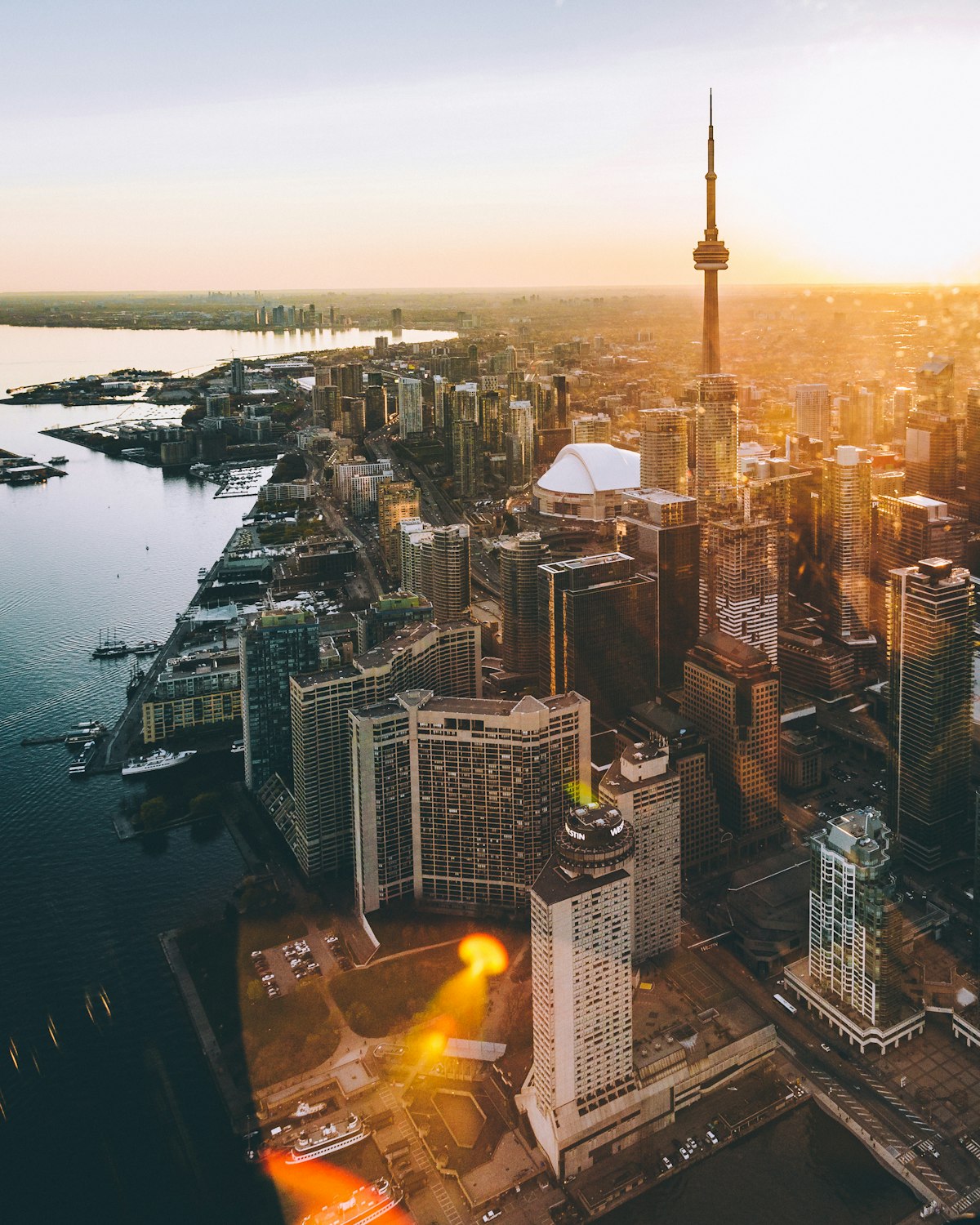
The CN Tower (C$43–$58/$31.64–$42.67 USD depending on view deck level) dominated the skyline from 1976 to 2010 as the world's tallest freestanding structure. The observation deck at 447 meters and the glass-floor lookout at 342 meters provide clear-day views extending 150 km to Niagara Falls. The EdgeWalk (C$195–$265/$143.44–$194.87 USD, minimum booking requirements) lets you walk the outer edge of the main pod at 356 meters — hands-free, tethered, facing outward over the city.
Distillery District: a 13-acre Victorian industrial complex (the former Gooderham & Worts Distillery, once the British Empire's largest distillery) converted into a pedestrian-only precinct of galleries, restaurants, boutiques, and event venues. Free to explore; the SOMA Chocolatemaker, Mill Street Brewery (original location, now a pub), and the Young Centre for the Performing Arts are the standouts. The annual Toronto Christmas Market (November–December, free entry on weekdays) transforms the cobblestone streets.
St. Lawrence Market (Tuesday–Saturday, free to browse) — a two-building public market on the south side of the old city with 120+ vendors; the south building has fresh produce, meats, cheeses, and the legendary peameal bacon sandwich (back bacon cured in a cornmeal coating, served on a bun from Carousel Bakery, C$8–$10/$5.89–$7.36 USD — considered one of Toronto's defining food experiences).
Neighborhood eating: Koreatown on Bloor West for Korean BBQ and bibimbap (budget C$20–$35/$14.71–$25.74 USD/person); Little Italy on College Street for proper pizza and aperitivo hour; Leslieville (Queen Street East, east end) for brunch culture and the city's best independent coffee shops.
Montréal: Food, Festivals, and French North America
Montréal is North America's most European city and its most underrated food destination — a city that produces extraordinary restaurants, a bagel culture that New Yorkers grudgingly admit produces a different-but-possibly-superior product, the continent's best smoked meat, and a hospitality culture influenced by French-Canadian joie de vivre that makes eating and drinking here feel like a genuine pleasure rather than fuel. It's also home to the best summer festival programming anywhere in North America.
The Plateau Mont-Royal neighborhood is Montréal's most characterful — block after block of colorful Victorian duplexes with exterior spiral staircases (designed so interior stairs don't reduce floor area, a peculiarity of the Montreal building code), independent cafes and bookshops, and the relaxed energy of a neighborhood that knows it's excellent without needing to advertise it. Avenue du Mont-Royal and Rue Saint-Denis are the main arteries; the Marché Jean-Talon (20 minutes north by metro) is the finest public market in Canada, covering two city blocks with a glass-and-steel roof and 300+ vendors.
Smoked meat: Schwartz's Hebrew Delicatessen on the Main (Boulevard Saint-Laurent) has been producing Montreal smoked meat since 1928 — a 10-day curing and smoking process using a secret spice blend applied to beef brisket. Lineup extends outside. A sandwich with rye bread and mustard: C$11–$13 ($8.09–$9.56 USD). The Main (around the corner) is the main competition and has shorter lines. Pick either; both are excellent.
Montréal bagels: St-Viateur Bagel and Fairmount Bagel have been locked in a generations-long rivalry that Montréalers treat with genuine seriousness. The Montréal bagel is hand-shaped, boiled in honey water, and baked in a wood-fired oven — denser, sweeter, and smaller than New York bagels. St-Viateur (baked continuously 24 hours; the sesame is the standard order, C$1.50/$1.10 USD each) on Saint-Viateur Street in Mile End has a slightly better crumb in most assessments.
The Montreal International Jazz Festival (late June–early July) is the world's largest jazz festival — 500+ concerts over 11 days, about 350 of them free outdoors in the Quartier des spectacles. Just For Laughs (July–August, world's largest comedy festival) and Osheaga (late July–early August, major music festival in Parc Jean-Drapeau, C$160–$340/$117.65–$249.98 USD for 3-day pass) are summer festival highlights.
Old Montréal (Vieux-Montréal): cobblestone streets, the Basilique Notre-Dame (C$8/$5.89 USD, one of the most ornate Gothic Revival interiors in North America, evening light shows in the winter months), and the waterfront Old Port with cycling along the riverside are all excellent and walkable. Piknic Électronik (Sunday afternoon outdoor electronic music on Île Sainte-Hélène, May–September, C$20/$14.71 USD entry) is the most Montréal thing you can do on a Sunday.
Niagara Falls: Beyond the Tourist Traps
Niagara Falls is the highest-volume waterfall in North America — 2,832 cubic meters of water per second passing over the brink in peak flow, a statistic that becomes viscerally real when you're standing 25 meters away on the Maid of the Mist boat being drenched in spray while 57 meters of water thunders past with a bass note you feel in your chest. The Horseshoe Falls on the Canadian side is more dramatic than the American falls, and the Ontario town of Niagara Falls — despite its aggressive tourist strip — provides the best viewing angles.
The Maid of the Mist boat tour (C$28–$32/$20.59–$23.53 USD, season May–November) has operated since 1846 and remains the single best Niagara experience — you approach the base of Horseshoe Falls to within 200 meters, close enough to be enveloped in mist and sound. Ponchos provided. Arrive early morning for shorter lines and golden light on the falls.
Journey Behind the Falls (C$22/$16.18 USD, open year-round) uses tunnels cut into the limestone bedrock to emerge behind the Horseshoe Falls — you're looking through curtains of falling water at the Canadian and American shores. Different from the boat experience and worth doing as a complement to the Maid of the Mist.
Table Rock Welcome Centre is the free vantage point directly at the brink of Horseshoe Falls — arrive at night when the falls are illuminated in rotating colors (free, nightly year-round) for a different but equally impressive experience. The Fallsview area restaurants and casino are touristy and expensive; instead, eat in Niagara-on-the-Lake (20 km north), a perfectly preserved 19th-century loyalist town with excellent restaurants and the Shaw Festival theatre (May–November, professional classical theatre company).
Niagara wine region: the Niagara Peninsula's Niagara-on-the-Lake wine region is Canada's most productive VQA (Vintners Quality Alliance) appellation, famous for Riesling, Pinot Noir, and most distinctively, Icewine (wine pressed from naturally frozen grapes on the vine, intensely sweet and rich, typically served in small 50ml pours, C$20–$40/$14.71–$29.42 USD per pour at the cellar door). Inniskillin and Jackson-Triggs are the large-scale operations with visitor centers; Stratus Vineyards and Tawse Winery are more artisanal.
Nova Scotia: Lobster, Tides, and the Celtic Shore
Nova Scotia (New Scotland, named by Scottish settlers in 1621) is a maritime peninsula connected to the rest of Canada by a narrow isthmus at the New Brunswick border, and its isolation has preserved a culture — Acadian French, Scottish Gaelic, Mi'kmaq Indigenous, and African Nova Scotian blended in a way found nowhere else — that makes it one of Canada's most distinctive regions. It's also home to the world's highest tides (Bay of Fundy), excellent lobster, and a Celtic music tradition that persists in weekly pub sessions across the province.
Halifax is the provincial capital and the best base — a compact, walkable harbor city with an excellent waterfront boardwalk, the Historic Properties (Canada's oldest surviving group of waterfront warehouses, now restaurants and bars), and the Canadian Museum of Immigration at Pier 21 (C$12/$8.83 USD, the Ellis Island equivalent — 1 million immigrants processed here between 1928 and 1971). The Halifax Farmers' Market at the Seaport (Saturday and Sunday, free entry) is one of the country's best.
Lunenburg (1.5 hours south of Halifax) is a UNESCO World Heritage Site — a perfectly preserved 18th-century British colonial planned town whose color-painted wooden buildings on a hillside over the harbor have changed remarkably little since the 1750s. It's also home port of the Bluenose II (replica of the famous 1921 racing and fishing schooner, free to board when in port). Eat chowder here — the fish chowder at The Old Fish Factory or the Lunenburg-style dark and complex chowder with salt fish at local diners is among the best in eastern Canada.
The Cabot Trail (298 km loop around Cape Breton Island, 5–6 hours driving without stops, 2–3 days to do properly) is one of Canada's great scenic drives — curling along cliff-edge roads above the Gulf of St. Lawrence through the highlands of Cape Breton Highlands National Park. The Skyline Trail (9.3 km return, free with national park pass, C$10.50/$7.72 USD/adult) follows the cliff edge with views across the Gulf. Celtic music sessions happen nightly at The Red Shoe Pub in Mabou and Normaway Inn in the Margaree Valley — sit near the fiddle players and try not to tap your foot.
Bay of Fundy tides: the Bay of Fundy between Nova Scotia and New Brunswick has a 17-meter tidal range — the world's highest. At Hopewell Rocks in New Brunswick (C$11/$8.09 USD, free parking), massive flowerpot rock formations are surrounded by water at high tide and stand 21 meters high on a tidal beach at low tide, where you can walk between them. Time your visit using the official tide tables — the difference in the landscape between high and low tide is one of the most extreme natural transformations in Canada.
Ottawa: Museums, Parliament, and the World's Largest Skating Rink
Ottawa is Canada's capital, and it does capital things exceptionally well — it has the highest density of world-class museums of any city in the country, several of them free, and the buildings themselves (the Gothic Revival Parliament Hill complex overlooking the Ottawa River, the modernist Canadian Museum of History across in Gatineau, the copper-roofed National Arts Centre) form an architectural cityscape that takes the city's federal role seriously.
Parliament Hill (free admission to the grounds and tours, advance booking recommended) is the heart of Canadian democracy — the Centre Block (under restoration until approximately 2030, the Peace Tower temporarily accessible via the East Block during works), the Senate, and the House of Commons can be toured when parliament is in session. The daily Changing of the Guard ceremony (June–August, 10 AM, free) on the front lawn deploys 125 Canadian Forces personnel in scarlet tunics. The Eternal Flame at the main entrance commemorates Canada's centennial (1967) and burns continuously.
The Canadian Museum of History in Gatineau, Quebec (accessible by a pleasant 20-minute walk across the Alexandria Bridge or bus, C$22/$16.18 USD) is one of the finest museums in North America — the Grand Hall is the world's largest collection of Indigenous totem poles and houses (seven authentic West Coast houses with 16 poles), and the Canada Hall traces 1,000 years of Canadian history through full-scale reconstructions of a Viking settlement, a Québec village, an Ontario main street, and a Cape Breton mining town.
The Rideau Canal (running 7.8 km through the city center) is a UNESCO World Heritage Site and the world's oldest continuously operated canal (1832). In winter (typically January–late February), when the canal freezes to a navigable depth, it becomes the world's largest natural skating rink — 7.8 km of maintained ice, skate rentals available at two locations (C$15–$20/$11.03–$14.71 USD), beaver tails (fried dough pastry with toppings, C$7–$10/$5.15–$7.35 USD from canal-side stands) are an Ottawa winter institution.
The ByWard Market neighborhood (east of Parliament, walkable) is the city's oldest and most vibrant food and social district — the original market building houses local produce vendors and the legendary BeaverTails kiosk (original location, since 1978). The surrounding blocks have some of the city's best restaurants: Soif Bar à vin for Quebec wine and charcuterie, The Whalesbone for sustainable Canadian seafood, and L'Atelier de Joël Robuchon for French fine dining at Canadian prices.
Québec City: North America's Only Walled City
Québec City is the only fortified city north of Mexico in North America, and Old Québec (Vieux-Québec) — its 17th-century upper town and lower town enclosed by massive stone ramparts — is a UNESCO World Heritage Site that feels more like a preserved European medieval city than anything else in North America. Walking the Rue du Petit-Champlain (the oldest commercial street in North America, dating to 1685, now boutiques and restaurants in original stone buildings) with the turreted Château Frontenac looming above is a genuinely transporting experience.
The Château Frontenac (C$350–$700/$257.41–$514.82 USD/night) is the most photographed hotel in the world, according to some assessments — a Fairmont castle-style grand hotel built in 1893 on the strategic cliff edge where Samuel de Champlain built his 1608 fort. Non-guests can walk the exterior on the Dufferin Terrace (free, riverfront boardwalk at the cliff base), which provides the classic Château view across the St. Lawrence River.
The Plains of Abraham (free park access) is where the 1759 battle between British General Wolfe and French General Montcalm determined the fate of New France — a 15-minute engagement that killed both generals and ultimately transferred control of Canada to Britain. The Musée des Plaines d'Abraham (C$14/$10.29 USD) tells the story; the park itself is a vast urban green space used today for skiing, skating, and the Festival d'été de Québec (July, 10-day music festival, C$110/$80.89 USD for full-festival pass).
Winter Carnival (Carnaval de Québec): held each February (Canada's largest winter festival), featuring the ice palace, snow sculpture competitions, ice canoe races across the St. Lawrence, and the Bonhomme Carnaval mascot appearing everywhere. A unique experience that makes the brutally cold Québec winter feel festive rather than punishing.
Food: poutine (fries, cheese curds, gravy — invented in Québec in the 1950s) is ubiquitous; Chez Ashton is the local chain considered the authentic standard. Tourtière (deep-filled meat pie, spiced pork and/or veal, a Québec Christmas tradition) appears on restaurant menus year-round. Île d'Orléans (accessible by bridge, 15 minutes from Vieux-Québec) is the market garden island of Québec — farm stands selling strawberries, cider, maple products, and Québec cheeses line the 67 km perimeter road.
Northern Lights and Arctic Experiences
Canada's vast subarctic and arctic regions offer some of the world's best Aurora Borealis viewing, and with the peak of Solar Cycle 25 (the current solar cycle reached maximum in 2024, meaning elevated geomagnetic activity through 2025–2026), this is an excellent window for Northern Lights travel.
Yukon — specifically Whitehorse and the surrounding wilderness — is consistently ranked among the world's top three Aurora viewing destinations. The combination of clear skies (cold, dry continental air), minimal light pollution, and position directly under the auroral oval makes it extraordinary from late August through mid-April. Northern Tales and Up North Adventures run dedicated Aurora tours (C$180–$250/$132.36–$183.84 USD) that transport you into dark wilderness and provide hot drinks in wall-tent camps while you wait for the lights. The Yukon Wildlife Preserve (C$25/$18.39 USD) offers daytime wildlife viewing of wood bison, elk, mountain goats, and muskoxen.
Churchill, Manitoba (accessible by overnight train from Winnipeg on VIA Rail, C$400–$600/$294.12–$441.18 USD return in a berth) is the Polar Bear Capital of the World — every October and November, several hundred polar bears gather on the Churchill coast waiting for Hudson Bay to freeze. Natural Habitat Adventures runs tundra buggy tours (large wheeled vehicles that move over the frozen tundra to where bears congregate, C$300–$450/$220.59–$330.88 USD/day) that put you within meters of bears in the wild. Churchill is also an excellent Aurora destination from January through March, when temperatures drop to -30°C and the skies are crystalline.
Northwest Territories (Yellowknife is the base): the Aurora Village outside Yellowknife operates heated teepee-style aurora viewing shelters with a 99% success rate over a 5-night stay (C$55/$40.44 USD per viewing night). Snowmobile tours, dog sledding, and ice fishing on Great Slave Lake complement the Aurora experience.
Icefields Parkway between Banff and Jasper (230 km, Canada's most spectacular highway): the Columbia Icefield at the midpoint is North America's largest icefield south of the Arctic, accessible via the Ice Explorer snow coach tours onto the Athabasca Glacier surface (C$58/$42.65 USD, included in the Columbia Icefield Adventure package C$88/$64.71 USD with the Glacier Skywalk). The Glacier Skywalk (C$32/$23.53 USD standalone) is a glass-floored observation platform cantilevered 280 meters above the Sunwapta Valley floor — for those who can handle the glass floors and the 10°C of wind.
Ready to explore?
Browse Destinations