Things to Do in Germany: The Ultimate Travel Guide for 2026
Germany defies easy summary. Official tourism: [germany.travel](https://www.germany.travel/en/home.html) (the German National Tourist Board) covers all 16 states. [r/germany](https://www.reddit.com/r/germany/) has active local and visitor threads. [r/travel](https://www.reddit.com/r/travel/) has Germany itinerary discussions. [Lonely Planet Germany](https://www.lonelyplanet.com/germany) provides comprehensive destination coverage. [TripAdvisor Germany](https://www.tripadvisor.com/Attractions-g187275-Activities-Germany.html) covers attraction booking and reviews. It's the country that gave the world Beethoven and the Autobahn, the Christmas market and the techno club, the Bavarian dirndl and the Berlin drag bar. You can spend a morning at a Michelin-starred restaurant in Hamburg, an afternoon hiking through the Black Forest, and an evening in a Dresden concert hall that was rebuilt stone by stone after Allied bombing. Few countries pack this much variety into a single train ride. This guide cuts through the tourist brochure version and shows you the Germany that rewards slow travel — the neighborhood bars, the regional food obsessions, the lesser-known corners that locals actually love.
Berlin: Where Alternative Culture Lives and Never Goes to Bed
Berlin operates on its own timeline. Clubs open at midnight and peak at 6am. Galleries occupy former power stations and ice factories. Entire neighborhoods that were rubble in 1990 are now the most talked-about creative districts in Europe. The city is deliberately unpolished, and that's entirely the point.
Mitte and Museum Island is where you start to understand Berlin's layers. The five museums on the Spree island — including the Pergamon Museum (currently under renovation, partially open) and the Neues Museum with its iconic bust of Nefertiti — form one of the densest concentrations of antiquities in the world. A day pass covering all five costs around €29. But the neighborhood around it, especially along Auguststraße, has become one of the best gallery strips in Europe. Entry is free and the art is genuinely interesting rather than decoratively safe.
Kreuzberg and Neukölln are where Berlin's multicultural soul lives loudest. Bergmannstraße in Kreuzberg has the density of a small-town high street — cheese shops, record stores, Turkish groceries, vintage clothes. The Markthalle Neun (Eisenbahnstraße 42-43) holds a Thursday street food market from 5pm to 10pm where vendors sell everything from Korean corn dogs to Eritrean injera. The canal path along the Landwehrkanal in summer is Berlin at its most relaxed: people swimming, boats, beers from corner kiosks for €1.50.
The Techno Scene is Berlin's most exported cultural product and its most misunderstood. Berghain — the converted power plant that is simultaneously the most famous and most exclusive club in the world — is just one node in an ecosystem that includes Tresor (industrial, less selective), Watergate (glass floor, Spree views), and a dozen smaller venues in Friedrichshain and Prenzlauer Berg. If Berghain is on your list, dress down, go alone or in pairs, leave the phone in your pocket, and don't try to explain yourself at the door. The bouncer's decision is final.
East Side Gallery (1.3km of the original Berlin Wall painted by 118 artists in 1990) is touristy but genuinely moving, especially at non-peak hours. The checkpoint at Schlesisches Tor neighborhood nearby has some of the best street food in the city — Döner Kebab here costs €5-7 and is done properly, not the airport version.
Practical Berlin: A 24-hour transit pass is €9.90 and covers everything including the S-Bahn to the airports. Berlin is genuinely cheap by Western European standards — dinner at a good restaurant runs €20-35 per person, and you can eat extremely well at the street food and market level for €8-12. Berlin's tap water is excellent.
Munich: Beer Halls, Baroque Architecture, and the Gateway to the Alps
Munich is the Germany that visitors imagine before they arrive — orderly, prosperous, culturally confident, with an unironic love of lederhosen and a beer culture that has been refined over 500 years. It's also one of the most expensive cities in Germany, with Munich rents rivaling Paris. But the old city is compact, walkable, and still built to a human scale that most German cities bombed into the postwar grid never recovered.
The Hofbräuhaus on Am Platzl is the obvious starting point for beer hall culture — and it's worth doing once despite the crowds. But the better experience is the Augustiner-Keller on Arnulfstraße or the Löwenbräukeller in Maxvorstadt, where the clientele is more local and the garden tables under chestnut trees in summer feel genuinely Bavarian rather than performed for tourists. A Mass (1-liter stein) costs €12-14. The food that goes with it — Schweinshaxe (pork knuckle), Obatzda (a Bavarian cheese spread), Weißwurst with sweet mustard — is regional and good.
Marienplatz is the heart of the old city. The Neues Rathaus Glockenspiel does its thing at 11am, noon, and 5pm and is worth seeing once. More interesting is the English Garden (Englischer Garten), a 3.7km park that is larger than Central Park and has a river surf wave at the Eisbach canal entrance. Locals surf it year-round. The Chinese Tower beer garden in the middle of the park holds 7,000 people and has been operating since 1791.
The Viktualienmarkt, Munich's daily outdoor market, is the best place to assemble a Bavarian picnic: local cheeses, smoked meats, fresh-baked bread, and a beer garden at the center. Budget €15-25 for a proper spread.
Schloss Nymphenburg, 5km northwest of the center, is the former summer palace of the Bavarian royal family. The grounds are free, the interior tour is €15, and the carriage museum houses some of the most opulent horse-drawn vehicles ever built, including the golden coronation coach of Karl VII. It's spectacular in a completely excessive way.
Practical Munich: The S-Bahn runs to the Alps in under an hour. Garmisch-Partenkirchen (€27 return) has the Zugspitze cable car (Germany's highest peak at 2,962m). Neuschwanstein Castle, the Disney-template original, is 2 hours by train and bus — book tickets at least a day in advance (€15 entry + €3.50 palace bridge ticket for the famous photo angle).
Hamburg: Port City, Music History, and Europe's Second-Largest Stage Scene
Hamburg's self-image as a hard-working port city rather than a tourist destination makes it the most underrated stop in Germany. The city has more canals than Amsterdam and Venice combined, an industrial waterfront being converted into the most architecturally ambitious new urban district in Europe, and a music history that produced the Beatles' first residencies and a club scene still operating at Reeperbahn that somehow feels authentic instead of legacy-themed.
The Elbphilharmonie (Herzog & de Meuron, 2017) is the most talked-about building in Germany, a concert hall built on top of a 1960s brick warehouse. Free tickets to the public observation deck (9am-midnight, book online) give you one of the best harbor views in Europe from 110 meters up. Concert tickets start around €15 for weekday performances by the Hamburg Philharmonic. The acoustics are extraordinary — the vineyard-style hall seats 2,100 and there's not a bad seat in it.
HafenCity is the 155-hectare urban development around the Elbphilharmonie — Europe's largest inner-city development project. It's still being built out through 2030, but the existing sections around the Speicherstadt (19th-century red-brick warehouse district, UNESCO listed) are already compelling. The International Maritime Museum in Speicherstadt is genuinely excellent and charges a reasonable €15. The local food market on Sundays near Überseequartier runs from 10am-5pm.
Reeperbahn in the St. Pauli district is Hamburg's nightlife district — clubs, bars, the Davidstraße sex work zone, and the Grosse Freiheit street where the Beatles played the Indra and Kaiserkeller in 1960-61. The Beatlemania Museum is tourist-facing but comprehensive. The actual nightlife is best approached via the clubs on Spielbudenplatz and the side streets: Molotow (indie rock), Prinzenbar (mixed programming), Waagenbau (techno in a converted weighing house).
The Fish Market at Altona harbor (Sundays, 5am-9:30am) is one of Hamburg's great experiences — live music, haggling fish vendors, the entire city seeming to show up either very early or still awake from the night before. Smoked eel, fresh shrimp sandwiches, strong coffee. Get there early.
Day trip to Lübeck: 45 minutes north by train (€20 return), Lübeck is the medieval Hanseatic port that invented marzipan (or at least perfected it). The Old Town is UNESCO listed, the Holstentor gate is on the old €2 coin, and Niederegger Marzipan on Breite Straße has been selling the stuff since 1806. Sample freely at the counter.
Rhine Valley and Moselle: Castles, Wine, and Slow River Travel
The Middle Rhine Valley between Bingen and Koblenz (65km) has more medieval castles per kilometer than anywhere else in Europe — UNESCO listed, steep-sloped, and built from the 11th through 14th centuries by regional lords who taxed every boat on the river. Traveling this stretch by boat rather than train gives you the correct vantage point: the castles are built to be seen from the water.
Lorelei Rock near St. Goarshausen is the most famous cliff on the Rhine — the narrowest, fastest-flowing section of the river, where the Lorelei siren legend says she distracted sailors onto the rocks. The cliff is 132m high and you can hike to the top for the view across the river bends. The actual rock is underwhelming from the road; from a boat, it's properly dramatic.
Marksburg Castle near Braubach is the only Rhine castle never destroyed in battle, and the tour is genuinely comprehensive — torture chamber to great hall. Entry €9. Most other Rhine castles are either ruins (Rheinfels near St. Goar, €5 to wander, well worth it) or renovated into hotels (Burg Rheinfels is now a hotel, Schloss Schönburg in Oberwesel has a good restaurant).
Wine: The Rhine and Moselle wine regions produce Riesling at a level unmatched anywhere. The style is different from New World Riesling — lower alcohol (8-11%), high acidity, mineral rather than fruit-forward. Weingut Joh. Jos. Prüm in Bernkastel-Kues on the Moselle and Weingut Dr. Bürklin-Wolf in the Pfalz region both do tastings. In the villages, the local Straußwirtschaft (seasonal wine bars run by the producers themselves, indicated by a pine branch above the door) are where you drink estate wine at €4-6 a glass with local bread and cheese.
The Moselle, joining the Rhine at Koblenz, is its own distinct experience — narrower, quieter, more winding, with Roman ruins at Trier (2 hours from Koblenz) that include the best-preserved Roman bath complex north of the Alps and the Porta Nigra gate. Trier was the western capital of the Roman Empire in the 4th century and the scale of what remains is shocking.
Practical navigation: The KD Rhine Line (www.k-d.com) runs passenger boats between Rüdesheim and Koblenz. The full run takes 5-6 hours one way. A German Rail Pass covers the boat service as a free inclusion. Trains run along both banks and are fast (Rüdesheim to Koblenz in 50 minutes), but the boat is the experience.
Black Forest: Deep Woods, Cuckoo Clocks, and Schwarzwälder Kirschtorte
The Black Forest (Schwarzwald) of fairy tale legend — Brothers Grimm territory, dense spruce and fir covering rolling hills in the southwest corner of Baden-Württemberg — is real and largely intact. It's also a working landscape: clock-makers, glassblowers, thermal spas, and the origin point for Germany's most serious hiking trails.
Triberg is the self-proclaimed cuckoo clock capital of the world and leans fully into it — the town has two competing shops each claiming to house the world's largest cuckoo clock. It's gloriously kitsch. But Triberg is also the access point for the Triberg Waterfalls, the highest waterfalls in Germany at 163m total drop, accessible via a marked hiking path (entry €4). In winter, they partially freeze and light up for an ice festival.
The Westweg, Germany's oldest long-distance hiking trail (285km from Pforzheim to Basel), runs through the heart of the Schwarzwald. You don't need to walk all of it — the 3-day section through the central high forest between Freudenstadt and Freiburg passes the Feldberg (the highest peak at 1,493m) and a series of lakes formed by glacial action after the last ice age. The Titisee and Schluchsee are swimmable in summer and have been since the Romans.
Freiburg im Breisgau is the Black Forest's university city and most livable town. The Münster (cathedral, free, started 1120) has one of the finest Gothic towers in Germany and a gargoyle-level of architectural detail that rewards slow examination. The Saturday market around the Münster sells Black Forest ham, locally produced honey, cherry schnapps (Kirschwasser), and flowers. The old town is crossed by Bächle — medieval water channels that run alongside the footpaths for drainage; legend says if you fall in one you'll marry a Freiburger.
The Schwarzwälder Kirschtorte (Black Forest cake) here is nothing like the supermarket version: layers of dark chocolate sponge, fresh whipped cream, sour cherries, and a generous soaking of Kirschwasser schnapps. Café Schäfer in Triberg claims the original recipe. Expect €6-8 per slice in a proper café, which is fair for something this good.
Baden-Baden on the northern edge of the Schwarzwald has been a spa town since the Romans. The Caracalla Therme has indoor and outdoor thermal pools fed by 68°C spring water (entry from €19/2 hours), while the Friedrichsbad is the ornate 19th-century Roman-Irish bath (€35, no swimwear allowed, genders separated except on Wednesdays/Saturdays). The casino is the oldest in Germany and the most architecturally impressive — even non-gamblers can pay €5 for a guided tour.
Dresden: Rebuilt Baroque City and Germany's Most Surprising Art Collection
Dresden was comprehensively destroyed by Allied firebombing in February 1945 and then spent 45 years as a GDR industrial center before reunification. The fact that it is now one of the most architecturally coherent baroque cities in Europe is a testament to what Dresden decided to do with itself after 1989 — the Frauenkirche alone took 11 years of reconstruction from salvaged original stones. What makes Dresden different from other rebuilt European cities is that the rebuilding was done meticulously and the result is genuinely extraordinary.
The Zwinger is the most spectacular secular baroque building in Germany — a complex of galleries and pavilions surrounding a moat-like courtyard, built by Augustus the Strong between 1710-1728. Inside the Gemäldegalerie Alte Meister (Old Masters Gallery), Raphael's Sistine Madonna hangs in a purpose-built room, surrounded by Vermeer, Rembrandt, and Titian. The gallery is one of the best in Europe and admission is €14. Arrive when it opens (10am) to have the Raphael room to yourself.
The Grünes Gewölbe (Green Vault) in the Dresden Royal Palace holds the jewel collection of the Wettin dynasty — 3,000 objects, the densest concentration of baroque goldsmithing anywhere. The collection is across two sections: the Historic Green Vault (no photography, timed entry, €14) and the New Green Vault (photography allowed, €12). Both are worth it; book tickets online weeks in advance.
Neustadt across the Elbe from the historic center is where Dresden's arts scene actually lives — the neighborhood survived the bombing and has been bohemian since GDR days. The Kunsthofpassage on Görlitzer Straße is a series of interconnected courtyards decorated with fantastical installations (the Drainpipe Orchestra courtyard makes music when it rains). The bars on Louisenstraße and Alaunstraße get going after 10pm.
The Elbe Cycle Path from Dresden upstream toward the Czech border is some of the best recreational cycling in Germany — flat, well-signed, with Saxon vineyard villages (yes, Germany's most easterly wine region) and sandstone rock formations in the Saxon Switzerland national park 40km east of the city. The Bastei Bridge, standing 194m above the Elbe on sandstone pillars, is the most photographed sight in eastern Germany and justifiably so.
Semperoper: Dresden's opera house (rebuilt after 1945 bombing, reopened 1985) is one of the great European opera venues. The tours run daily and give access to the royal boxes and foyer. Standing tickets for performances start at €15.
German Christmas Markets: The Original, Not the Imitation
Germany exports its Christmas market model to cities worldwide, but the originals — particularly the ones in Nuremberg, Cologne, Rothenburg ob der Tauber, and Strasbourg (technically French but historically German-influenced) — are different in kind, not just degree. They run from late November through December 23rd and are genuinely woven into German life rather than being tourist attractions that locals avoid.
Christkindlesmarkt Nuremberg (Hauptmarkt, opens last Friday of November) is the most famous in Germany and dates to 1628. The market opens with the Christkind — a girl in golden costume — reading a prologue from the church balcony. The food here is region-specific: Nuremberg Bratwurst (the thin, finger-sized variety, six for €3.50), Lebkuchen (gingerbread, the authentic Nürnberger variety with protected origin status), Glühwein in keepsake mugs you pay a deposit for. Come on a weekday morning rather than a weekend afternoon.
Cologne Christmas Market spreads across five distinct locations, the largest being around the Dom (cathedral) with the cathedral's 157m twin spires as backdrop. The Cologne market is bigger and more commercial than Nuremberg's, but the Heumarkt location in the old town is more traditionally oriented. The city's hot chocolate (Heißer Kakao mit Sahne) is outstanding here.
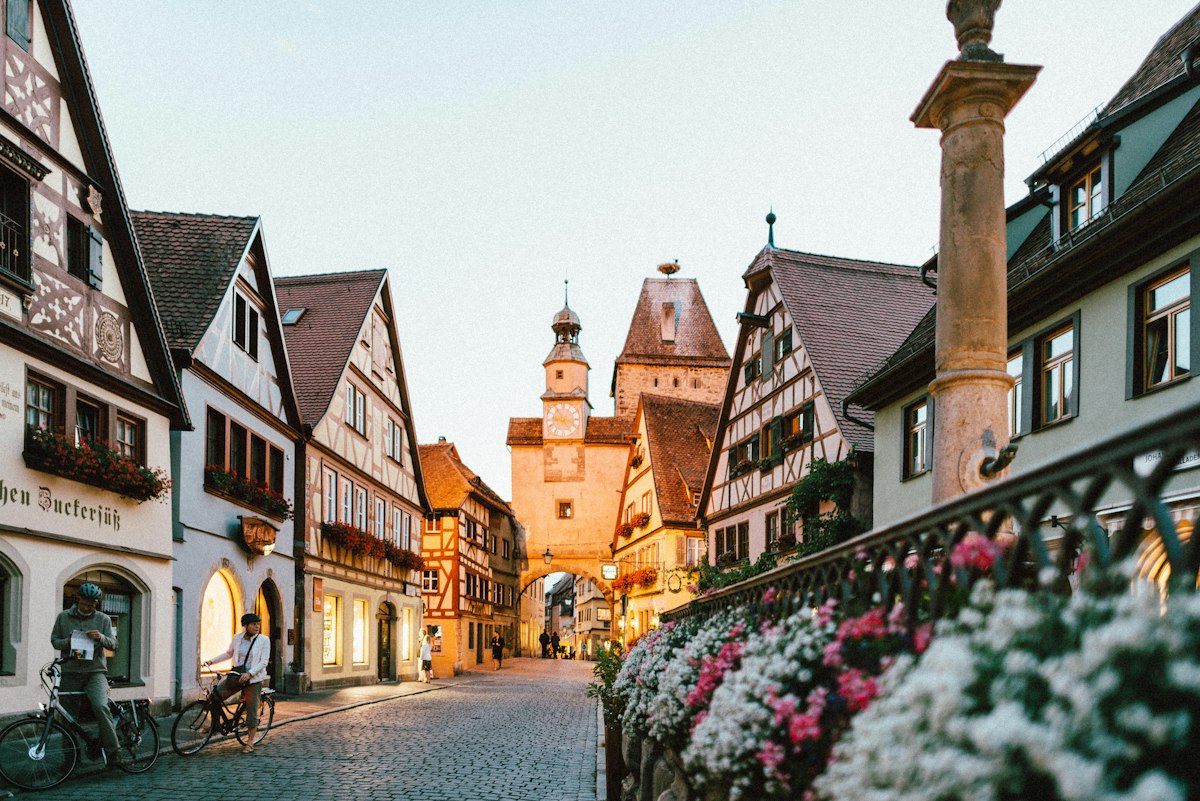
Rothenburg ob der Tauber on the Romantic Road is one of Germany's best-preserved medieval walled towns — the entire old city is a film set and it knows it. The Christmas market is small and genuinely charming, and the Käthe Wohlfahrt Christmas Village shop (open year-round) is the platonic ideal of German Christmas decoration excess. The night watchman tour of the medieval walls (€9) is the best €9 you'll spend in Germany.
Glühwein intelligence: The standard red wine Glühwein (€3-5 per cup plus €3-5 deposit on the mug) is everywhere, but look for the regional variations — Feuerzangenbowle (rum-soaked sugarloaf set on fire over red wine, theatrical and excellent), Kinderpunsch (non-alcoholic spiced fruit punch), and Eierlikör (egg liqueur, the German equivalent of eggnog). The deposit mugs are collectibles and many Germans pay the deposit rather than return them.
Logistics: Markets get extremely crowded on weekends from 3pm onward. Arriving at noon on a weekday gives you essentially the whole market to yourself. Weather in December is 0-7°C with occasional snow; dress in layers and plan for a lot of standing.
Germany's Food Scene: Beyond the Bratwurst
German cuisine has an international reputation problem. The reality — and Germany has 340 Michelin-starred restaurants to make the argument — is that Germany's culinary range extends from the world's most serious bread culture to one of Europe's most adventurous dining scenes in Berlin and Hamburg.
Bread: Germany bakes over 3,200 officially recognized bread varieties. The sourdough rye breads of the north (Vollkornbrot, Pumpernickel) are dense, slightly sour, and last a week without refrigeration. The pretzel culture of Bavaria is its own world — a proper Laugenbrezel is glossy from lye treatment, salty, chewy, and costs €1.50 from a bakery. German bread culture was added to the UNESCO Intangible Cultural Heritage list in 2015.
Regional variations: German food is intensely regional. Baden-Württemberg produces Germany's best white wines and has a French-influenced cuisine (Maultaschen — stuffed pasta squares — are the regional pride of Swabia). The Rhineland specializes in Sauerbraten (slow-braised marinated beef) and Rheinischer Reibekuchen (potato pancakes with apple sauce). Bavaria is pork-heavy, with Schweinshaxe, white sausage, and pretzels forming a holy trinity. Saxony has its own bread culture and the best Stollen (fruit bread) in Germany.
Berlin dining: The city has developed its own distinct food culture that is explicitly multicultural — currywurst (a Berlin original from 1949, pork sausage with curried ketchup, €3-4 from a proper Imbiss) is the street food icon, but the Turkish doner kebab culture here is more evolved than in Turkey, and the Vietnamese noodle soup shops in Lichtenberg are the real deal. For fine dining, Nobelhart und Schmutzig (Friedrichstraße 218, tasting menu €120) cooks exclusively with Brandenburg-region ingredients and is one of the most interesting restaurants in Europe.
Beer infrastructure: Germany has over 1,500 breweries (more than any other country) and a regional beer culture that the Reinheitsgebot (purity law of 1516, allowing only water, barley, hops, and yeast) both defines and constrains. The key regional styles: Kölsch (Cologne, light golden, served in thin 200ml glasses), Alt (Düsseldorf, dark copper, slightly bitter), Weizen (Bavaria, wheat beer, cloudy and banana-scented), Berliner Weisse (Berlin, sour wheat beer, traditionally served with fruit syrup). A beer in a local bar costs €3.50-5.50.
Practical Germany: Getting Around, Costs, and What Locals Know
Germany's rail network (Deutsche Bahn) is one of the largest in the world — 33,000km of track — and theoretically connects every major destination. The reality is that DB has a well-documented punctuality problem (only 65% of long-distance trains arrived on time in 2024) and a booking system that rewards advance purchase aggressively. A Berlin-Munich journey booked 6 weeks ahead on an ICE (high-speed) train costs €29-49. Same journey day-of can cost €180+.
The Deutschlandticket (€58/month since 2023, now €58 despite price changes — confirm current rate) covers all regional trains, S-Bahns, U-Bahns, trams, and buses across the entire country. It does not cover ICE/IC long-distance trains but makes exploring a region intensely affordable. For day trips from any German city, this is essential.
Costs: Germany is mid-range by Western European standards. Berlin is cheapest, Munich is most expensive. Budget guidance:
- Budget daily (hostel/street food/free sights): €60-80
- Mid-range (hotel/restaurant lunch + dinner): €130-200
- Comfortable (good hotel, restaurant dinners, museum admissions): €250-350
Supermarkets: Aldi and Lidl are German inventions and the benchmark for budget eating. Both have deli sections and baked goods. REWE and Edeka are one tier up. A prepared meal from any of these costs €3-6.
Sunday laws: Germany has strict Sonntagsruhestörung (Sunday quiet) laws. Most shops close entirely on Sundays (supermarkets included, except at train stations and airports). Museums, restaurants, and tourist attractions are open. Plan accordingly.
Tipping: Not expected at the same American level. Round up the bill or add 5-10% for good service. Never leave coins on the table — tell the server the total you want to pay when they take payment. Saying 'Das stimmt so' (that's correct) means keep the change.
For attraction tickets and reviews, TripAdvisor Germany covers the major sights. r/germany has practical threads from residents. r/solotravel has Germany itinerary discussions. Berlin's official tourism site visitberlin.de and Munich's muenchen.de/en provide city-specific event listings.
Language: English is widely spoken in cities and tourist regions, especially among under-40s. Rural Bavaria and eastern Germany have less English coverage. Learning Bitte (please), Danke (thank you), and Entschuldigung (excuse me) goes a long way — Germans appreciate the effort even when they reply in English.
Ready to explore?
Browse Destinations