Things To Do in New Zealand: The Ultimate Guide for 2025
New Zealand packs a density of natural drama into two islands that is almost implausible. Within a single day's drive you can go from glacier to vineyard to active volcano to surf beach — and the country's 5 million people (and 6 million sheep) haven't overwhelmed the landscapes the way development has in more populous destinations. This is a place where the hiking tracks are genuinely world-class, the food and wine scene has grown up into something exciting, and the Māori culture running through everything from place names to contemporary art gives the whole country a distinctiveness that no other English-speaking nation can match. Whether you're here to jump off things, walk between them, or simply drive slowly while eating very good cheese, New Zealand rewards every style of traveler.
Milford Sound: The Eighth Wonder of the World
Rudyard Kipling called Milford Sound the eighth wonder of the world, and on a good day — dramatic waterfalls cascading from peaks that rise sheer from the water, seals lounging on rock shelves at eye level from a boat deck, Mitre Peak's perfect pyramid reflected in the still fiord — it earns that description. Milford Sound (technically a fiord, not a sound — carved by glaciers, not rivers) sits at the end of 53 km of the most dramatic road in New Zealand, the Homer Tunnel route through Fiordland National Park.
The Milford Sound cruise is the essential experience — 1.5 to 2-hour boats that travel the full 15 km length of the fiord from the wharf to the Tasman Sea entrance and back. Multiple operators run departures from 7 AM to 3 PM. Prices: NZ$85–$95 ($50–$56 USD) for standard cruise; NZ$120–$165 ($70–$97 USD) for smaller vessels with fewer passengers. Real Journeys and Jucy Cruize are consistently well-reviewed. newzealand.com — Tourism New Zealand's official site — has comprehensive Milford Sound planning info. Book ahead in peak season (December–February) — the road can handle finite traffic and boats sell out. For the most dramatic waterfall action, visit in winter (June–August) when rainfall peaks and hundreds of temporary waterfalls appear on the cliff faces.
The underwater observatory at the cruise wharf (NZ$25/$14.75 USD, free with some cruise packages) reveals one of Milford Sound's great scientific peculiarities: the layer of tannin-darkened freshwater runoff floating on the saltwater allows deep-water black coral to grow at only 10 meters depth — normally it lives at 40 meters or deeper. You can see it through the observatory windows alongside schools of fish and the occasional bottlenose dolphin.
The Milford Track (53.5 km, 4 days, one of the 'Great Walks' of New Zealand) runs from the head of Lake Te Anau through the Clinton and Arthur river valleys to Milford Sound. It requires booking hut accommodation through DOC (Department of Conservation) well in advance — the track is one-directional, guided or independent, and costs NZ$70–$85 ($41.30–$50.15 USD) per night in the huts (guided walks through Real Journeys run NZ$2,370/$1,398 USD for 4 days including meals and accommodation in more comfortable guided lodges). The best months are November through April.
Getting to Milford Sound: it's 287 km from Queenstown (3.5–4 hours driving) and 119 km from Te Anau (2 hours). The road closes occasionally in winter due to avalanche risk near the Homer Tunnel. Bus tours from Queenstown (NZ$180–$250/$106–$147.50 USD) include the cruise.
Queenstown: Adventure Capital of the World
Queenstown sits on the shores of Lake Wakatipu surrounded by the Remarkables mountain range — a setting so theatrical it looks like a stage set for an adventure film. It's also the global home of the bungee jump (first commercial bungee was here in 1988, invented by AJ Hackett, who jumped off the Eiffel Tower to publicize it), and the adventure sports concentration here remains unrivaled.
AJ Hackett Bungy's Kawarau Bridge — the original 43-meter bungee site, from a Victorian suspension bridge over a glacier-green river — runs $205 NZD ($121 USD). The Nevis Bungy (134 meters, highest in Australasia, over a remote canyon accessible by 4WD, 8-second freefall) runs NZ$275 ($162.25 USD). Both include video/photo packages if you pay extra. Book online for small discounts. Adventure planning tips and firsthand trip reports are shared regularly on r/newzealand and r/travel's NZ threads.
Skydiving over Queenstown is extraordinary — 15,000-foot tandem jumps over the lake and mountains run NZ$299–$349 ($176.40–$205.91 USD) depending on the operator. Nzone and NZONE Skydive are the established operators. The 60-second freefall followed by 5 minutes of parachute descent with the Southern Alps spread across the horizon is a genuine bucket list experience.
Whitewater rafting on the Shotover River: the river runs through a dramatic canyon with Class IV–V rapids and a 170-meter river tunnel section. Half-day trips with Serious Fun River Surfing or Queenstown Rafting run NZ$155–$175 ($91.50–$103.25 USD). Jet boating on the Shotover (360-degree spins, 80 km/h through a 3-meter-wide canyon gap): NZ$149 ($87.91 USD) with Shotover Jet.
Beyond the adrenaline: The Remarkables ski area (NZ$125–$155/$73.75–$91.53 USD lift ticket in season, June–October) is 45 minutes from town and offers excellent intermediate and advanced terrain. Coronet Peak (30 minutes, NZ$115–$145/$67.85–$85.58 USD) is better for beginners and has night skiing on Fridays and Saturdays.
Arrowtown (20 km from Queenstown, free to explore) is a preserved 19th-century gold rush town in an autumn-gold poplar grove — the main street of stone buildings, the Chinese settlement remains, and the Lakes District Museum (NZ$10/$5.90 USD) provide a genuinely different historical experience from the adventure focus of Queenstown itself.
Auckland: Volcanoes, Harbours, and the City of Sails
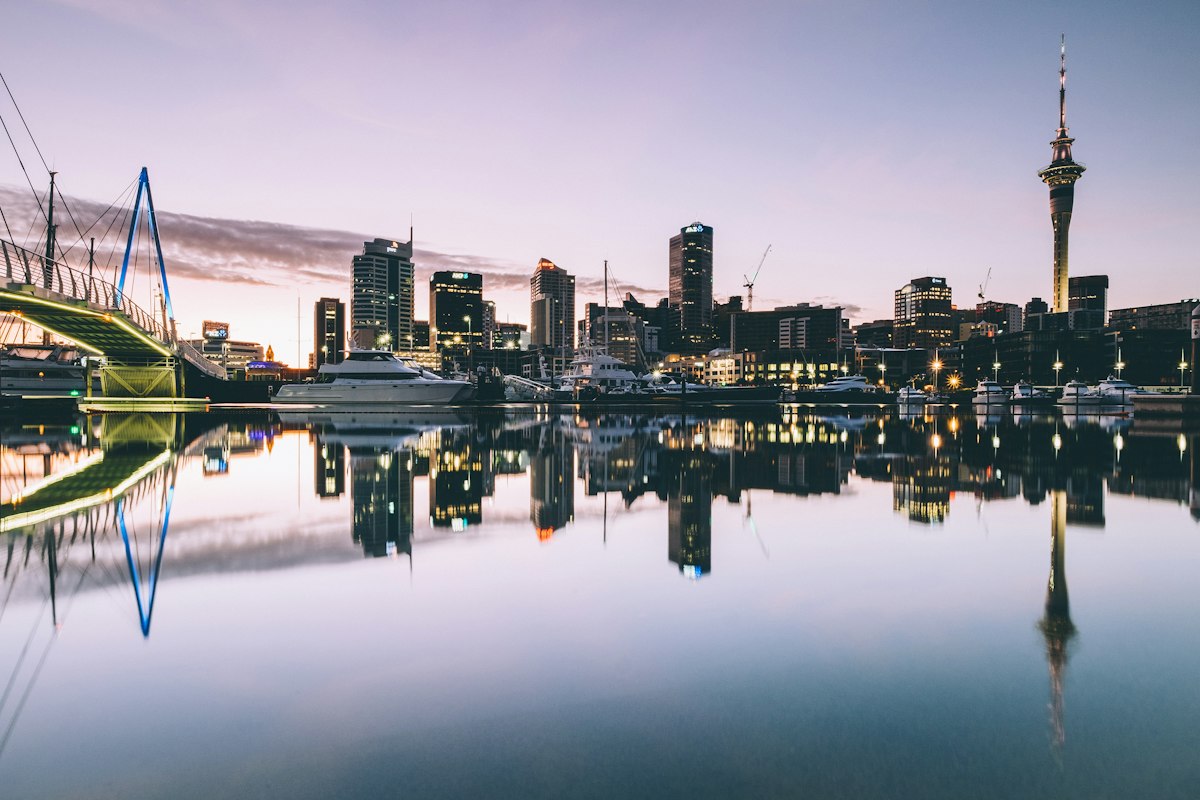
Auckland is built on a volcanic field of 53 volcanoes, all of them dormant (for now) but still dominant in the landscape — cone-shaped hills visible from most of the city, their slopes used as parks and lookouts. It's also a city built between two harbours (the Waitemata to the east, the Manukau to the west), making water visible from almost every hill, and its sailing culture — NZ won the America's Cup in 1995, 2000, and 2017 — runs deep.
One Tree Hill (Maungakiekie) in Cornwall Park is the most historically significant of Auckland's volcanic cones — an ancient Māori pā (fortified village) site, identifiable by the terracing on its slopes, and the site of the largest pre-European Māori population in New Zealand. The summit obelisk and views across the Hauraki Gulf are excellent at any time of day, but the park itself — 1,650 acres of sheep-grazed parkland with Cornwall Park's collection of massive old trees — is beautiful for a morning walk. Free.
Waiheke Island, a 35-minute ferry from the Auckland Ferry Terminal (NZ$38/$22.44 USD return), is Auckland's wine island — 30+ wineries producing Bordeaux-style reds and rosé in an island microclimate slightly warmer than the mainland. Passage Rock, Mudbrick, and Man O' War all have excellent cellar doors with views across Waiheke to the gulf and city skyline. The ferry terminal in Matiatia has excellent rental bikes (NZ$35/$20.65 USD/day) for exploring independently.
Sky Tower in the CBD is Auckland's most recognizable landmark — 328 meters, observation deck at 220 meters (NZ$32/$18.88 USD entry), restaurant at 190 meters. The SkyJump (free-fall wire descent from the 192-meter platform, base-jump style) runs NZ$225 ($132.75 USD); the SkyWalk (walking the outer ledge with a harness, 192 meters up) runs NZ$145 ($85.55 USD).
Food: Ponsonby Road is Auckland's best dining street — a 1.5 km strip of restaurants, bars, and cafes with every cuisine represented. Depot (oysters, seafood, charcuterie, excellent New Zealand wine list) and The Grove (fine dining with NZ produce focus) are among the most acclaimed. Dominion Road (Auckland's 'Chinatown' strip) has the best Chinese and Malaysian food in New Zealand — try the Northern Shaanxi restaurant for hand-pulled noodles or any of the Malaysian restaurants for curry laksa.
Rotorua: Geothermal Wonders and Māori Culture
Rotorua is New Zealand's geothermal capital, and within 10 minutes of arriving you'll know exactly why — the entire city smells of sulphur, mud pools bubble beside the road, and steam vents from footpaths as casually as if it's perfectly normal for the earth to be exhaling. This is also the heartland of Ngāti Whakaue and Arawa iwi (tribes), and Rotorua offers some of the most accessible and genuine Māori cultural experiences in the country.
Te Puia in the Whakarewarewa Geothermal Valley is Rotorua's most comprehensive cultural attraction: the Pohutu Geyser (the largest active geyser in the Southern Hemisphere, erupting 20+ times daily, reaching 30 meters high), living Māori village, carving and weaving schools where students train in traditional arts, and kiwi house. Day entry: NZ$60 ($35.42 USD) adult; the evening cultural performance with hāngi (earth-oven-cooked feast) runs NZ$120–$150 ($70.85–$88.56 USD).
Wai-O-Tapu Thermal Wonderland (20 km south of Rotorua, NZ$45/$26.57 USD) has the region's most photogenic thermal features: the Champagne Pool (a 65-meter-diameter acidic hot spring at 74°C, brilliant orange and green from arsenic and antimony sulfides, photographed constantly and never quite reproducible), the Lady Knox Geyser (erupts daily at 10:15 AM after soap is poured in to reduce surface tension, shooting 10–20 meters), and the Devil's Bath (bright acid-sulfate green water in a crater you can walk around).
Polynesian Spa on the lakefront (NZ$34–$50/$20.07–$29.52 USD depending on pool access) is a Rotorua institution — natural hot spring mineral pools in two temperature ranges (Lake Pools: 36–42°C; Priest Pools: 35–44°C), directly on the edge of Lake Rotorua. Go in the late afternoon and stay for sunset.
Māori cultural experiences: beyond Te Puia, Tamaki Māori Village (evening program, NZ$135/$79.72 USD including hāngi) offers a fully immersive village experience with traditional welcome (pōwhiri), performances of haka and action songs (waiata), and a feast. Mitai Māori Village (NZ$125/$73.80 USD) includes a night canoe arrival of warriors on a stream lit by firelight — dramatic and moving.
Hobbiton: Middle-earth in the Waikato Farmland
The Hobbiton Movie Set near Matamata in the Waikato, about 2 hours from Auckland or 1.5 hours from Rotorua, is one of the great pilgrimages for fans of Peter Jackson's Middle-earth films — and also, somewhat unexpectedly, one of the best-executed tourist attractions in New Zealand regardless of whether you've seen the films. The set was built on Alexander Farm's rolling green hills because the location matched Tolkien's Shire descriptions almost perfectly, and after The Hobbit trilogy wrapped, it was made permanent and opened for tours.
The 2-hour guided tour (NZ$49/$28.93 USD adult) walks through all 44 Hobbit holes (none of them are actually full sets — they're facades of varying sizes to create forced perspective; Bilbo's Bag End hole is full-scale), the mill, the party tree, and ends at the Green Dragon Inn where you receive one included drink (local Southfarthing ales and cider brewed specifically for the attraction). Photography is excellent throughout — the gardens and landscaping are so carefully maintained that the set looks better than it did in the films.
The Evening Banquet Tour (NZ$195/$115.13 USD) runs at sunset with lanterns lit throughout the set, followed by a 4-course meal in the Green Dragon. It's theatrical and quite beautiful, though a significant premium.
Practical note: Hobbiton is only accessible on guided tours booked through the official website — you cannot drive directly to the farm. Shuttle buses run from Matamata (NZ$15/$8.85 USD return); many visitors combine it with a day trip from Auckland or a stop on the way between Auckland and Rotorua/Taupo.
Matamata itself is a pleasant small agricultural town — the Matamata i-SITE Visitor Centre has Hobbiton displays and is where shuttle buses depart. The town holds a Shearing World Record: this is pastoral New Zealand at its most genuine.
Tongariro Alpine Crossing: New Zealand's Best Day Walk
The Tongariro Alpine Crossing is widely described as New Zealand's best one-day walk, and among the world's best — and when you cross between two active volcanic craters, walk the rim of a steaming emerald lake, and descend through lava fields while the glacially-capped cone of Mount Ruapehu dominates the horizon, the description feels earned rather than hyperbolic.
The crossing is 19.4 km from Mangatepopo Road end to Ketetahi Road end — it's a point-to-point walk requiring shuttle transport (NZ$25–$30/$14.75–$17.70 USD return, multiple shuttle operators from National Park village and Turangi). Allow 6–8 hours. The walk is entirely above the treeline, crossing South Crater, ascending steeply to the Red Crater rim (the crossing's highest point at 1,886 meters), descending to the Emerald Lakes (three hydrothermal lakes in vivid blue-green acid water), and continuing past Blue Lake before the descent through old lava flows and native bush to the Ketetahi end.
Critical practical points: the crossing requires good fitness (the Red Crater ascent is steep and loose-surfaced volcanic scree), sturdy footwear (trail runners minimum, hiking boots preferred), layers (weather changes rapidly at altitude — snow possible any month), and water. DOC (Department of Conservation) recommends only doing the crossing in good weather — check the Mountain Weather forecast on metservice.com specifically for Tongariro the morning of your planned walk. The crossing is genuinely dangerous in bad weather: whiteout conditions, hypothermia risk, and disorienting terrain.
Accommodation: National Park village (30 minutes from the Mangatepopo end) has backpacker lodges from NZ$35–$45 ($20.65–$26.58 USD)/night in dorms and small motels from NZ$90–$130 ($53.13–$76.73 USD). The Chateau Tongariro at Whakapapa Village (from NZ$250/$147.57 USD/night) is a grand 1929 hotel with the mountain directly outside every window.
Skiing at Whakapapa: Mount Ruapehu has the North Island's largest ski areas — Whakapapa and Turoa, with combined 1,800 hectares of skiable terrain. Season is typically late June to October. Lift passes NZ$125–$150 ($73.80–$88.56 USD).
Bay of Islands: History, Dolphins, and Sailing
The Bay of Islands in Northland — about 3.5 hours drive north of Auckland, or a short domestic flight to Kerikeri or Kaitaia — is where New Zealand's history as a European nation began. The Treaty of Waitangi (signed in 1840, the founding document of modern New Zealand, still the subject of treaty settlements being negotiated today) was signed at Waitangi on the bay's southern shore. The Waitangi Treaty Grounds (NZ$50/$29.52 USD, includes guided tour and cultural performance) is New Zealand's most important historical site and provides essential context for understanding the country.
The bay itself contains 144 islands, and sailing or cruising between them is the primary activity. Fullers GreatSights operates the Cream Trip (a full-day historic mail boat tour of the outer islands, NZ$165/$97.42 USD, Tuesday and Thursday), which mimics the route once used to deliver supplies to remote island farms. Cape Brett and the Hole in the Rock — a 50-meter hole punched through a headland promontory at the bay's entrance, accessible by boat — are the most dramatic features of the outer bay.
Dolphin encounters in the Bay of Islands are among New Zealand's best — common and bottlenose dolphins are resident in the bay year-round. Explore NZ offers dolphin swim trips (NZ$145/$85.60 USD) where you snorkel alongside wild dolphins; these are subject to availability and dolphin willingness, which is generally high.
Paihia is the main base town — good range of accommodation, restaurants on the waterfront, and all tour operators. Kerikeri, 22 km north, is more charming — NZ's oldest stone building (the Stone Store, 1832, now a museum), excellent cafes, and the surrounding citrus and subtropical fruit orchards that produce Northland's excellent avocados and kiwifruit.
Cape Reinga, 200 km further north, is where the Tasman Sea meets the Pacific Ocean at the tip of the North Island — a sacred site in Māori belief where departed spirits begin their journey to the ancestral homeland Hawaiki. The lighthouse and the crashing seas below are extraordinary. Access via a 4-hour drive from Paihia or day tour (NZ$110–$130/$64.95–$76.73 USD).
Wellington: The Coolest Little Capital in the World
Wellington is New Zealand's capital and its cultural heart — a compact harbor city where the container port shares the waterfront with Te Papa Tongarewa (the national museum), the Michael Fowler Centre (concert hall), and a dense grid of heritage buildings converted into one of the world's most concentrated café and bar scenes per capita. It's also the home of Weta Workshop (the physical effects and prop studio behind the Lord of the Rings, Avatar, and dozens of other films) and a city that takes food, coffee, and independent culture seriously enough to back it with real spending.
Te Papa Tongarewa (Museum of New Zealand, free, on the waterfront) is one of the finest national museums in the world — the permanent exhibition traces New Zealand's natural history, geological origins (the country sits on the Pacific-Australian tectonic plate boundary, explaining the volcanoes, earthquakes, and fiords), and the story of Māori and Pākehā (European) New Zealanders from the Treaty of Waitangi to the present. The marae (meeting house) complex inside the museum is a working ceremonial space, not a display. Budget 3–4 hours.
The Wellington Cable Car (NZ$6/$3.54 USD one-way) runs from Lambton Quay in the CBD up to the Botanic Garden and Carter Observatory (NZ$17.50/$10.33 USD evening stargazing sessions). Riding up and walking back down through the botanic garden is a pleasant 45-minute loop — the garden has the city's best viewpoint across the harbor to the Remutaka Range.
Cuba Street is Wellington's bohemian axis — a pedestrianized street of independent boutiques, record stores, excellent cafes, and the famous Bucket Fountain (a kinetic sculpture that tips and splashes passersby). Fidel's (reliable brunch, strong coffee, Castro-themed decor, been there forever) and Prefab (roastery café in a converted warehouse) are among the city's most beloved coffee institutions.
Weta Workshop's Unleashed Venue on Weka Street in Miramar (NZ$35–$65/$20.66–$38.37 USD, various tour options) offers behind-the-scenes looks at the production design and physical effects work for major films including Lord of the Rings, The Avengers, and dozens of others. The detail and craft in the creature work is astonishing even if you're not a film buff.
Franz Josef Glacier and the West Coast
The West Coast of the South Island is wild, wet, and dramatically beautiful — a narrow strip of rainforest and coastline squeezed between the Tasman Sea and the Southern Alps, with the continent's most accessible glaciers at its center. Franz Josef Glacier and Fox Glacier, 25 km apart, both descend from the Southern Alps ice fields to within a few hundred meters of sea-level temperate rainforest — a collision of ecosystems found almost nowhere else on earth.
Both glaciers have retreated significantly in recent decades (Franz Josef has retreated approximately 3 km since the 1980s), meaning the terminal face is now further from the valley floor viewpoints than it once was. The Franz Josef Glacier Valley Walk (free, 2 km return from the carpark to the current viewpoint at the valley's terminal moraine) is still impressive — the valley walls are polished and grooved by centuries of ice, and the grey-white snout of the glacier is visible in the distance. Guided walks on the glacier ice itself have been suspended since 2019 due to access changes; check GuideMe NZ for current glacier access options.
Heli-hiking is now the primary on-ice experience: helicopter to the upper glacier surface (AUD/NZD $460–$600/$271.58–$354.22 USD for a 2-3 hour heli-hike with crampons and guide). Expensive but extraordinary — the ice caves, seracs, and moulins of the upper glacier are inaccessible any other way, and the helicopter ride over the rainforest-to-snow transition is spectacular in itself.
Punakaiki Pancake Rocks (110 km north of Greymouth, free entry) are one of the West Coast's most distinctive geological formations: sedimentary limestone stacked in compressed horizontal pancake-like layers, with blowholes that erupt in spectacular spouts when the swell is right. The 30-minute boardwalk loop around the Dolomite Point headland is free and easily one of the best short walks in New Zealand.
The Haast Pass (SH6, the highway south from Franz Josef to Wanaka) is one of the great mountain road drives in the southern hemisphere — 145 km through old-growth beech forest, past the Thunder Creek Falls (28 meters, visible from the road pullout), through the Gates of Haast gorge, and gradually ascending to the tussock high country of the Southern Alps interior before descending to the blue of Lake Wanaka.
Ready to explore?
Browse Destinations