Things to Do in South Korea: The Ultimate Travel Guide for 2026
South Korea spent decades building an economy and arrived, almost by surprise, with one of the most culturally influential countries in the world. Official tourism: [English.visitkorea.or.kr](https://english.visitkorea.or.kr/) (Korea Tourism Organization) has English-language itineraries, attraction details, and the VisitKorea app. [r/korea](https://www.reddit.com/r/korea/) and [r/Seoul](https://www.reddit.com/r/Seoul/) have active visitor and resident threads. [Lonely Planet South Korea](https://www.lonelyplanet.com/south-korea) provides comprehensive destination coverage. [TripAdvisor South Korea](https://www.tripadvisor.com/Attractions-g294196-Activities-South_Korea.html) has booking and reviews for major attractions. The Korean Wave (Hallyu) — K-pop, K-drama, Korean cinema, Korean food — is not a marketing project. It emerged from a culture that has been producing art, ceramics, poetry, and philosophical thought for 5,000 years, applied to modern forms with a work ethic and creative intensity that is distinctly Korean. Visiting Korea now, when the rest of the world is arriving simultaneously, is the challenge — but the country is enormous enough to absorb the attention. This guide covers the Seoul that tourists see, the Korea that locals live in, and the parts of the country that most visitors miss entirely.
Seoul: The City of Neighborhoods
Seoul is a city of 9.7 million people arranged around a series of distinct neighborhoods that developed different identities over centuries and centuries of dynastic history, Japanese colonial reorganization, and postwar reconstruction. Understanding which neighborhood you're in — and why it feels the way it does — makes Seoul navigable rather than overwhelming.
Jongno-gu and the Historic Core: The Joseon dynasty (1392-1910) built its capital here, and the five grand palaces, the Jongmyo Royal Shrine, and the Bukchon Hanok Village (2-3km of restored traditional Korean wooden houses on the hillside between Gyeongbokgung and Changdeokgung palaces) form the physical memory of that era. Gyeongbokgung Palace (₩3,000 entry, grounds free, 9am-5pm, closed Tuesdays) is the largest of the five — the changing of the guard ceremony at the Gwanghwamun Gate runs at 10am and 2pm. Wearing hanbok (traditional Korean dress) — which can be rented at the entrance for ₩15,000-25,000/hour — provides free entry to all five palaces and access to the Jongmyo Shrine.
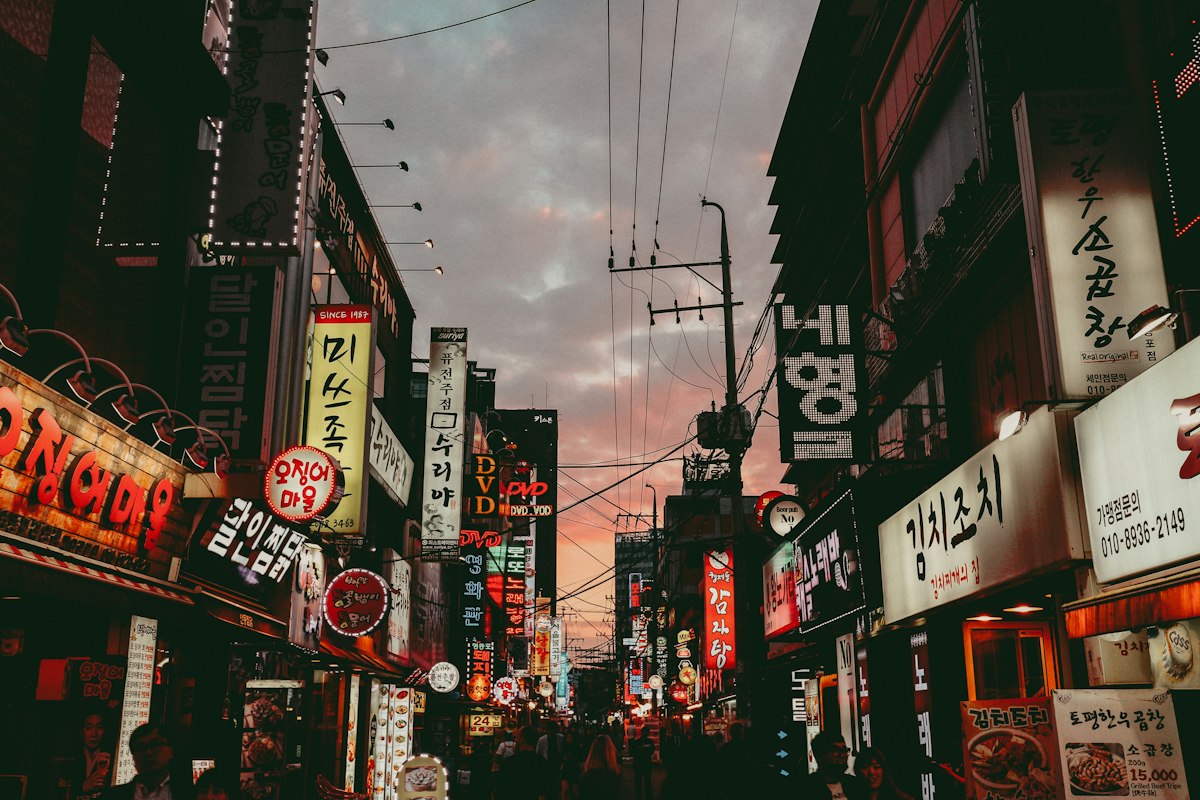
Hongdae (Hongik University neighborhood): The center of indie music, street art, late-night food, and the youth culture that doesn't map to the K-pop industry. The streets around Hongik University Station (lines 2, 공항철도, Gyeongui–Jungang) are active from 8pm to 4am. Free street performances happen Friday-Saturday evenings on the main pedestrian street. The best record shops, independent clothing designers, and the densest concentration of Korean hip-hop venues are here. The Saturday afternoon flea market (Hongdae Free Market, 1pm-6pm, March-November) has student artists selling prints, ceramics, and accessories at direct prices.
Insadong: The antiques and crafts district — celadon pottery, Korean folk art, traditional tea houses, and the best concentration of naengmyeon (cold buckwheat noodle) restaurants in Seoul. The Ssamziegil complex (open shopping courtyard with independent designer shops) is the most interesting architecture. Ssambap (rice wrapped in leaves) restaurants on the side streets here cost ₩12,000-18,000 for a full table of accompaniments.
Itaewon: The historically international neighborhood (US military base adjacent until 2004 relocation) now has the widest range of non-Korean restaurants in Seoul — Little Istanbul, Nigerian stalls, Indian restaurants, American BBQ — plus the Leeum Samsung Museum of Art and the most accessible LGBTQ+ social scene in Korea. The Friday/Saturday night Hooker Hill and Hamilton Hotel area is raucous; the streets leading up to Namsan mountain above are quiet and residential.
Gangnam: What It Actually Is Beyond the Song
PSY's 2012 song made Gangnam (literally 'south of the river,' Gang = river, nam = south) internationally known as Seoul's district of wealth and status. That's accurate but incomplete. The Gangnam district contains Apgujeong (luxury fashion and plastic surgery clinics), Cheongdam-dong (Korean entertainment industry headquarters, luxury brands), Garosu-gil (tree-lined boutique street, coffee shops, concept stores), and COEX (underground mall + aquarium + convention center). It's also one of the most expensive and least navigable-on-foot parts of Seoul.
Garosu-gil (길 = street/road, garosu = tree-planted) is the most pleasant area for walking — 500m of ginkgo-lined street with coffee shops, contemporary Korean design shops, and galleries that doesn't have the mall-density of most Seoul retail. Coffee shop culture here: third-wave specialty coffee was embraced early and thoroughly in Seoul; Garosu-gil has the flagship location of Blue Bottle Korea and several notable independent roasters.
Apgujeong Rodeo Street: Korean entertainment companies (SM Entertainment, JYP, HYBE) have offices in or near this neighborhood, and the cosmetics clinics that have made South Korea the global leader in medical aesthetics line the streets. The area is fascinating as cultural geography even if you're not there to shop.
Bongeunsa Temple: A working Buddhist temple in the middle of Gangnam, surrounded by glass towers. The evening lantern lighting (after 7pm) and the hourly dharma bell are a genuine contrast to the commercial energy of the surrounding streets. Free entry; open 24 hours.
Han River Parks: The Han River (Hangang) divides Seoul north-south and the park system along both banks is where Seoul residents actually spend weekends. Banpo Hangang Park (Gangnam side, accessible from Dongjak station) has the Banpo Rainbow Bridge moonbow fountain show (spring-autumn, multiple times daily, free to watch), cycling rentals (₩3,000/hour), and a night market on weekends (April-October). Convenience stores throughout the parks sell cheap beer, chicken, and ramen — the 'han river ramen' (cup noodles from the park GS25 with boiling water from the machine) is a specific Seoul institution.
Lotte World Tower: At 555m, the fifth-tallest building in the world. The observation deck (Seoul Sky, floors 117-123) costs ₩27,000 (weekday) to ₩29,000 (weekend). The glass floor extends over the city; the elevator glass wall gives views during the 90-second ascent. Better value: the observation deck of N Seoul Tower on Namsan mountain (₩21,000 cable car + tower entry combined, or 20-minute hike) with the classic Seoul panorama.
Korean BBQ, Street Food, and the Logic of Korean Eating
Korean food is one of the world's great culinary traditions and it is genuinely difficult to eat badly in Korea. The combination of fermentation culture (kimchi, doenjang, ganjang), careful seasoning, quality ingredients, and the communal eating format produces meals that are consistently excellent across price points.
Korean BBQ (Gogi-gui): The format — raw meat grilled at your table on a gas or charcoal grill, cut with scissors, wrapped in lettuce with garlic and ssamjang paste — is already internationally known, but the Korean original is different from the exported version. Key points: the banchan (small side dishes, free and refillable) arrive first and before meat is ordered; 삼겹살 (samgyeopsal, pork belly) is the most popular and costs ₩15,000-20,000 per 200g portion; 갈비 (galbi, short ribs) is pricier but more flavorful; the 소 (beef) versions — 불고기 (bulgogi, marinated beef) and 소갈비 (beef ribs) — are considered more special occasions eating. Gwangjang Market (Jongno-gu) has a BBQ alley with charcoal grills that has been operating since 1905.
Gwangjang Market is the most essential food experience in Seoul — an indoor market covering two entire city blocks with 5,000 stalls, including the legendary bindaetteok (mung bean pancake) alley, the best mayak gimbap (narcotics gimbap, tiny rice rolls allegedly addictive, ₩3,000 for a bag) from the vendors who've been selling them for decades, and soju and makgeolli (rice wine) drunk at communal plastic tables. Peak hours: 11am-2pm for food shopping, 6-10pm for evening eating.
Street food mapping:
- Myeongdong (tourist area, expensive but comprehensive): egg toast (₩3,000-4,000), hotteok (sweet filled pancake, ₩2,000), corn dog with potato chunks (₩4,000-5,000), spicy rice cake tteokbokki (₩3,500)
- Insadong: traditional tea and Korean sweets (yeot candy, gangjeong cracker)
- Noryangjin Fish Market (subway line 1): buy raw fish from the market stalls, take upstairs to cooking restaurants to have it prepared (typically ₩10,000-20,000 for the cooking fee) — the freshest and most cost-effective sashimi in Seoul
Chimaek: Chicken (치킨, chikin) + maekju (beer) is South Korea's definitive late-night combination. Korean fried chicken is different from the American version: double-fried for extreme crispness, glazed with either soy-garlic or spicy sauce, served with pickled radish and beer. Delivery culture means 11pm chimaek is entirely normal. Brands to look for: Kyochon, BBQ Chicken, Nene Chicken. A half-chicken order + delivery: ₩18,000-22,000.
Busan: Beaches, Mountains, and Korea's Second City
Busan (population 3.4 million) is South Korea's second city and its first port — the largest port in Korea and one of the busiest in the world. Where Seoul is intense and vertical, Busan is spread across a valley between mountains and the sea, with beaches, fish markets, a mountain temple, and a neighborhood built by Korean War refugees still clinging to a hillside. It is significantly more manageable than Seoul and consistently underappreciated.
Haeundae Beach is South Korea's most famous beach — 1.5km of white sand with 5-star hotels behind it and the Dongbaek Island park at the western end. The beach is genuinely beautiful and the water is warm July-August (22-26°C). The Songjeong Beach 5km northeast is smaller, less crowded, and preferred by surfers. Gwangalli Beach (20 minutes from Haeundae) faces the Gwangan Bridge (the 'Diamond Bridge,' illuminated at night) and has the best beachfront bar scene.
Jagalchi Fish Market: The largest fish market in Korea, operating since 1924 on the western harbor. The covered indoor market (8-story building, opened 2006) sells live fish, shellfish, and sea squirts on the ground floor; the upper floors have restaurants that cook your market purchases. The exterior market stalls (operated primarily by women in blue aprons, known as jagalchi ajumma) stay open late. Best time: 8-10am when the market is in full operation.
Gamcheon Culture Village: A 1950s refugee settlement built on a steep hillside in concentric rings that the city could never flatten. In 2009, artists began painting the houses and installing sculptures in the lanes. The result is an open-air gallery covering an entire hillside — colorful walls, murals, tiny galleries and cafés in former family homes. Free to wander (small admission to some art installations). The view over Busan harbor from the upper streets is one of the best in the city.
Haedong Yonggungsa Temple: Built on seaside cliffs in 1376, the only Buddhist temple in Korea built facing the sea. The statue of the Seated Haesu Gwaneum (18m, white granite, 2012) above the crashing waves is striking. Free entry; 30 minutes from Haeundae by taxi (₩25,000-30,000) or city bus 181.
KTX from Seoul: The KTX (Korea Train Express, bullet train) runs Seoul Suseo to Busan in 2 hours 10 minutes (₩59,800 second class). Standard KTX Seoul Station to Busan: 2.5 hours (₩59,800). The train runs hourly. Busan is entirely manageable as a 2-night addition to a Seoul trip.
Jeju Island: Korea's Hawaii and Its Own Culture
Jeju-do is a volcanic island the size of Long Island sitting 80km off Korea's southern coast — subtropical, independent-spirited, and culturally distinct enough to have its own dialect (Jejueo, recognized by UNESCO as critically endangered), its own mythology, and its own female diving culture (haenyeo) that has been practiced for 1,500 years and was inscribed on the UNESCO Intangible Cultural Heritage list in 2016.
Hallasan National Park: The central volcano of Jeju, Hallasan at 1,950m is the highest peak in South Korea. The Eorimok Trail (6.8km one way, 4-5 hours round trip to the 1,700m Witseoreum shelter) winds through forests of larch, yew, and wild flowers that bloom in sequence spring through autumn. The Seongpanak Trail (9.6km one way, 5-6 hours round trip to the crater lake at the summit) is the only route to the actual summit and requires an early start (summit section closes 2pm in summer, 1pm in winter). Entry to trails: free. Hallasan weather: bring warm layers and rain gear regardless of base weather.
Haenyeo (Seaborn Women): Jeju's haenyeo dive without breathing equipment to depths of 10-20m for sea cucumber, abalone, and sea urchin. The practice began because Joseon-era tax laws made women's income exempt, so women became the primary wage earners through sea harvesting. Today, approximately 4,000 haenyeo practice (average age 70+). You can watch them surface at Kimnyeong Beach, Hamdeok Beach, or the Haenyeo Museum in Hado-ri (₩1,100 entry). The haenyeo diving demonstration at Seongsan Ilchulbong harbor runs when enough divers are present.
Seongsan Ilchulbong (Sunrise Peak): A tuff cone that erupted underwater 100,000 years ago and sits at the eastern tip of Jeju — the 10-hectare crater at the summit is like a bowl carved from the cliff edge above the sea. Entry ₩2,000, 1km trail to the summit, best seen at sunrise (arrive 30 minutes before, sunrise times listed at the entrance). The descent on the other side leads to Seongsan village and the haenyeo performance area.
Manjanggul Cave: A 7.4km lava tube formed 300,000 years ago during Hallasan's volcanic activity — the cave maintains 11°C year-round, and the 1km accessible section has illuminated lava formations including a 7.6m lava column that is one of the largest in the world. Entry ₩4,000.
Getting to Jeju: Domestic flights from Seoul Gimpo Airport take 1 hour (₩50,000-120,000 one-way depending on advance purchase and airline). Jeju Air, T'way, and Jin Air operate 30+ daily flights. A car is essentially required for exploring the island — international driving permits accepted, rental from ₩40,000-60,000/day. Kakao Taxi and local taxis cover Jeju City adequately.
The DMZ: Korea's Most Haunting Day Trip
The Demilitarized Zone (DMZ) is the 4km-wide, 250km-long buffer zone separating North and South Korea along the 38th parallel. It is simultaneously the most heavily militarized border in the world — 1 million soldiers stationed within 100km, landmines across 250km² of buffer zone, a 2km-high propaganda loudspeaker on the North side — and, paradoxically, the most biodiverse protected ecosystem in temperate Asia. The absence of humans for 70 years has made the buffer zone a wildlife refuge for Amur leopard cats, Asiatic black bears, and rare migratory birds.
Joint Security Area (JSA, Panmunjom): The only point where North and South Korean soldiers stand 30 meters apart and tourists can physically step across the border. Tours are organized only through authorized operators — USO (US military tourism, most comprehensive access, ₩60,000-80,000) or Korean DMZ specialized tour companies (TripAdvisor DMZ tours). The conference rooms at the Military Armistice Commission straddling the Military Demarcation Line allow you to technically stand in North Korea (inside the building, under military supervision).
Infiltration Tunnels: North Korea dug four tunnels under the DMZ in the 1970s (intended for troop infiltration in an attack scenario). Three are open to tourists via organized tours — helmets are required; the tunnels are 1.2m-1.8m high, 2km long, and descend to 73m underground. The Third Tunnel (discovered 1978) is 44km from Seoul and clearly visible from the observation deck at Dora Observatory.
Imjingak Park: 7km south of the DMZ, reachable by independent train (Gyeongui-Jungang Line from Seoul Suseo to Dorasan Station, the last station before the border, ₩2,800 one-way) — the station lobby has North Korean propaganda posters and currency on display. The Bridge of Freedom at Imjingak was where 12,800 South Korean POWs crossed south after the 1953 armistice. The 'Peace Bell' and rusted remains of steam locomotives destroyed during the war are accessible without a tour.
Tour logistics: Full DMZ + JSA tours leave from central Seoul hotels daily (Gyeongbokgung/City Hall area, 8am-5pm approximately). Cost: ₩55,000-90,000 depending on inclusions. Book 2-3 days ahead; tours are capped and fill quickly on weekends. Bring your passport (required for JSA access). Photography is permitted at most sites but strictly prohibited in specific zones — guides explain on site.
K-pop and Korean Pop Culture: How to Engage Meaningfully
The K-pop industry generated $12.7 billion in 2023 and reaches an estimated 156 million fans globally. Understanding how it works — the training system, the idol group model, the fan culture (fandom) — makes Korea's contemporary cultural landscape legible in a way that is genuinely interesting regardless of whether you're a fan.
HYBE Insight Museum (Yongsan-gu, ₩22,000, advance booking required, consistently sold out weeks ahead): The museum and cultural space attached to HYBE Corporation (home of BTS, TXT, NewJeans) offers a serious exhibition on K-pop production from trainee audition through global distribution. The digital installations are genuinely impressive, and the building's architecture (designed to resemble stacked shipping containers) is notable. Book through the Weverse Shop app.
SM Entertainment's SM Town Museum (COEX, Gangnam): SM's pop-up experience space covering the history of SM artists from H.O.T (1996) to aespa. Less intense than HYBE; more accessible walk-in. ₩15,000-20,000 depending on exhibition.
Music Bank, Inkigayo, and Show Champion tapings: The major weekly music shows (KBS Music Bank, SBS Inkigayo, MBC Show! Music Core, M Countdown) tape on weekday afternoons and Saturday mornings in Seoul. Standing audience tickets are free but require fan club registration or lottery application through each broadcaster's website 1-4 weeks ahead. Specific procedures change; search '[show name] audience ticket 2026' for current instructions.
Idol cafés and pop-up shops: Entertainment companies open temporary concept stores in Hongdae and Apgujeong when albums drop — these are where limited merchandise is available and where photocard trading (collecting and exchanging specific artist photo cards from album packages) happens at the sidewalk trading spots on Saturday afternoons near Hongik University Station.
Karaoke (Norebang): Korean norebang differs from Western karaoke — you rent a private room (for 1-10 people) by the hour rather than performing for strangers. Cost: ₩15,000-30,000/hour per room (split between the group). Most norebang open until 6am. The song selection covers Korean pop (mandatory), American classics, J-pop, and Bollywood. Tambourines are provided. Snacks and beer can be ordered to the room. This is one of the great social institutions of Korea and is expected at any group outing.
Temple Stays and Seoraksan: Korea's Mountains and Spiritual Traditions
Korea is 70% mountainous and the mountains are not decorative background. Every peak has a Buddhist temple, usually Silla dynasty-era (7th-10th century), often still operating. The national park system (22 parks covering 7.1% of the country) includes some of the most beautiful mountain landscapes in Northeast Asia, and the templestay program — overnight stays at working monasteries — makes Korean Buddhist practice genuinely accessible to non-practitioners.
Templestay program: Run through the Cultural Corps of Korean Buddhism (eng.templestay.com), with 138 participating temples nationwide. Two formats: 'overnight' (2 days/1 night, ₩50,000-150,000 depending on temple, includes monk-led meditation, tea ceremony, dharma talk, 108 prostrations, 4:30am temple bell ringing) and 'day program' (3-5 hours, ₩10,000-30,000). Jogyesa Temple in Seoul (easily accessible, 3 days/2 nights ₩90,000) is the headquarters of Korean Buddhism and the most practical for a Seoul-based trip. Beomeosa Temple in Busan (in a mountain valley, ₩60,000) is the most atmospheric.
Seoraksan National Park (Sokcho, Gangwon Province, 2.5 hours from Seoul by express bus, ₩22,000 one-way from Seoul Express Bus Terminal; TripAdvisor Seoraksan): The most dramatic mountain scenery in South Korea — granite peaks, clear mountain streams, and the Ulsan Bawi formation (six rock pillars rising 873m above sea level, accessed via a 3.9km trail with a final section of metal ladders bolted to the cliff). Entry to the park: ₩4,000. The Biryong Falls trail (₩0-2km from the ticket gate, 15 minutes to the waterfall) is the easiest route. The Ulsanbawi trail (round trip 5km, 3-4 hours, 800+ stone steps) is the most rewarding.
Bukhansan National Park: In northern Seoul, accessible by metro (Gupabal station, line 3, or Suyu station, line 4). The most accessible mountain hiking in any major world city — 45 minutes from downtown Seoul to a granite summit (Baegundae, 836m, 8km round trip, 5 hours) with views over the entire Seoul metropolitan area. Spring brings azalea blooms; autumn brings maple color. The trail conditions in winter require microspikes (rentable at the trailhead stores, ₩3,000-5,000).
Jirisan National Park (southern Korea, 3.5 hours from Seoul, largest national park): The Nogodan ridge at 1,507m is a 18km traverse with mountain shelters for overnight stays (reservation required, ₩10,000-14,000). The Cheonwangbong summit (1,915m) is a 2-day ascent. Autumn (mid-October to early November) is peak season when maple and gingko cover the slopes in red and gold.
Practical South Korea: Getting Around, Costs, and What Locals Know
South Korea has one of the world's most efficient and affordable transit systems. The Seoul subway (9 lines + 6 metro lines, 1,000 stations in the greater metropolitan area) covers effectively the entire city and its satellites. The T-money IC card (₩2,500 deposit, reloadable at any convenience store or subway machine) works on all subways, buses, and Seoul city buses, and provides a ₩100-150 transfer discount when switching modes within 30 minutes.
Subway costs: Single trip ₩1,250-1,550 depending on distance. A day's transit in central Seoul averages ₩3,000-5,000. KTX (Korea Train Express bullet train) Seoul to Busan ₩59,800 standard; Seoul to Gyeongju ₩47,700. KTX tickets book up on Friday outbound and Sunday return — book via Korail website or the SRT app at least 2-3 days ahead for popular routes.
Daily budget framework:
- Budget (hostel dorm/street food/free sights): ₩45,000-70,000 (~$33-52)
- Mid-range (guesthouse/restaurant meals): ₩120,000-200,000 (~$88-147)
- Comfortable (hotel/restaurant dinners/museum entry): ₩250,000-400,000 (~$184-294)
Mobile data: Korea has the best mobile network coverage in the world (5G covering 96% of the population). Airport SIM cards at Incheon: ₩25,000-40,000 for 7-14 days unlimited data. eSIM from Airalo or KT olleh: ₩15,000-25,000 (book before departure). Having data is essential for Naver Maps (far superior to Google Maps for Korea — more accurate transit data, Korean address resolution).
Kakao T app: South Korea's taxi booking app (download Kakao T), equivalent to Uber but operates through licensed taxis, which are abundant and affordable. Basic taxi from central Seoul to Hongdae: ₩7,000-10,000. Kakao Taxi (premium, slightly higher rate, guaranteed car quality): ₩12,000-18,000. Same fare destination to Incheon airport: ₩60,000-80,000 depending on departure point.
Language: Korean (한국어) uses the Hangul alphabet, which is systematically designed and learnable to read in 2-3 hours of study — it's worth doing before your trip as street signs, menu boards, and subway displays are easier to navigate when the script is legible even without knowing the words. English is widely spoken in Seoul tourist areas and less so outside major cities. Papago (Naver's translation app) handles Korean better than Google Translate for spoken phrases and menu photography translation.
Safety and etiquette: South Korea is extremely safe by any measure. Violent crime against tourists is essentially nonexistent. Practical etiquette: remove shoes when entering Korean homes and some restaurants (you'll see shoes outside the door). Don't tip at restaurants (seen as insulting). Eat communal dishes with your chopsticks if no serving utensils are provided — this is normal. Pouring your own drink rather than letting others pour for you is considered impolite; pour for others and they'll pour for you.
Further resources: TripAdvisor Seoul for attraction reviews and booking. r/korea and r/Seoul for current visitor and resident advice. Lonely Planet South Korea for destination deep-dives. Numbeo Seoul cost of living for up-to-date prices. Register with STEP and follow US Embassy Seoul for safety alerts.
Ready to explore?
Browse Destinations