
Common Real Estate Scams in Costa Rica Americans Keep Falling For

Costa Rica has been marketed to American retirees as the easiest, safest place in Latin America to buy property. Most of that is true. Costa Rica is politically stable, has a functioning land registry, allows foreigners to own fee-simple property in nearly all of the country, and has a robust expat community. It also has one of the most enthusiastic networks of real-estate scams specifically targeting first-time American buyers in the Western Hemisphere.
The scams aren't random. They are predictable, repeating, and well-known to honest Costa Rican lawyers and Colegio de Abogados members — but they keep working because new waves of Americans arrive every year without knowing what to look for. Discussion threads on r/CostaRica, r/expats, r/ExpatFIRE, and the long-running AM Costa Rica archives are full of first-person accounts of Americans who lost five and six figures to scams that are well-documented and entirely preventable.
This article catalogs the specific patterns, explains how each one works, and describes the due diligence steps that defeat it. If you are shopping for property in Guanacaste, the Nicoya Peninsula, the South Pacific, or the Central Valley, read all of it before you sign anything.

Scam 1: The phantom seller / fake title
The oldest and still the most profitable. A beachfront lot sits unused for years — maybe owned by an elderly Tico who moved to the capital, or a family who inherited it and doesn't track it. A scammer takes listing photos from the street, posts the property on a Costa Rica real estate aggregator, and waits for an American to make contact.
The scammer plays the role of seller (or seller's "representative"), provides a name that matches the registered owner, produces a convincing folio real number, and pushes to close fast — usually through their own "lawyer," who is also in on it. The money wires to an account controlled by the ring. By the time the buyer flies down to see their new property, the real owner has no idea anything happened.
How it works mechanically. The scam exploits two realities: (1) Costa Rica's Registro Nacional folio real system is public and searchable online, so anybody can pull a real title record and pretend to be the owner; (2) many Americans rely on the email communication of the "seller" and the "lawyer" as proof of identity.
How to defeat it. Your independent Costa Rican lawyer — one you hired, not one the "seller" introduced — must verify the seller's identity against the cédula (national ID) or foreign passport registered on the folio, confirm the seller in person at their office, and cross-check against the Tribunal Supremo de Elecciones voter registry where possible. Any claim that "the seller lives abroad and can't meet, but the lawyer is authorized" is a hard red flag. Never proceed on remote identity alone for a sale by an individual Tico. See our bilingual lawyer guide.
The Organismo de Investigación Judicial (OIJ) publishes occasional warnings about this scam but enforcement after the fact is slow. Prevention is the only meaningful defense.

Scam 2: The Maritime Zone concession that can't be sold
This is the most technically sophisticated scam and the most expensive. It targets buyers looking for beachfront property in Guanacaste, Nicoya, or the South Pacific — precisely the most desirable locations.
Costa Rica's Ley 6043 (Zona Marítimo Terrestre, or ZMT) establishes a 200-meter strip along the coast that is inalienable public land. The first 50 meters (zona pública) can never be owned or fenced by anyone. The next 150 meters (zona restringida) can only be used under a renewable concession granted by the local municipality, and Article 47 prohibits foreigners from holding concessions unless they have five continuous years of legal residency OR the concession is held by a Costa Rican corporation where Costa Ricans hold at least 50% of the shares. See our dedicated Costa Rica Maritime Zone article and our farmland article for the full legal framework.
The scam: an American is shown a beachfront "house for sale" in the ZMT. The seller (often an American already in-country) produces paperwork showing a "concession title" currently registered to a Costa Rican S.A. corporation with nominal Tico shareholders. The buyer is told: "You'll buy the S.A., you'll be the beneficial owner, the Tico shareholders are just figureheads." The price is €200,000–€500,000.
The problem: Article 47 is not a paperwork formality. Concessions held by corporations that are effectively foreign-controlled have been challenged and in some cases cancelled by ICT (Instituto Costarricense de Turismo) and municipalities under the legal concept of fraude de ley (legal fraud) — the S.A. is a paper wrapper around a prohibited act. Concession renewals happen every 5 or 20 years, and the renewal is precisely when these structures get scrutinized. Buyers who thought they owned a beach house find that at renewal the municipality refuses to renew, or requires actual Costa Rican control, or cancels the concession outright.
In addition, many of the "concession title" documents being sold are not actually concessions at all — they are informal occupation permits, old lease agreements, or in some cases forged. The Instituto Geográfico Nacional maps the ZMT but overlays of which parcels are actually within the 200-meter strip are not always clearly posted, and unscrupulous sellers exploit that ambiguity.
How to defeat it. First, never, under any circumstances, buy beachfront property in Costa Rica without a lawyer who specializes in ZMT concessions and has litigated them. Second, require the lawyer to pull (a) the concession title from the municipality, (b) the plan regulador zoning from the municipal planning office, (c) an IGN survey confirming the parcel boundary and where the 50m/200m lines fall, and (d) the concession renewal history. Third, understand the legal structure you are actually buying — a fee-simple beach property outside the ZMT, a concession inside the ZMT with proper Tico-majority structure, or nothing at all. If the seller cannot clearly state which of the three it is, walk.
For comparison: there are plenty of completely legitimate ZMT concession properties, and there are fully fee-simple beach properties in specific areas where old titulación predated the ZMT law or where properties sit just outside the 200m line. You can buy either of those safely. What you cannot safely buy is a corporate wrapper around a concession with minority Tico shareholders that was structured specifically to get around Article 47. Threads on r/CostaRica and the AM Costa Rica archives contain year after year of disputes over exactly this.

Scam 3: The corporate title flip
This one is subtler and doesn't require outright fraud — it just requires the buyer not to ask. Costa Rican real estate is often held in Sociedades Anónimas (S.A.) — corporations — for liability, tax, and transferability reasons. When you buy, you have two options: (a) transfer the underlying property title via an escritura pública to you personally or to a new S.A. you own, or (b) buy the shares of the existing S.A. that holds the property.
Option (b) is faster and cheaper because it skips the property transfer tax (1.5% of registered value) and stamp duty. But it carries a hidden risk: when you buy the shares of an existing S.A., you inherit all its past liabilities — unpaid corporate taxes, pending lawsuits, undisclosed debts, contingent claims, past director liabilities. Anything the corporation did or owed before you became owner is now your problem.
The scam version: the seller knows the S.A. has unpaid corporate income tax, pending contractor disputes, or an outstanding municipal fine. They aggressively push "share sale" over "property sale" to save the buyer on transfer tax — but they are actually transferring hidden liabilities that will surface months later. Some sellers even set up a fresh S.A., transfer the property into it, and then transfer the shares — hoping the buyer doesn't realize the S.A. was only recently created and has an unclean recent history.
How to defeat it. If the seller proposes a share purchase, insist on (a) a full corporate due diligence by your Costa Rican lawyer including tax clearance certificates from Hacienda (Ministerio de Hacienda), (b) a review of all past director decisions and shareholder meetings, (c) a search of Registro Judicial for any pending litigation, (d) confirmation that annual corporate representation fees and impuesto a personas jurídicas are current, and (e) an indemnity clause in the share purchase agreement where the seller warrants no undisclosed liabilities and agrees to hold you harmless for a defined period.
Often, the correct answer is to refuse the share sale and insist on a fresh property-title transfer via escritura pública, paying the 1.5% transfer tax and 0.5% stamp duty, to get a clean chain of title. The extra few thousand dollars is cheap insurance.

Scam 4: Squatters and adverse possession
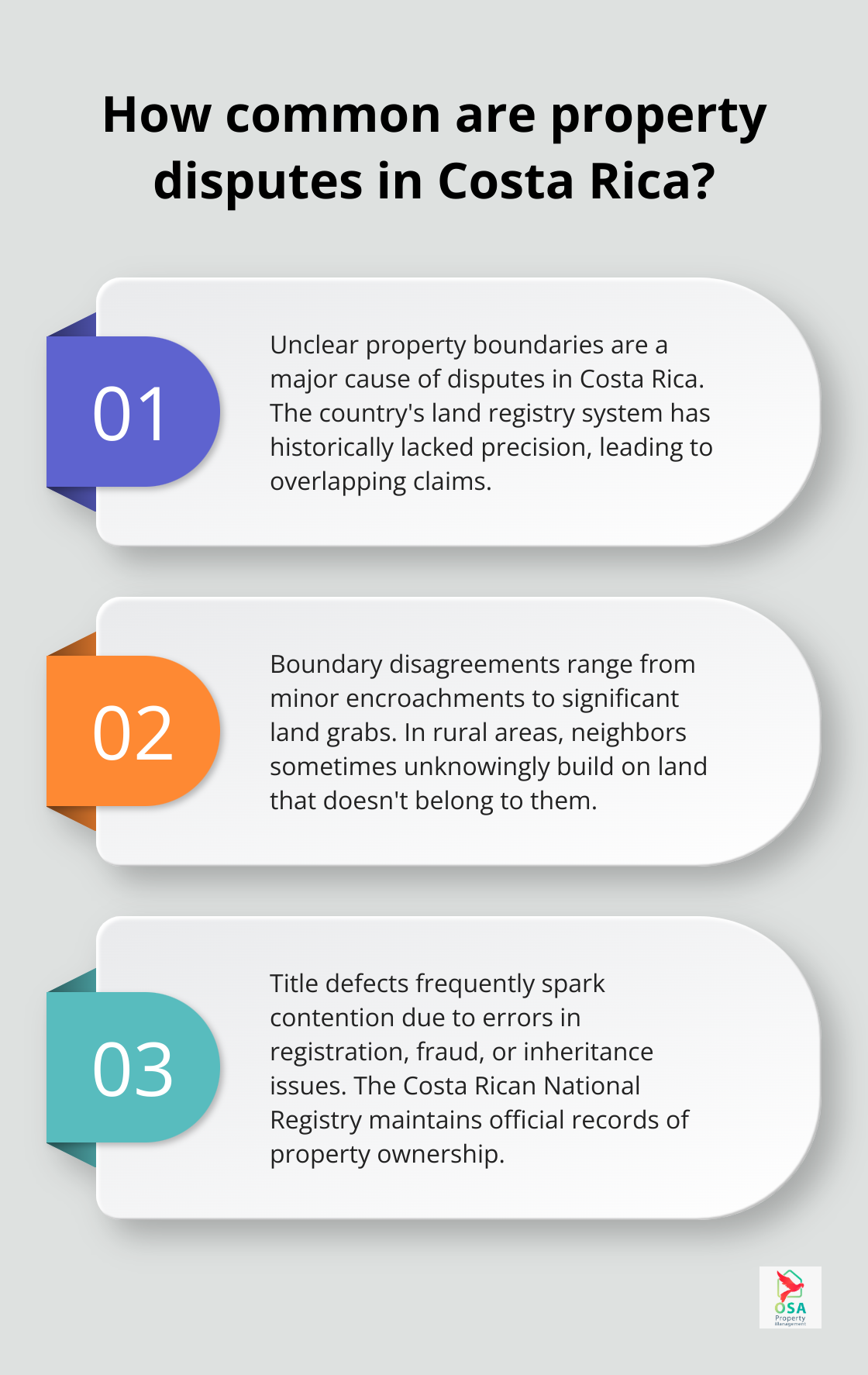
Costa Rican property law recognizes adverse possession (usucapión) after 10 years of open, peaceful, uninterrupted possession under color of title — and after 30 years without any title at all. This is codified in the Código Civil de Costa Rica. For absentee owners and undeveloped rural parcels, this is a real risk — and for Americans buying cheap rural land without inspecting it, a nasty surprise.
The scam version: the seller is selling a rural lot that has squatters on it. The squatters are fenced off in a corner with some coffee trees or a cow; the seller says "they'll be gone by closing, don't worry." They are not gone by closing. The new American owner is now in a legal dispute with occupants who may have been there for years, have witnesses, and have a possible usucapión claim.
How to defeat it. Before closing, visit the property in person with your lawyer and confirm it is physically empty. If you can't visit, have a trusted local (not the seller's agent) walk the property and film all four boundaries. Require the seller to warrant in the sale contract that the property is free of occupants and that any squatters discovered within 12 months of closing will be the seller's legal and financial responsibility. This clause alone is usually enough to make a dishonest seller back out.
Be especially careful with (a) inherited properties where the family has not visited in years, (b) properties in litigation or probate, (c) properties marketed as "investment lots" in remote areas, and (d) anything in the Southern Zone (Osa Peninsula, Golfito) or along dirt roads in Guanacaste where squatter claims are most common.
Scam 5: The dual pricing / declared value underreporting
This one is presented to the buyer as a "favor" — the seller offers to declare a lower price on the escritura to reduce transfer tax and stamp duty. "Everybody does it," the seller says. "You'll save $3,000 on the 1.5% transfer tax."
The trap: the declared value becomes your cost basis for Costa Rican property and capital gains tax. When you later sell, your gain is calculated from the declared value, not the actual price you paid. If you paid $300,000 but declared $150,000, your taxable gain on resale at $350,000 is $200,000 — not $50,000. Costa Rica's 15% capital gains tax on real estate (implemented via Law 9635 in 2019) then bites hard on the difference. You saved $2,250 at purchase and paid $22,500 extra at sale. Terrible trade.
There is also a separate risk: municipalities reassess property tax based on declared values and can update upward, and the Costa Rican tax authority can challenge an obviously under-declared purchase as simulación (tax evasion).
A third and worse risk: under-declared purchases are used by money-laundering investigators as a pattern marker. Costa Rica is a FATF member and strengthened its AML framework significantly through the 2010s. An under-declared purchase followed by a later sale at the real value can flag the foreign buyer's account and trigger inquiries both in Costa Rica and via FinCEN in the U.S.
How to defeat it. Declare the real price on the escritura. Pay the 1.5% transfer tax and 0.5% stamp duty honestly. Ignore any agent or lawyer who suggests otherwise. A lawyer who proposes under-declaration should be fired and reported to the Colegio de Abogados.
Scam 6: The 'recommended' lawyer who works for the seller
Not every dishonest lawyer is in on a ring. Many simply have a structural conflict: they are the listing agent's "preferred lawyer" and get referrals from the agency in exchange for moving deals to closing without friction. In a country where lawyer fees are a small percentage of the sale, the referral relationship is economically more valuable than any individual client.
Symptoms of this conflict:
- The lawyer was recommended or introduced by the listing agent.
- The lawyer shares a physical office, email domain, or staff with the agency.
- The lawyer proposes to "also represent the seller to save money."
- The lawyer waves off your concerns about due diligence steps (title, ZMT, corporate history) as unnecessary.
- The lawyer pressures you to wire funds before the due diligence is complete.
None of these are necessarily criminal. All of them mean the lawyer is not fully aligned with you, and in a country where buyer beware is the default, that misalignment is expensive.
How to defeat it. Hire an independent lawyer with no referral relationship to the agency. Verify licensing at the Colegio de Abogados de Costa Rica. Ask for references from other American clients. See the American Citizens Association of Costa Rica for English-speaking professional referrals.

Expect to pay $1,500–$3,500 for a clean, independent Costa Rican real estate transaction closing. That is less than 1% of a typical purchase and is the cheapest insurance you will buy.

Scam 7: The 'finder's fee' developer kickback
In newer developments in Guanacaste, Nosara, Tamarindo, and parts of the Southern Zone, a networked model has emerged where developers pay aggressive "finder's fees" (often 10%–15% of sale price) to American influencers, relocation coaches, Facebook group admins, and YouTube "move-to-Costa-Rica" content creators who bring in buyers. The content creators present themselves as neutral advisors and recommend properties to their audience without disclosing the kickback.
This isn't technically fraud, but it's a structural conflict that American buyers should assume is present in every "free" Costa Rica relocation consultation they receive from a U.S.-based content creator. The price the buyer pays is inflated by the finder's fee — meaning the same property offered on the open market through a traditional listing agent would cost 10%–15% less.
How to defeat it. Ask every advisor directly: "Are you receiving any commission or referral fee from the developer or seller on this property? Please confirm in writing." If the answer is yes, treat their recommendation as advertising, not advice. If the answer is no but you cannot verify it, get a second independent valuation from a Costa Rican perito valuador (appraiser) through the Colegio Federado de Ingenieros y Arquitectos. An independent valuation costs $300–$800 and is a cheap check on whether you're paying market price or marked-up price.
The larger point is that Costa Rica's expat real estate market is saturated with intermediaries whose economics depend on keeping prices high. The defense is simple: buy at arm's length through neutral channels, get independent valuation, and never rely on a single recommended advisor. The Cámara Costarricense de Bienes Raíces (CCCBR) maintains a register of licensed real estate professionals, which is a starting point for vetting but not a guarantee of independence.
What the best Costa Rican real estate lawyers actually do
Speak to any bar-admitted Costa Rican real estate lawyer who has been practicing for more than ten years and they will tell you that 90% of the problems American buyers bring them could have been prevented by five checks. Here is that checklist, in priority order:
- Pull the folio real from the Registro Nacional and confirm the registered owner matches the person selling.
- Confirm the property is outside the ZMT, or if inside, obtain the concession title and review Article 47 compliance.
- Pull the tax clearance certificate from Hacienda confirming no outstanding property tax, corporate tax, or capital gains tax on the property or the selling S.A.
- Pull the Registro Judicial to confirm no pending litigation affecting the property.
- Physically visit the property (or have your lawyer visit) to confirm no occupants, no boundary disputes, no visible encumbrances.
Those five steps, done properly, cost $500–$1,200 in lawyer time and eliminate the vast majority of the scams described above. Add a full estudio de título (title study), a corporate audit if buying shares, an independent perito valuación, and a physical ZMT map check, and the all-in due diligence cost is $2,000–$4,000 on a typical $300,000 transaction. That is 0.7%–1.3% of purchase price — and the closest thing to insurance you can buy.

Costa Rica remains a great place for Americans to own property. The scams described above are not universal, are not even particularly common among well-advised buyers, and are almost always defeated by the same set of careful practices. The American buyers who lose money are, without exception, the ones who either (a) didn't hire an independent lawyer, (b) relied on the seller's lawyer or the agency's lawyer, (c) didn't do any due diligence beyond visual inspection, or (d) trusted the "recommended advisor" without checking financial incentives. Avoid all four of those mistakes and Costa Rica is exactly as friendly to American buyers as its reputation suggests.
Ready to explore?
Browse Destinations