
How to Find a Bilingual Real Estate Lawyer Abroad (and What to Pay Them)

The single biggest mistake Americans make buying property abroad has nothing to do with market timing, exchange rates, or visa rules. It is hiring the wrong lawyer — or, more often, hiring no lawyer at all and letting the seller's notary or the real estate agency's in-house counsel handle the deal "for free."
In the United States we are used to a transaction structure where the title company is neutral, the escrow is regulated, and the listing and buyer's agents each owe fiduciary duties to their respective clients. Almost nothing about that model exists in continental Europe, Latin America, or Asia. In most of the rest of the world the notary is a neutral state official who serves neither party, the listing agent works exclusively for the seller, and the buyer has exactly one person in the transaction legally obligated to protect them: their own independently hired lawyer.
This guide walks through how to actually find one, what to pay, what questions to ask, how to spot conflicts of interest, and which national bar associations to cross-check. It is written for somebody whose Spanish is ordering-tapas grade, whose Italian is non-existent, and who is about to wire six figures to a country where they cannot read the contract.

Why you can't just use the seller's notary
In Spain, Italy, France, Portugal, Germany, the Netherlands, Belgium, and most Latin American countries, the closing is done before a notary (notario, notaio, notaire, notário, Notar). The notary is a licensed public official who drafts the deed, verifies identities, confirms tax payment, and registers the property. Critically, the notary is legally neutral. Their job is to the state, not to either party. A notary will not negotiate on your behalf, will not warn you if the price looks inflated, will not question why the preliminary contract was drafted with a one-sided penalty clause, and will not represent you in a dispute afterwards.
This structure is described in detail on the Council of the Notariats of the European Union (CNUE) site and on individual national pages like Notaires de France and Consiglio Nazionale del Notariato. Read them. The Notaires de France explainer is blunt: the notaire is impartial between buyer and seller, and the buyer is free (and encouraged) to hire their own avocat for legal advice. See our French notaire role article for the full breakdown.
The trap is that many American buyers arrive thinking "I already have a notary, I don't need a lawyer" — which is exactly like saying "I already have a judge, I don't need an attorney." You need both.

The exceptions are the UK, Ireland, and Scotland, where the buyer hires a solicitor (or conveyancer in England) who is fully on their side and performs a function similar to a U.S. real-estate attorney. See the Law Society of England and Wales Find a Solicitor tool and the Law Society of Ireland equivalent. You still need to hire one who speaks clearly to an American client, but the structural role is familiar.
Where to look: the bar associations and registers that actually matter
The single most important filter is whether the lawyer is currently registered with the national or regional bar. Anybody can call themselves a "legal consultant" or an "immigration specialist" on Instagram. Only licensed lawyers appear on their country's bar register, and only they can represent you in court if something goes wrong.
Here is where to verify credentials in each major country Americans buy in:
- Spain — each province has its own Colegio de Abogados. The national umbrella is the Consejo General de la Abogacía Española. Ask for the lawyer's ICAM (Madrid) or ICAB (Barcelona) collegiate number and look it up.
- Italy — the Consiglio Nazionale Forense runs REGINDE, the national register of avvocati. Search by name or bar association.
- France — the Conseil National des Barreaux runs the national annuaire of avocats.
- Portugal — the Ordem dos Advogados has a public search.
- Ireland — the Law Society of Ireland Find a Solicitor tool, regulated by the Legal Services Regulatory Authority.
- UK — Law Society Find a Solicitor plus the Solicitors Regulation Authority register.
- Germany — the Bundesrechtsanwaltskammer federal register.
- Netherlands — the Nederlandse Orde van Advocaten has a zoek-een-advocaat tool.
- Mexico — Mexican lawyers are licensed by state Tribunales Superiores de Justicia. Ask for the cédula profesional number and verify at the federal Registro Nacional de Profesionistas.
- Japan — the Japan Federation of Bar Associations (Nichibenren) publishes a bengoshi search. Note that in real estate closings a shiho shoshi (judicial scrivener), not a bengoshi, typically handles the transfer — they are licensed under a separate body.
- Costa Rica — the Colegio de Abogados y Abogadas de Costa Rica maintains a searchable register.
Reddit threads on r/expats, r/amerexit, country-specific subs like r/Spain and r/japanlife, and the r/ExpatFIRE community are useful starting points for names but you must then verify the license independently.
How to screen candidates: five interview questions
Once you have three or four names, schedule 20-minute video calls. Do not pay for the initial call — any competent law firm does a free intake. In each call, ask the following five questions and listen carefully to the answers.
1. "How many American-buyer transactions did you personally close last year?" You want a specific number. Not the firm's number, not "many," not "lots." Personally closed. Under 5 is a yellow flag; zero is a red flag unless they are charging accordingly cheap.
2. "Do you or your firm accept any referral fee, commission, or other compensation from real estate agencies or sellers?" The answer must be no. In Spain and Italy this is explicitly regulated by the bar association's code of ethics. In some countries, especially less-regulated LATAM markets, the standard practice is for the agency to pay the "lawyer" a kickback — meaning the lawyer is economically aligned with the seller, not you. Ask the question directly and get the answer in writing.
3. "Can you represent me under a fixed fee, and can you put the scope and the number in writing today?" A good lawyer will quote 1%–1.5% of purchase price (often with a minimum of €1,500–€2,500), cover a defined scope (title search, contract review and negotiation, attendance at notary, post-closing registration), and commit in an engagement letter. If the answer is an hourly rate, push for a cap. If the answer is "we'll see," move on.
4. "Will you issue a formal title report in English after your due diligence?" The answer should be yes, with a turnaround of 1–3 weeks from when you supply the property details. That report is what you are paying for. It should cover: registered owner, any charges or mortgages, any embargoes, urban-planning status, cadastral match, energy certificate, pending community fees, and confirmation of the seller's right to sell. In Spain this is built around the nota simple from the Registradores de España. In Italy it comes from the visura catastale and visura ipotecaria at the Agenzia delle Entrate. In the UK it is the local authority search, Land Registry title register, and environmental search.
5. "What is your professional indemnity insurance coverage?" In EU countries, lawyers are required to carry minimum professional indemnity cover, and in the UK the minimum for solicitors is £2 million (SRA rules). Ask for the policy limit and the insurer. A firm that hesitates here either doesn't have insurance or has forgotten to renew it.


Red flags that should end the call
These are the things that came up repeatedly in expat horror stories on r/IWantOut, r/Italy, r/Spain, r/Portugal, and the older Expats in Spain forum:
- The lawyer was recommended by the real estate agency and cannot cite other clients they represent independently. The agency's "preferred lawyer" is a structural conflict of interest. Even when technically licensed, their economic loyalty is to the referral source.
- The lawyer shares an office, staff, or email domain with the estate agency. This happens more than you'd think in Spain and Portugal. Walk away.
- The lawyer proposes to also act for the seller "to save fees." This is illegal in most EU bars and grounds for disciplinary complaint. Dual representation in a property sale is prohibited because the interests diverge.
- No written engagement letter, no fixed fee, no professional indemnity insurance certificate. Any of these alone is enough to disqualify.
- "We don't need to do a title search, the notary will handle it." The notary checks whether the title is clean enough to be deeded — they do not check whether there are planning violations, illegal extensions, pending community fee arrears, unregistered renovations, or disputes with neighbors. Those are the lawyer's job.
- Payment requested to a personal account or to an account in a different name than the law firm. All reputable firms have a registered client account (in the UK called a pooled client account governed by the SRA Accounts Rules, in Spain called a cuenta de clientes). Funds never go to the lawyer's personal bank account.
- The lawyer pushes you to sign the preliminary contract before the title search is complete. This is the single most common way Americans lose deposits. A good lawyer insists the nota simple / visura / Land Registry title register is pulled and read before any money moves.
What the fee actually covers, and what it doesn't
Real estate lawyers in Europe typically charge a fixed fee between 1% and 1.5% of the purchase price, with a minimum threshold around €1,500–€2,500. Some firms charge lower percentages (0.7%–1%) on higher-value deals above €500,000. The fee usually includes VAT at the country rate (21% Spain, 22% Italy, 20% France).
What the standard fee includes:
- Initial consultation and document review
- Pulling the title register (nota simple, visura, Land Registry)
- Drafting or reviewing the preliminary contract (arras, compromis, compromesso)
- Negotiating the final deed wording with the seller's side
- Attending the notary signing (either in person or via POA)
- Arranging the post-closing registration in the land registry
- Calculating and arranging payment of transfer taxes (ITP, IMU, IRS, droits de mutation)
What it does not typically include:
- The notary fee itself (another 0.3%–1%, paid separately to the notary)
- Transfer taxes and stamp duty
- Translation services (sworn translator at notary: €300–€600)
- Obtaining the buyer's tax number (NIE, codice fiscale, NIF, PPSN) — some firms include this, some charge €200–€400 extra
- Power of attorney drafting and apostille coordination — budget €400–€800 if you cannot attend in person
- Representing you in any dispute, mortgage contract review, or corporate structure for the purchase
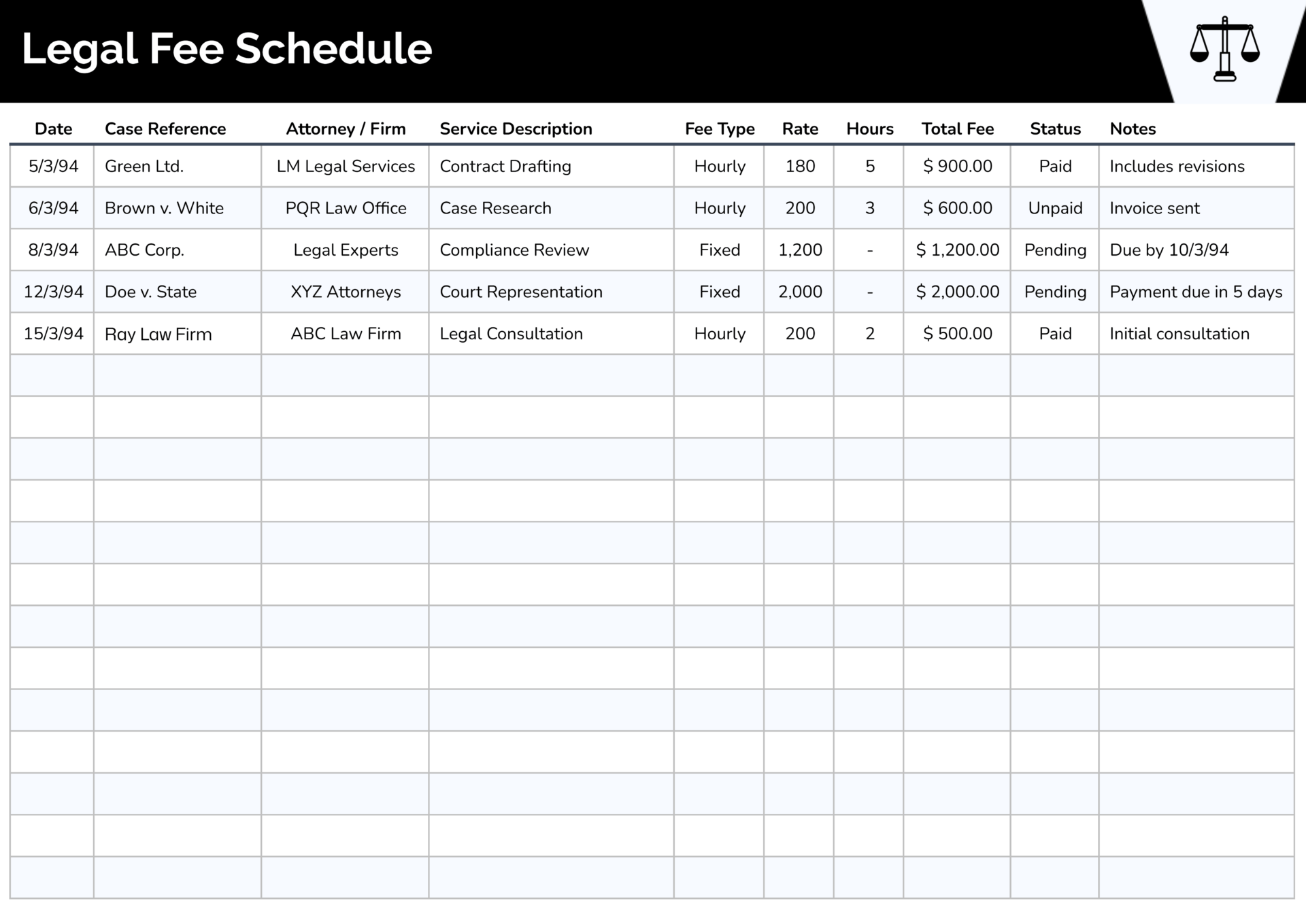
Ask for a detailed quote that separates legal fees from disbursements. Any firm that refuses is hiding something. The Law Society of Ireland's guidance on solicitor's fees is a good model for what transparency looks like — every firm should be willing to produce something similar.
Country-specific gotchas
Spain. Spanish real estate fraud is well-documented. The classic problem is undeclared building extensions that don't appear in the Catastro — perfectly common, and perfectly fine until the next owner tries to get a mortgage or sell. A competent Spanish lawyer pulls both the nota simple from the Registro de la Propiedad and the Catastro cadastral file and cross-checks the square meters in each against the square meters in the listing. Mismatches mean the extension is illegal, and legalizing it is expensive and uncertain.
Italy. The Italian counterpart is the abusi edilizi — illegal building works. An abuso cannot be deeded without first being legalized via condono or sanatoria, and the seller is responsible. Your Italian lawyer must verify the planimetria catastale (cadastral floor plan) matches the actual floor plan of the building. If it does not, do not sign. See the Agenzia delle Entrate guide for the relevant forms.
France. French real estate is highly regulated in favor of the buyer. The dossier de diagnostic technique is mandatory and must be attached to the compromis. Your French avocat's main value-add is interpreting that dossier honestly, negotiating clauses suspensives (financing, inspection, planning), and making sure the compromis isn't silently one-sided. See service-public.fr for the required diagnostics.
Portugal. Check whether the property has a licença de utilização (habitation license). Without it the property technically cannot be occupied as a residence. Also check the caderneta predial tax record at Portal das Finanças.
Ireland. Gazumping is legal until contracts are signed. A good Irish solicitor moves fast after your offer is accepted to get contracts drafted and exchanged before another bidder slips in. See the Property Services Regulatory Authority and our Ireland no-residency article.
UK. SDLT, the non-resident surcharge, ATED for company structures, and possible inheritance tax exposure make UK purchase tax planning complex. Ask if the solicitor works with a tax advisor and how they coordinate.
Japan. The transaction is usually handled by the real estate agent plus a shiho shoshi scrivener. A full bengoshi (bar-admitted lawyer) is only necessary for disputed transactions or corporate structures. See our Japan no-Japanese article.
Mexico. In the restricted zone (within 50km of the coast or 100km of a land border), Americans buy through a bank fideicomiso (trust). Hire a lawyer independent of the fideicomiso bank to review the trust instrument itself — this is where documented disputes most often occur, per SAT and the Instituto de la Función Registral registers.

How to actually pay them, and when to walk
Your lawyer's fee is paid in stages. Typical structure in Europe: a small retainer of €500–€1,000 on engagement, 50% on the title report being delivered, and the balance at closing. Some UK solicitors work on "no completion, no fee" for their own legal work (you still owe disbursements). The SRA guide on solicitor fees describes the options.
Pay via international wire to the firm's client account, never to a personal account. The wire should name the firm, its bank, and the client-account suffix. If you are asked to pay into a crypto wallet, an individual named account, or a "holding company," walk away and report to the country's bar association. This happens often enough that the UK SRA publishes monthly scam warnings about fraudulent firms posing as real ones.
When to walk. Fire your lawyer, hire a new one, and start over if any of these happen:
- They pressure you to sign a preliminary contract before the title report is delivered.
- They refuse to explain a clause in English, or tell you "it's standard, don't worry."
- You catch them on the seller's side communicating with the listing agent in a way that suggests coordination.
- They miss a deadline without explanation, especially a tax registration or POA apostille deadline.
- The engagement letter numbers and the final invoice numbers don't match, and they cannot explain the difference line by line.
The cost of changing lawyers mid-transaction is real — you'll lose the retainer, a couple weeks, and some goodwill with the seller. The cost of keeping the wrong lawyer is losing your deposit, or worse, closing on a property with a latent defect your lawyer failed to flag. There is no version of the second cost that is cheaper than the first.
The best test of whether you hired the right lawyer is simple: at every stage, do they tell you what you want to hear, or what you need to hear? A lawyer who tells you the property has a planning problem and you should walk away is more valuable than a lawyer who tells you everything looks fine and gets you to closing. One of them is protecting their commission. The other is protecting you.
Ready to explore?
Browse Destinations