
Can a US Citizen Buy a House in Ireland Without Residency?

Ireland is one of the most open real estate markets in the developed world for American buyers. There is no residency requirement, no citizenship requirement, no foreign buyer surcharge, no permit regime, no equivalent of Canada's ban or Switzerland's Lex Koller. You can fly in on a tourist entry, view houses on a Monday, bid on Tuesday, and be in contracts the following month. The friction you run into is not legal — it's administrative, and it comes down to a handful of very specific Irish quirks (the PPSN, the way bidding works, the limited mortgage market for non-residents) that an American Reddit thread will never prepare you for.

This article walks through what a US citizen actually needs to buy a house in Ireland in 2026, assuming you have zero ties to the country — no Irish passport, no relatives, no visa, no PPS number. By the end you'll know exactly what to file, who to hire, how to pay, and what the total cost of ownership looks like. Related reading on our site: moving to Ireland guide, cost of living in Ireland, and off-market Ireland American buyers. For peer experience, r/ireland, r/AskIreland, r/IrishEconomy, r/AmerExit, and r/IWantOut are the most active English-language communities.
The Headline: No Restrictions, But No Residency Either
Let's clear up the most common misconception first. Americans can buy property in Ireland with exactly the same rights as Irish citizens. There are no foreign buyer limits, no quotas by building, no prior-permission regime, no Lex Koller equivalent, no stamp duty surcharge for non-residents. The Citizens Information Ireland stamp duty page, which is the official government service, states the stamp duty rate 'is the same for non-resident purchases as resident purchasers.' There is no equivalent of the UK's 2% non-resident surcharge or Australia's FIRB regime.
But — and this is the part Americans miss — buying property in Ireland does not grant you any right to live in Ireland. It doesn't get you a visa, it doesn't get you residency, it doesn't get you onto a path to citizenship. You can own the house and still be limited to your 90-day visa-waiver tourist entry. MB Solicitors' non-resident buying guide is blunt about this.
The visa paths Americans actually use to live in Ireland — Stamp 0 (self-supporting retiree), Critical Skills Employment Permit, Stamp 4 based on Irish family — are completely separate from the property purchase. If your plan is 'buy a cottage in West Cork and move there,' you need to solve the visa side in parallel. See our moving to Ireland guide for the visa breakdown. r/IWantOut threads on Ireland retirement visa are a reality check.
Step One: Get a PPSN Before You Bid
The most common administrative blocker for unprepared American buyers is the PPSN — the Personal Public Service Number. It is Ireland's equivalent of the Spanish NIE or French SIREN: a unique tax ID that the state uses to track you. You need a PPSN to file stamp duty with Revenue, to register the deed, to pay your Local Property Tax (LPT), and effectively to close.

As a non-resident American you apply through Revenue's Client Identity Services, typically by submitting proof of identity (passport), proof of address (US utility bill or bank statement), and a letter stating the reason for needing the number — 'purchasing Irish residential property at [address]' is accepted. The Revenue Commissioners PPSN page and the Department of Social Protection PPSN guidance have the current forms.
Non-resident PPSN applications typically take 2-6 weeks to process, sometimes longer if the reviewer wants additional documentation. Start the process before you go on a viewing trip. Americans who bid first and apply for the PPSN after often lose the property because Irish closings move faster than the PPSN can catch up. See r/ireland threads on getting a PPSN from abroad for current processing reports.
One small workaround: if you travel to Ireland and register as a short-stay visitor at a specific address (such as a long-term Airbnb used as a relocation base), you can sometimes apply for the PPSN in person at an Intreo Centre, which is faster than the non-resident postal route. Most Dublin-based relocation services offer this as a paid service.
How Irish Property Sales Actually Work — Private Treaty and Bidding
Americans frequently misunderstand Irish sales because 'bidding' in Ireland means something different from a US auction. Most residential sales in Ireland are by private treaty, not at public auction. The way it works:
- The seller's estate agent (auctioneer) lists the property at an 'asking price' (Asking Price or AMV for at-auction listings).
- Interested buyers submit bids directly to the auctioneer. All bids are typically verbal or by phone/email. There is no closed envelope, no deadline, no standard binding offer.
- The auctioneer communicates bids back and forth between interested parties. It is normal for the auctioneer to tell you 'there's a bid of €520,000, can you beat it?' — which may or may not be true. Irish estate agents are notorious for 'phantom bidders' and there is no regulator that reliably polices this. r/ireland threads on estate agent phantom bidding are worth reading before your first bid.
- A bid is not legally binding until contracts are signed. This is critical: in Ireland, nothing is binding until the deposit is paid and the contract is signed. Sellers can accept a bid and then accept a higher one a week later ('gazumping'). Buyers can walk at any time before signing.
- Once bids stabilize, the seller instructs their solicitor to issue contracts. You sign within 1-3 weeks and pay a 10% deposit.
- Closing happens 4-8 weeks later.

For Americans coming from a US system where a signed purchase agreement is binding, gazumping is the biggest culture shock. Our offer accepted on a house abroad article covers how to protect yourself. Hire a good solicitor and get contracts moving fast — the faster you sign, the less exposed you are to a higher bidder. McKenna & Co.'s relocation guide for US buyers has a concise summary of the process from a Dublin solicitor's perspective.

Stamp Duty, LPT, and the Cost Breakdown
Ireland's stamp duty rates as of early 2026, per the Revenue Commissioners stamp duty page:
- 1% on the first €1 million of the purchase price
- 2% on the portion between €1 million and €1.5 million
- 6% on any portion above €1.5 million (this was introduced in October 2024 as part of Budget 2025 and catches genuinely expensive Dublin 4 and Dublin 6 houses)
Non-principal private residence and certain second-home transactions can trigger the 10% higher rate if you buy 10 or more homes in a 12-month period — a rule aimed at institutional buyers, not individuals. Irish Tax Hub's 2026 stamp duty explainer walks through the edge cases.
For a typical American buying a €450,000 Dublin apartment, the stamp duty is €4,500 — notably low by European standards. Compare to Spain's 6-10% ITP, Italy's 9% imposta di registro, or the UK's 5-17% stamp duty bands.
Other costs you pay at closing or shortly after:
- Solicitor's fee — typically €1,500 to €3,500 flat, or 1% of the purchase price whichever is higher. Plus VAT at 23%. A good non-resident-experienced solicitor in Dublin (Matheson, A&L Goodbody, McKenna & Co, Callan Tansey) runs toward the top of the range.
- Searches and registration — roughly €400-800 for the Land Registry and local authority searches.
- Valuation (if financing) — €150-300.
- Building survey (optional but strongly recommended on anything built before 1980) — €400-900.
- VAT on new builds only — 13.5% is already baked into the asking price on newly-built properties.
Annual costs after closing:
- Local Property Tax (LPT) — assessed on self-declared value, banded, typically €225 to €1,500/year for most residential properties. New rates took effect November 2025 per Revenue. See the Revenue LPT page.
- Household insurance — €300-800/year.
- Management fees for apartments — €1,500 to €4,000/year typical.
- Heating (oil/gas/electric) — varies hugely; budget €1,500-3,500/year for a three-bed house, more if poorly insulated.
Total closing costs for a standard American cash purchase run 2% to 3% of purchase price. Financed purchases run 2.5% to 4% with valuation and lender fees. These numbers are low compared to most of Europe and the US.
Financing: Why Most American Buyers Pay Cash
Irish banks technically lend to non-residents, but in practice the non-resident mortgage market is narrow and expensive. The three main Irish banks (AIB, Bank of Ireland, Permanent TSB) all have non-resident lending policies, but:
- Maximum LTV is typically 60-70% for non-residents, compared to 90% for first-time buyers with Irish income.
- Interest rates are higher — 2026 non-resident rates are running 4.5% to 6.5% variable, versus 3.5% to 4.5% for resident owner-occupiers.
- Documentation is heavy — three years of US tax returns, audited accounts if self-employed, proof of ongoing US income, US credit reports (which Irish underwriters can't read natively), and proof of source of funds.
- Processing is slow — 8-16 weeks for a non-resident application is normal, which creates tension with the fast Irish contract timeline.
In practice, most American non-resident buyers pay cash or carry a US-side HELOC. Our wiring money foreign property article covers the mechanics of moving a large sum into Ireland. You'll typically use Wise, CurrencyFair, or a broker like Moneycorp rather than a US bank wire, which will cost you 1-3% in hidden spread.
The Central Bank of Ireland mortgage rules page has the authoritative lending rules. r/irishpersonalfinance threads on non-resident mortgages are the best peer source for which bank is currently most open.
Where Americans Actually Buy: Dublin, Cork, Galway, and the Rural Play
The 2025-2026 American buyer pattern in Ireland has three distinct clusters.
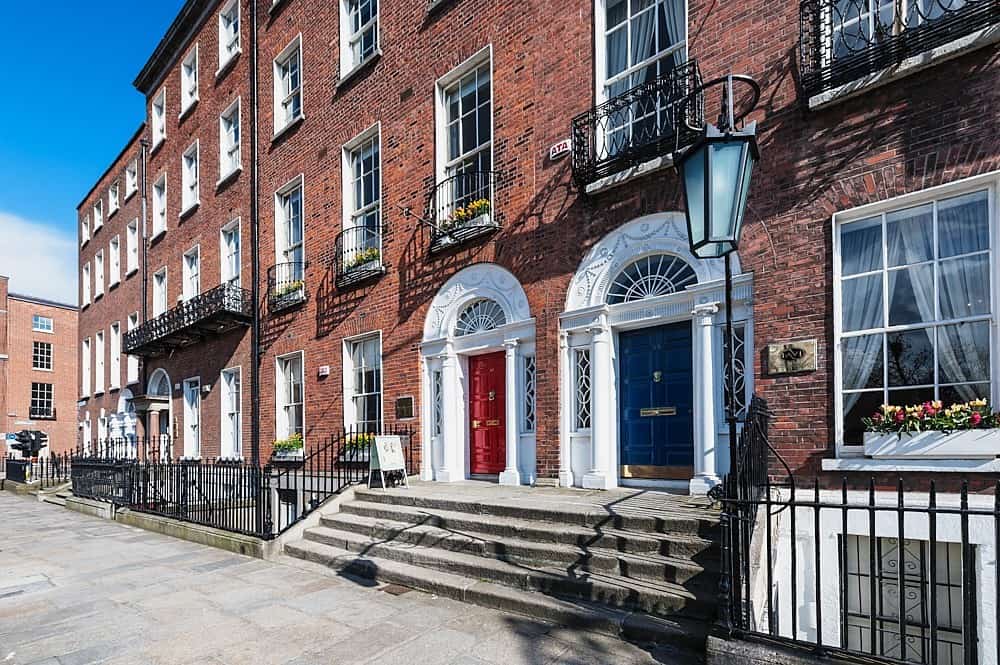
Dublin — the obvious choice and the most expensive. Median Dublin house prices in early 2026 are around €460,000 per the CSO Residential Property Price Index. Dublin 2, 4, 6, 14, and Dún Laoghaire-Rathdown are the traditional American expat neighborhoods, with prices €600K-1.5M+ for family homes. Apartments in Docklands, Smithfield, and Stoneybatter run €350K-550K. See our Dublin property listings.
Cork and Galway — the second-city pattern. Cork is Ireland's second-largest and a major tech employer (Apple, Pfizer, Amazon, Dell). Galway is smaller, has a famous quality of life, and is where a lot of American retirees land. Median prices in both cities run 30-40% below Dublin, often putting three-bed houses in good neighborhoods in the €280K-400K range. r/cork and r/galway are active.
Rural West Cork, Kerry, Clare, Connemara, Donegal — the dream-cottage play. Prices drop dramatically outside the cities. A two-bed stone cottage in rural Mayo or Leitrim can still be had for €100K-180K, though 'needs work' is the standard caveat. The trap is BER (Building Energy Rating) — many rural Irish houses are G-rated, which means heating them through an Irish winter costs €3,000-5,000/year. See SEAI's BER rating database and our cost of living in Ireland article for running cost numbers.
The portal pattern: Daft.ie is the dominant listings site and has the most inventory. MyHome.ie is the second player and is owned by the Irish Times. Both are free to search, English-first, and reliably current. Rural listings sometimes appear only in local auctioneer windows and not online at all — see our off-market Ireland American buyers article for how to find them.

Taxes After Closing: LPT, CGT, and the US Side
Three tax obligations continue after you close.
Local Property Tax (LPT) — annual, self-assessed, banded, paid to Revenue. The 2026 bands start at around €225/year for homes valued under €200K and climb to €1,500+/year for homes over €1M, with an additional marginal rate above €1.5M. See the Revenue LPT bands page. You file the first LPT return within 30 days of closing; thereafter it's annual.
Capital Gains Tax (CGT) on sale. Irish CGT is 33% of the gain, with a personal exemption of €1,270/year. Ireland does not offer a primary-residence exemption to non-residents, so if you sell as a non-resident, the 33% applies to the full gain. If you become Irish tax-resident before selling, the principal private residence relief can eliminate the CGT entirely for the period it was your home. This is a meaningful reason to consider establishing residency before a sale. See Revenue's CGT rules and our capital gains foreign property article.
The US side. As an American citizen, all your worldwide income and all your worldwide property transactions remain reportable to the IRS. A few points:
- FBAR — if at any point during the year you hold more than $10,000 across non-US bank accounts, you file FinCEN Form 114.
- FATCA Form 8938 — higher thresholds, filed with your 1040 if your foreign financial assets exceed the limits.
- US CGT on sale — the US taxes your worldwide capital gains. You'll claim a foreign tax credit for the Irish CGT paid, but the US rate can be higher and you may owe additional tax in the US.
- US-Ireland tax treaty — the US-Ireland Income Tax Treaty prevents double taxation but doesn't eliminate US filing obligations.
An Irish accountant who is familiar with US-Ireland tax interaction is a good investment — budget €800-2,000/year for dual compliance support. r/irishpersonalfinance has recommendations.
The Bottom Line for Non-Resident American Buyers
Ireland in 2026 is a genuinely friendly market for Americans with the means to buy. The legal process is clean, the language is English, the title system works, the taxes are moderate, and there is no foreign-buyer surcharge. The real constraints are:
- You need a PPSN before closing. Start 4-6 weeks out.
- The bidding system is verbal and non-binding until contracts are signed. Protect yourself by moving fast and keeping your solicitor on speed dial.
- Mortgage access is thin as a non-resident. Assume cash or US-side financing.
- Closing costs are low (2-3%) but ongoing costs (heat, BER retrofit, apartment management fees) can be meaningful.
- Buying doesn't give you residency. Solve the visa path in parallel.
If all five of those work for you, Ireland is one of the most straightforward foreign purchases an American can make in 2026. The typical elapsed time from 'I want to buy' to 'I have keys' is 8-14 weeks for a cash buyer with the PPSN already in hand. For the step-by-step buyer playbook once you're in contracts, see our offer accepted on a house abroad article and our hiring a bilingual real estate lawyer abroad guide. For specific neighborhoods and real current listings, browse our Ireland country page and the city pages for Dublin, Cork, Galway, and Limerick.
Ready to explore?
Browse Destinations