
Costa Rica Inversionista Visa: Can You Get Residency by Buying a House?

Costa Rica has one of Latin America's most accessible residency-by-investment programs. The Inversionista category (Residente Inversionista) lets any foreigner who makes a qualifying investment of $150,000 USD or more apply directly for temporary residency. Real estate counts. A single clean property purchase can — in theory — deliver a residency card. The reality is more nuanced. Migración has specific requirements for the form the investment must take, the process routes through the Dirección General de Migración y Extranjería rather than a consulate, and the timelines stretch 8-18 months from filing to card.

This post walks Americans through the Inversionista path honestly — what qualifies, what doesn't, how the $150K threshold interacts with Costa Rica's maritime zone rules on beachfront property, and how the Inversionista compares to the much simpler Pensionado (retiree) and Rentista (income-based) paths that most American retirees actually end up using. Primary sources: Dirección General de Migración y Extranjería (DGME), the Ministry of Foreign Affairs, and Procomer. Expat perspective: r/costarica, r/IWantOut, and r/ExpatFIRE.
The Inversionista Category: What the Law Actually Says
Costa Rica's General Immigration Law (Ley General de Migración y Extranjería, Law 8764) and its regulations (Decree 37112) define the Residente Inversionista category. The core requirement, updated by the 2021 investment promotion reform (Law 9996, the "Ley para la Atracción de Inversionistas"), is an investment of at least $150,000 USD in any of the following:
- Real estate (residential or commercial, purchased in the applicant's name)
- A registered Costa Rican company (capitalization contribution)
- Reforestation projects with a specific government concession
- Securities and tradable instruments registered in Costa Rica
- Venture capital funds registered with SUGEVAL
Before 2021 the threshold was $200,000. Law 9996 cut it to $150,000 explicitly to attract more foreign investment, and the same law added several tax incentives for Inversionistas (duty-free import of household goods and one vehicle, favorable income tax treatment for the first years of residency). The Procomer investment incentives page has the full current incentive list.
What qualifies as the $150K threshold for real estate:
- The property must be registered in the applicant's own name (individuals — not Costa Rican corporations where you hold shares, though the corporate route can qualify under the business investment subcategory).
- The deed (escritura) must show a recorded sale price at or above $150,000 USD equivalent. The current Costa Rican colones value on the day of registration is what the Registro Nacional records.
- The property must be fully paid. Mortgaged properties don't count toward the threshold — you need unencumbered equity of $150K+.
- Multiple properties can be combined if they total $150K and are all in your name.
Important: corporations vs. personal names. Much Costa Rican real estate is held through Sociedades Anónimas (S.A.) — local corporations whose shares the foreigner owns. This is a legitimate ownership structure for many reasons (liability protection, estate planning), but it creates a wrinkle for Inversionista applications: you own shares in a company that owns the property, not the property directly. DGME will accept this structure if you can document that you are the sole or majority shareholder, but the documentation burden is higher. Many applicants find it easier to register the property directly in their own name for the initial Inversionista application, then transfer to a corporate structure after the residency is granted.
The other 2021 law change worth noting: Inversionistas who qualify under Law 9996 get exemption from import duties on household goods and one vehicle for up to two years, plus a tax break on interest, dividends, and real-estate profits related to the investment for up to 10 years. Ticos Times and The Tico Times have covered the incentive package since its 2021 enactment.
The Maritime Zone Problem
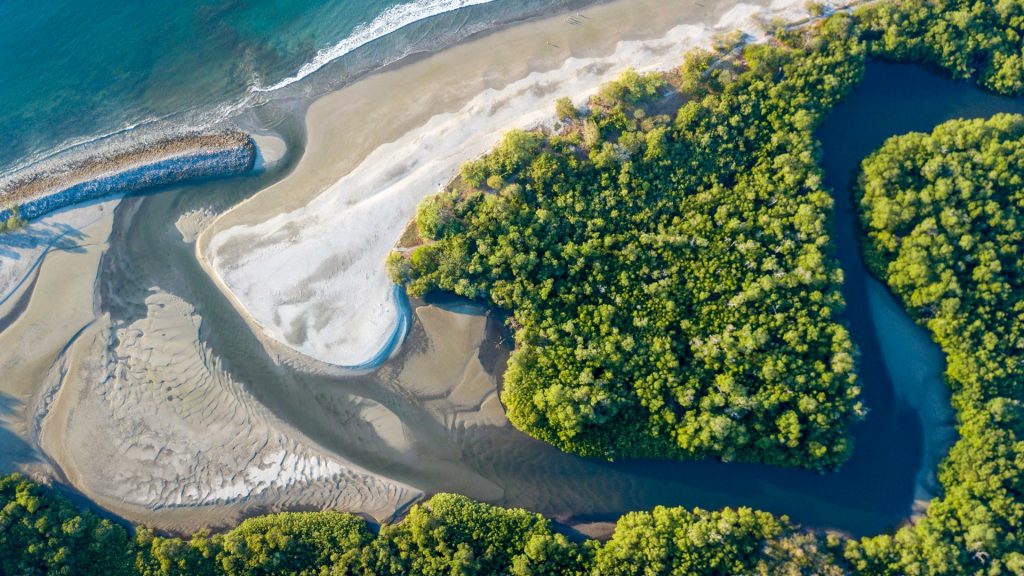
Costa Rica's Maritime Zone (Zona Marítimo Terrestre) regulation is the single most important thing to understand before buying coastal property with the intent of using it for Inversionista residency. The Maritime Terrestrial Zone Law (Ley 6043) designates the first 200 meters inland from the mean high tide line as public domain. Within that:
- The first 50 meters is the Zona Pública — absolute public domain, no private ownership or construction allowed, ever.
- The next 150 meters is the Zona Restringida — foreigners cannot hold direct fee-simple title. Only concessions (30-year renewable leases granted by the local municipality) are available, and the concession holder must be Costa Rican or a corporation with at least 50% Costa Rican ownership.
Implications for the Inversionista path:
- Property in the restricted 150m zone does NOT qualify for Inversionista residency because you don't hold fee-simple title — you hold a municipal concession. DGME wants a deed in your name registered with the Registro Nacional.
- Property OUTSIDE the 200m zone — even 300m back from the beach — is fine. It can be owned directly in the foreigner's name and counts normally.
- Popular beach towns like Tamarindo, Nosara, Santa Teresa, Jacó, and Dominical have a mix of zoned and unzoned properties. The location of the structure relative to the high tide line is what matters. Verify before you fall in love with a specific listing.
The restricted zone is the #1 cause of failed Costa Rica property transactions for Americans, per our own property scams in Costa Rica post and consistent coverage on The Tico Times and AM Costa Rica. The US Embassy Costa Rica specifically warns American citizens about the zone and related title confusion.
The fix if you want beachfront: either buy outside the 200m zone (easier than it sounds in most beach towns — there are always properties 250-500m back), or buy the concession under a Costa Rican corporation you control with a local partner (complicated, involves trust issues), or choose a different residency path (Pensionado or Rentista) that doesn't care about the form of property ownership.
For Americans who want Guanacaste beach life without the zone headache, look at inland hillside properties in areas like Playa Flamingo, Playa Grande, and Santa Teresa's upper barrios — you get ocean views, proper fee-simple title, and a clean deed that qualifies for Inversionista residency.
Application Process and Timeline
Unlike Mexico (where you apply at a consulate in the US first), Costa Rica's residency application is filed in-country with DGME. You enter Costa Rica as a tourist (up to 180 days for most Americans under the current tourist stay), then file the Inversionista application while you are in the country. The DGME application portal has the official forms and current document list.
Documents required:
- Passport (with at least 6 months of validity)
- FBI apostilled background check, translated into Spanish by an official Costa Rican translator (traductor oficial)
- Birth certificate apostilled and translated (needed for the Cédula de Residencia registration)
- Proof of income/financial solvency (bank statements showing the investment funds)
- Deed (escritura) for the property, registered with the Registro Nacional
- Property tax receipt and municipal permits showing the property is current
- Two passport photos, fingerprints taken at DGME
- Letter from a Costa Rican attorney attesting to the investment (most Inversionistas use an attorney for the full process)
- Application fee and corresponding stamps (~$250 USD total in government fees)
gov__of__costa__rica.jpg)
Processing timeline.
- Filing to initial review: 3-6 weeks
- Fingerprints and interview: 1-2 months after filing
- Approval: typically 8-18 months from filing to approval notification
- Cédula issuance: 2-6 weeks after approval, once you pay the issuance fee and Caja registration (see below)
Caja (CCSS) registration is mandatory. Once approved, Inversionistas must enroll in Costa Rica's public healthcare system, the Caja Costarricense de Seguro Social (CCSS). Monthly contributions are based on income and typically run $50-300/month per person. The requirement is strict — failing to register in the Caja can block your Cédula issuance. Covered in detail in our Costa Rica cost of living guide.
Attorney fees for the full process: typically $1,500-4,000 for a straightforward case, more if title issues or corporate structures are involved. The Costa Rica Bar Association and established firms like Outlier Legal and ARCR handle high volumes of American Inversionista applications. ARCR (Association of Residents of Costa Rica) is particularly worth joining — it's a member-owned organization that runs group seminars for new residents.
While your application is pending. You can continue to live in Costa Rica on tourist status, but be careful with border runs — the old "leave and re-enter every 90 days" strategy has been tightened since 2019, and immigration officers now have discretion to refuse re-entry if you appear to be living in Costa Rica on a tourist visa. Once your file is accepted (not approved — just accepted for processing), you receive a document showing your application is pending, which effectively authorizes your continued stay. See recent threads on r/costarica and AM Costa Rica's legal column.

Inversionista vs. Pensionado vs. Rentista: Which Actually Fits
The Inversionista is one of three major residency paths American retirees and part-time residents use in Costa Rica. The other two have dramatically different requirements and often fit better.
Pensionado — for retirees with pension income
- Requires proof of lifetime monthly pension income of at least $1,000 USD (Social Security qualifies, as does most US pension income from qualified plans)
- No property investment required
- Covers spouse and dependents on the same application
- Minimum presence: 4 months per year to maintain status
- Can be upgraded to permanent residency after 3 years
- This is the single most common visa for American retirees in Costa Rica. The $1,000 threshold is low enough that almost any American retiree with Social Security qualifies
- Official description on the DGME Pensionado page
Rentista — for non-retirees with stable income or a deposit
- Requires proof of $2,500/month in stable income for at least 2 years (24 × $2,500 = $60,000 minimum over 2 years) OR a $60,000 deposit in an approved Costa Rican bank that disburses at least $2,500/month
- No property investment required
- Covers spouse and dependents (you must show the income covers everyone — so a couple effectively needs income that supports 2 people, though the base figure is per family not per person)
- Minimum presence: 4 months per year
- Upgradeable to permanent after 3 years
- Most remote workers, early retirees, and pre-pension Americans use this category — it's the flexible middle ground between Pensionado (which requires lifetime pension income) and Inversionista (which requires $150K of investment)
Inversionista — for buyers with $150K+ of investable capital
- Requires $150,000 USD in qualifying investment (real estate, business, securities)
- No monthly income requirement (unlike Pensionado or Rentista)
- Covers spouse and dependents
- Minimum presence: 4 months per year
- Upgradeable to permanent after 3 years
- Benefits from Law 9996 incentives (duty-free import of household goods and one vehicle, income tax breaks on investment-related income for up to 10 years)
Quick decision tree:
- Retired with $1,000+/month lifetime pension (Social Security or similar) → Pensionado
- Not retired but $2,500+/month stable income or willing to park $60K in a Costa Rican bank → Rentista
- Capital-rich but low documented monthly income → Inversionista
- Want beachfront property + residency tied together → Inversionista, but carefully navigate the maritime zone rules
Most Americans with a pension end up on Pensionado because it's the cheapest and simplest. Most pre-retirement expats end up on Rentista. Inversionista is a minority path used mainly by people who wanted a property anyway, or who have money but not monthly income, or who want the Law 9996 tax benefits. ARCR's category comparison and The Tico Times' residency guide break this down in more detail.
Tax and Cost Implications of Becoming a Resident
Costa Rica taxes territorially — only income earned inside Costa Rica is subject to Costa Rican income tax. Foreign-source income (your US Social Security, US rental property, US brokerage dividends) is generally not taxed by Costa Rica regardless of your residency status. This is a huge tax advantage compared to Mexico or Spain, which tax worldwide income.
Costa Rican tax on in-country income:
- Progressive rates from 0% to 25% for individuals
- Rental income from Costa Rican real estate: if you opt into the simplified regime, 15% flat on gross; otherwise progressive rates on net
- Capital gains on real estate: introduced in 2019, 15% on gain from sale (primary residence exempt)
- See the Ministerio de Hacienda tax portal

Property tax (impuesto sobre bienes inmuebles): 0.25% of the registered cadastral value per year, paid to the local municipality. That's $250/year on a $100,000 registered value. Cadastral values are often below market, so effective rates are often 0.1-0.2% of market. Low by almost any international standard.
Solidarity tax (Impuesto Solidario). This is the one property-tax surprise Americans miss. Costa Rica imposes an additional annual tax on luxury homes above a specific threshold — for 2026 it's approximately 137 million colones (around $255,000 USD). Rates scale from 0.25% to 0.55% of the valuation. A $500,000 Atenas home pays roughly $1,500-2,500/year in solidarity tax on top of regular property tax. See the Ministerio de Hacienda solidarity tax page for current thresholds.
US side. Becoming a Costa Rican tax resident doesn't eliminate your US tax obligations — you still file US federal taxes every year on worldwide income. The FEIE can exclude up to $126,500 (2026) of earned income if you qualify via physical presence or bona fide residence. Investment income, Social Security, and pension income are not excludable via FEIE but may be offset by foreign tax credits on anything Costa Rica does tax. Our double taxation foreign property guide and capital gains foreign property post cover the full picture.
FBAR. Costa Rican bank accounts count. If your aggregate balance across all foreign accounts hits $10,000+ at any point in the year, FBAR is required. Form 8938 may also apply at higher thresholds. Costa Rica is not a FATCA country in the strict sense — US banks don't get automatic reporting from Costa Rican banks — but you are still required to report. See FinCEN's FBAR page and our FBAR foreign real estate post.
Honest Verdict and What to Do Next
If you have $150K+ to invest in Costa Rican real estate, a property outside the maritime zone, and no qualifying pension income — the Inversionista is the right path. You get residency tied to a property you were going to buy anyway, plus the Law 9996 tax and duty incentives. Budget 12-18 months for the full process from property closing to Cédula in hand, and $3,000-6,000 in legal and government fees on top of the property purchase itself.
If you have US pension income of $1,000+/month, use Pensionado instead. Simpler paperwork, cheaper, no investment requirement, and you can buy Costa Rican property separately on your own timeline without it being entangled with your residency file.
If you're pre-retirement and earning $2,500+/month actively, use Rentista. Almost as simple as Pensionado and more flexible for working-age Americans.
Where to go next:
- Our moving to Costa Rica guide covers the full settling-in process — healthcare, banking, neighborhoods, schools, driving.
- Our cost of living in Costa Rica post has 2026 price breakdowns for the Central Valley, Guanacaste, Central Pacific, and the Caribbean side.
- Our things to do in Costa Rica covers the lifestyle dimension — what daily life actually feels like in Atenas, Grecia, Escazú, San Ramón, and the other expat-heavy towns.
- DGME for the authoritative legal source.
- ARCR — Association of Residents of Costa Rica. Worth joining for the seminars and group discounts on healthcare and legal services. Memberships are modest and the community forums are active.
- The Tico Times, AM Costa Rica, and Q Costa Rica for English-language news and residency-related updates.
- r/costarica, r/expats, and r/ExpatFIRE for recent applicant experiences. The biggest cluster of current-year residency threads is usually in r/costarica's weekly Q&A megathreads.
- Costa Rica's major law firms for Inversionista work include Outlier Legal, BLP Legal, and Central Law. Get quotes from at least two before committing.
The single biggest mistake Americans make with Costa Rica residency is buying property first and then discovering either (a) the deed doesn't qualify, (b) the property is in the maritime zone, or (c) Pensionado would have been simpler all along. Do the residency analysis before the property purchase, not after.
Ready to explore?
Browse Destinations