
The FEIE Won't Cover Your Foreign Rental Income — Here's What Will

One of the most persistent misconceptions among Americans buying property abroad is that the Foreign Earned Income Exclusion (FEIE) will shield their rental income from US tax. It will not. The FEIE covers earned income — wages, self-employment income, and certain housing costs — and specifically excludes passive income, which is exactly the category rental income falls into under IRC §911.
This matters because most Americans considering a buy-and-rent strategy abroad (a Mexican condo, a Portuguese apartment, a Thai beachfront unit) assume that if they qualify for the FEIE by living overseas, their $30,000/year of rental income is tax-free. It's not. It's fully US-taxable at ordinary income rates, less allowable deductions. The FEIE does nothing for it.
The good news is that there's a legitimate strategy stack — Foreign Tax Credit, depreciation, and in some cases a structured entity — that dramatically reduces the actual US tax owed on foreign rental income. This post walks through the mechanics of why the FEIE doesn't apply, what IRC §901 (the Foreign Tax Credit) does for you, how foreign property depreciation differs from US depreciation, and what an effective total tax burden actually looks like for a typical American with a rental apartment in Mexico City, Lisbon, or Bangkok.
Why the FEIE Doesn't Apply to Rental Income (The Legal Text)
The FEIE is codified at IRC Section 911, which allows a qualifying US citizen or resident alien to exclude up to a specified amount of foreign earned income from their US gross income. For tax year 2026, the exclusion amount is approximately $130,000 (the amount is inflation-adjusted annually; see IRS Revenue Procedure 2025-32 for the current-year figure).
The critical word is earned. Section 911(b)(1)(A) defines "foreign earned income" as "amounts received by an individual as compensation for personal services actually rendered." That's wages, salary, bonuses, self-employment income from services. It explicitly does NOT include:
- Dividends and interest
- Rental income
- Capital gains
- Royalties (unless the royalty is essentially compensation for personal services)
- Pension and annuity income
- Social Security benefits
- Alimony
- Gambling winnings
Section 911(b)(2) also has a specific exclusion: "Earned income does not include amounts paid by the United States or an agency thereof to an employee of the United States or an agency thereof." So federal government employees abroad can't use FEIE on their federal wages either — but that's a separate issue.
The implementing regulation Treas. Reg. §1.911-3(d) goes further and specifically lists rental income as "unearned" income that is not eligible for FEIE. The IRS Publication 54 (Tax Guide for US Citizens and Resident Aliens Abroad) explains this in plain English in the "What Qualifies as Foreign Earned Income" section — worth reading once as the canonical reference.
So: if you live in Lisbon on a D7 visa, qualify for the FEIE via the bona fide residence test, and earn $80,000/year as a remote software engineer for a US company, that $80,000 is eligible for FEIE exclusion. If you also own a Lisbon apartment and rent it out for $24,000/year, the $24,000 is NOT excluded — it's fully reportable on Schedule E of your US return, subject to ordinary US tax.
What Actually Works: The Foreign Tax Credit (FTC)
The primary tool for reducing US tax on foreign rental income is the Foreign Tax Credit under IRC §901, claimed on Form 1116. The FTC lets you credit foreign income tax paid against your US tax liability, dollar-for-dollar, subject to a per-category limitation.
How it works for rental income:
- You earn $24,000 in Lisbon rental income.
- You deduct Portuguese allowable expenses (mortgage interest, HOA, repairs, depreciation, IMT property tax) to arrive at Portuguese taxable rental income. Say it's $15,000 after deductions.
- Portugal taxes this at the applicable rate (28% for non-residents under the flat rental regime, or progressive rates up to 48% for residents). Say you pay $4,200 in Portuguese tax.
- On your US return, you report the same $24,000 gross rental income on Schedule E, deduct your allowable US expenses (which differ somewhat — more on this below) to arrive at US taxable rental income. Say it's $11,000 after US depreciation and deductions.
- You compute US tax on the $11,000 at your marginal rate. Say your marginal rate is 24%, so the US tax on this slice is $2,640.
- On Form 1116, you claim an FTC of up to the $4,200 you paid in Portuguese tax, limited to the $2,640 US tax on this rental income category.
- Net US tax on Portuguese rental income: $0. You have $1,560 of excess FTC that you can carry back 1 year or forward 10 years.
This is why so many American landlords with foreign property pay minimal or zero US tax on their foreign rental income — not because of the FEIE, but because the country where the property sits already taxes the income, and the FTC prevents double taxation.
There's one important wrinkle: the FTC is calculated in separate "baskets" under §904(d). Rental income (passive category) is in its own basket separate from earned income (general category), so you can't use excess FTC from wage income to cover rental income or vice versa. IRS Publication 514 (Foreign Tax Credit for Individuals) has the full mechanics, and the American Citizens Abroad FTC explainer is a cleaner walkthrough for expats.
For a detailed case study on how this works in Mexico, see our how the US taxes rental income from property in Mexico post. The mechanics are the same in any treaty country; only the local tax rate differs.
Depreciation: The Quiet Tax Saver for Foreign Rentals
The most overlooked line item on Schedule E for foreign rental property is depreciation. US tax law requires you to depreciate residential rental property (foreign or domestic), and the depreciation deduction can reduce your US-taxable rental income to near zero even before you apply the FTC.
Key rule: Foreign residential rental property is depreciated over 30 years straight-line under IRC §168(g)(2), compared to the 27.5-year schedule for US residential rentals. This is the Alternative Depreciation System (ADS), and it applies automatically because the property is foreign.
How it works in practice:
- You bought a Lisbon apartment for $350,000, of which $280,000 is the building and $70,000 is the land (land is never depreciated). The building allocation can be done via the Portuguese valor patrimonial tributário (VPT) ratio, municipal assessment, or a reasonable good-faith estimate.
- Annual depreciation: $280,000 ÷ 30 = $9,333/year
- If the apartment generates $24,000/year of gross rent and has $6,000/year of other deductible expenses (mortgage interest, HOA, repairs, property tax), your pre-depreciation Schedule E income is $18,000.
- After depreciation ($9,333): Schedule E taxable income is $8,667.
- Your US tax on $8,667 at a 24% marginal rate is roughly $2,080.
- Portuguese tax on the same gross rent (at 28% flat non-resident rate on gross rent, without most US deductions): ~$6,720.
- Your FTC covers the entire US tax. Net US tax: $0.
Depreciation does one more thing: it creates a "depreciation recapture" liability when you sell the property. Under IRC §1250, accumulated depreciation on real property is recaptured at up to 25% when you sell. So the depreciation deduction is really a deferral, not an outright saving — you're trading a current deduction at your ordinary rate for a future recapture at 25% maximum.
For most foreign rental owners, this is still a win because: (1) the current marginal rate is often 24-37%, higher than the 25% recapture rate, and (2) the deferral itself has time value. The IRS Schedule E instructions and IRS Publication 527 (Residential Rental Property) cover the mechanics — Publication 527 is specifically about rental property and applies to foreign rentals with the 30-year modification noted above.
One more wrinkle: the Bona Fide Residence Test vs Physical Presence Test determines FEIE eligibility for your earned income, but neither affects your rental income treatment. You can fail the bona fide residence test, lose your FEIE on wages, and still depreciate your foreign rental under the same 30-year ADS schedule. They're independent systems.


Schedule E: What to Actually Report
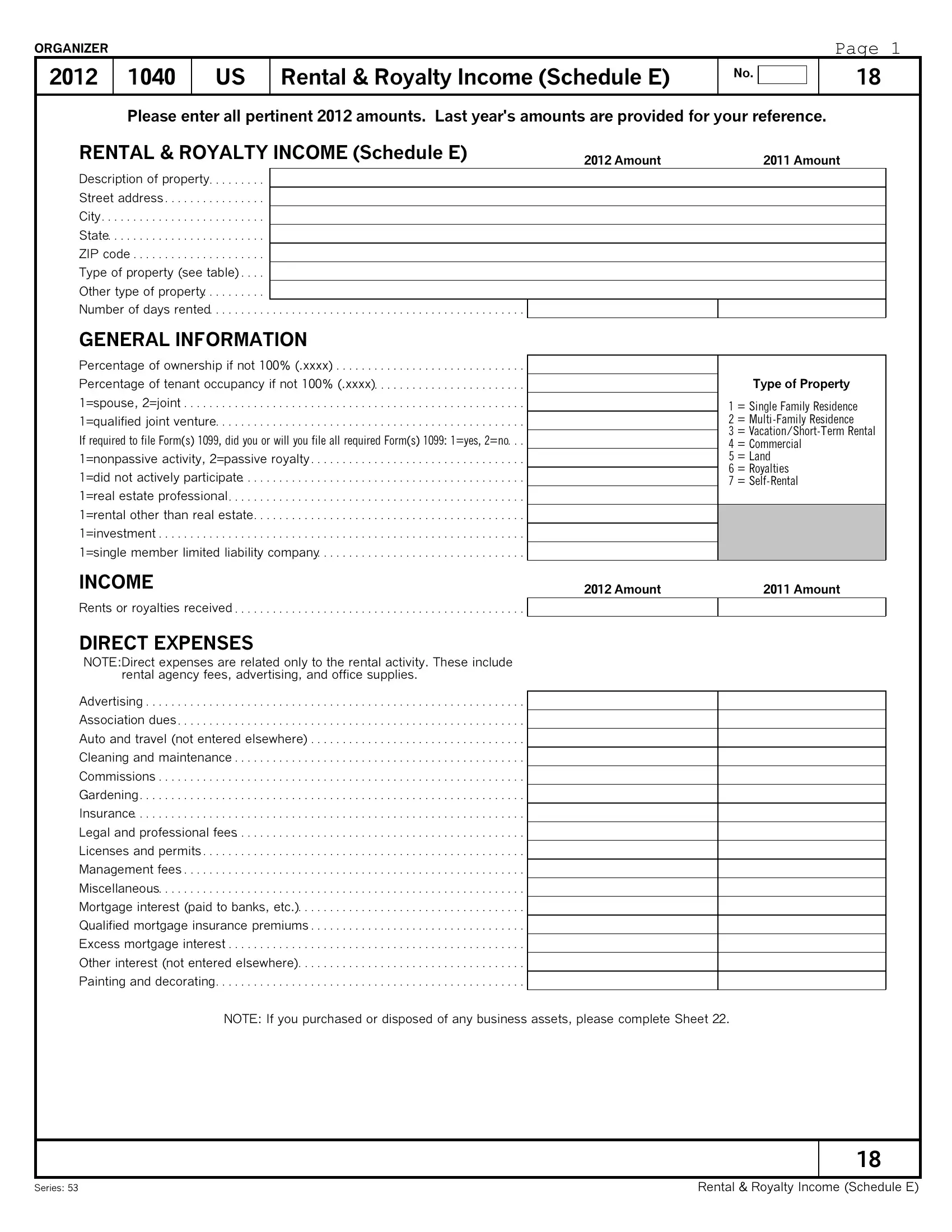
Foreign rental income goes on Schedule E, Form 1040, the same form you'd use for US rental property, with a few adjustments.
Address: Use the foreign address of the property. The IRS doesn't require a US-format address — you can write "Rua da Prata 45, 1100-412 Lisbon, Portugal."
Rents received (Line 3): Report gross rental income in USD, converted at the exchange rate on the date you received each payment — or, for simplicity and IRS-acceptance, the annual average exchange rate published by the IRS Yearly Average Exchange Rates page. Consistency matters: pick one method and apply it to all of your foreign transactions for the year.
Expenses (Lines 5-19): Deduct the same categories as US rentals:
- Advertising, auto and travel, cleaning, commissions, insurance, legal fees, management fees, mortgage interest, repairs, supplies, taxes (property tax paid to foreign government), utilities (if paid by landlord), depreciation
Specific notes:
- Mortgage interest: Foreign-bank mortgage interest is fully deductible on Schedule E, regardless of whether the lender is US or foreign. The interest you pay a Portuguese bank on your Lisbon mortgage is deductible. Report the USD-equivalent.
- Property tax: Foreign property tax (Portugal's IMI, Italy's IMU, Mexico's predial, Thailand's annual house tax) is deductible on Schedule E as a rental expense. Note: it is NOT deductible on Schedule A (personal itemized deductions) because Section 164(b)(6) limits the deduction of foreign real property taxes for personal-use property. For rentals, Schedule E deductibility survives this restriction because the expense is a business expense, not a personal itemized deduction.
- HOA / condominium fees: Fully deductible, the same as in the US.
- Depreciation (Line 18): Use the 30-year ADS schedule discussed above. File Form 4562 (Depreciation and Amortization) in the first year you place the property in service, and maintain the schedule each year.
Net rental income (Line 26): This is the taxable amount flowing into your Form 1040. It's subject to ordinary income tax rates, plus the 3.8% Net Investment Income Tax (NIIT) under IRC §1411 if your modified adjusted gross income exceeds the threshold ($200K single, $250K married filing jointly). The NIIT is a surtax that specifically applies to passive rental income, and it's not offset by the Foreign Tax Credit in most cases — see the IRS NIIT FAQ for the mechanics. This is a real gotcha: high-income Americans with foreign rentals often owe NIIT even when FTC zeroes out their regular US tax on the same income.
For more on the reporting side, see our Form 8938 and foreign real estate and FBAR foreign real estate posts.
The Mistake: Using an LLC to "Hide" Foreign Rental Income
A recurring bad idea on expat forums is routing foreign rental income through a US LLC or a foreign entity to "convert" it into business income or to avoid the Schedule E reporting. This does not work, and in several specific variations it makes the tax situation dramatically worse.
Using a US LLC: A single-member US LLC is a disregarded entity by default. The income flows to you directly, treated exactly as if you owned the property personally. You gain nothing on the tax side. A multi-member US LLC is a partnership, but the rental income still flows through to the partners and is still reported on their individual returns with the same character. You add complexity and paperwork, and you don't change the fundamental tax treatment.
Using a foreign entity: This is where it gets dangerous. A foreign corporation owned by a US person is subject to potentially crushing anti-deferral rules under Subpart F and GILTI. Under IRC §951A (GILTI), the foreign rental income earned by a Controlled Foreign Corporation (CFC) can be subject to current US taxation even if the corporation doesn't distribute it. Under IRC §1297 (Passive Foreign Investment Company, PFIC), a foreign corporation holding rental property can be a PFIC, and PFIC tax treatment for Americans is notoriously brutal — high tax rates, penalties for late filing, and a requirement to file Form 8621 annually.
Foreign holding structures work for some purposes (liability protection, estate planning, specific tax regimes in the host country), but they're almost never good tax moves from the US side without a specialist tax attorney running the numbers on CFC/PFIC exposure. The r/ExpatTaxes threads on LLC holding foreign rental property have multiple examples of Americans who created entity structures on advice from local attorneys and then discovered the US tax consequences after the fact.
If you want genuine US tax expertise on your foreign rental setup, look for a CPA who specifically handles cross-border individuals. Greenback Expat Tax Services, Bright!Tax, Taxes for Expats, and US Tax Help (Caplin & Drysdale) are four firms we've seen repeatedly recommended across r/expats, r/ExpatFIRE, and the American Citizens Abroad tax resources page.
Realistic Scenario: $3,000/Month Rental in Mexico City
Let's run the numbers for a specific real-world setup: an American living half-time in Mexico City, renting out their previous Austin home in the US (separate issue), and owning a second property — a Condesa apartment — that they rent to long-term tenants for 50,000 MXN/month (~$2,900 USD).
Annual gross rent: $34,800 Allowable deductions (Mexican side): HOA ~$2,400, predial ~$360, management ~$3,000, repairs ~$1,200, mortgage interest ~$4,800, property insurance ~$800. Total: ~$12,560. Taxable rental income (Mexican side): $22,240. Mexican tax at the 25% flat non-resident withholding rate (or progressive resident rate if Mexican tax resident): ~$5,560.
US side:
- Gross rent: $34,800
- Same deductions except mortgage interest is only deductible if the mortgage is qualified (traced to the property): $12,560
- Add US depreciation: building allocation $240,000 ÷ 30 = $8,000/year
- Schedule E net income: $14,240
- US tax at 24% marginal rate: $3,418
- FTC applied (up to $3,418): $3,418
- Net US tax on this rental: $0
- Excess FTC carryforward: $2,142 (usable in other years)
Combined total tax on $34,800 of gross Mexican rental income: $5,560 (Mexico) + $0 (US after FTC) = $5,560 total, or about 16% of gross rent.
Compare to a naive assumption of "FEIE will cover my rental income" — which would have left you reporting $34,800 fully taxable on Schedule E with no depreciation knowledge, owing US tax plus NIIT, and potentially owing $8,000-10,000 in total tax. The planning difference is $3,000-5,000/year in real dollars, every year for as long as you own the property.
For the Mexican tax mechanics specifically, see our property tax in Mexico vs California and how the US taxes rental income from Mexico posts. The Mexico-US Tax Treaty gives you treaty-based FTC eligibility, and SAT (Mexico's tax authority) publishes the withholding rates. The r/mexicocity tax thread has practical landlord experiences.

What to Do Before You Buy
The tax planning for foreign rental property is unusual in that the best moves happen before you buy. Specifically:
-
Get a CPA who does cross-border work to run the scenarios with realistic rent, local tax rate, and US marginal rate numbers. Expect to pay $300-800 for a 1-2 hour consultation. Our repeated recommendations: cross-border CPAs at firms that specialize in expat returns, not general US CPAs.
-
Understand the local rental tax regime. Many countries (Portugal, Spain, Italy, France) tax non-resident rental income at a flat rate that's higher than the resident progressive rate would be — this is intentional and usually overrides any treaty benefit. Get the number before you buy; the math changes if the local rate is 28% vs 15%.
-
Plan the building/land allocation for depreciation. Your Schedule E depreciation is driven by the building portion of the purchase price. Countries with high land-value allocations (Japan, Netherlands, coastal California) will give you smaller depreciation deductions than countries with low land allocations (interior rural areas). This is worth modeling before purchase.
-
Decide on personal-use vs pure-rental from day one. Mixed-use rentals (you stay in it part of the year, rent it out part of the year) trigger complex allocation rules under IRC §280A. For tax simplicity, pure rental (you never personally use the property) is significantly easier than mixed use.
-
Open a foreign bank account dedicated to the rental with clean, traceable flows — not mingled with personal money. This matters for FBAR and Form 8938 reporting and also for your own tax bookkeeping when you have to defend a Form 1116 FTC calculation.
For related planning, see our capital gains on foreign property post (because the depreciation recapture on sale is a major issue people forget) and our foreign currency risk piece (because your rental income in MXN or EUR is a foreign-currency flow that the IRS wants reported in USD with consistent exchange rate methodology).

Bottom Line
The FEIE is a valuable but narrow tool that does not apply to rental income from your foreign property — that income is passive under IRC §911 and fully reportable on Schedule E at ordinary rates. What actually reduces your US tax on foreign rentals is the combination of (a) Schedule E deductions for mortgage interest, property tax, and expenses, (b) 30-year straight-line depreciation under the ADS, and (c) the Foreign Tax Credit on Form 1116 for the foreign tax already paid on the same income.
Used correctly, this stack typically reduces the US tax on foreign rental income to zero or near zero, leaving you paying only the local country's rental tax — which for most treaty countries runs 15-28%. Used incorrectly (assuming FEIE applies, skipping depreciation, using inappropriate entity structures), you can end up paying both US and foreign tax on the same income and watching your net yield drop from a plausible 4-5% to a painful 1-2%.
If you own foreign rental property and have not had a cross-border CPA review your return, that's the single highest-value tax move you can make this year. The upfront consultation cost ($300-800) pays for itself in the first year for anyone generating more than about $15,000 in foreign rental income. Everything else in this post is just explanation of what that CPA is going to tell you.
Ready to explore?
Browse Destinations