
Mexico Temporary Residency Through Real Estate: Does It Actually Work?

Every relocation website promises Americans that buying a house in Mexico is a shortcut to temporary residency. Go to a realtor's open house in San Miguel de Allende or a condo sales pitch in Playa del Carmen and you will be told, confidently, that the deed alone grants you a four-year resident card. This is partly true and mostly misleading. Mexico's Ley de Migración does permit property ownership as a basis for temporary residency, but the threshold is high, the rule is administered by consulates (not by INM in-country), and consulate interpretation varies so widely that the same case can be approved in Austin and rejected in Chicago.

This guide is for Americans trying to separate the realtor marketing from the actual law. What's in Article 52 of the migration law, how the UMA (Unidad de Medida y Actualización) peso value sets the threshold each year, which consulates will accept property as economic solvency and which won't, how the income alternative actually works (and why most Americans end up using it instead), and how the fideicomiso trust structure for coastal property interacts with the residency question. Primary sources: the Instituto Nacional de Migración (INM), the Mexican Ministry of Foreign Affairs (SRE), and consulate-specific pages. Peer experience: r/mexicoliving, r/mexpats, and r/ExpatFIRE.
The Law: Article 52 and the UMA Multiplier
Mexico's Ley de Migración (published in the Diario Oficial de la Federación) creates three main residency categories: visitor (Visitante, up to 180 days), temporary resident (Residente Temporal, 1-4 years, renewable to permanent), and permanent resident (Residente Permanente, indefinite). Article 52 and its regulations list the paths to temporary residency, which include family unity, investment, job offer, retirement income, and — the one we care about — ownership of real property in Mexico at or above a value threshold.
The threshold is expressed not in pesos but in UMAs. UMA (Unidad de Medida y Actualización) is Mexico's indexed reference unit, updated annually by INEGI. For 2026 the daily UMA value is approximately 113.14 pesos — the INEGI UMA page publishes the current figure each February.
For property-based residency, you need property with an acquisition value of at least 40,000 UMAs. Math:
- 40,000 × 113.14 pesos = ~4,525,600 pesos
- At the early 2026 exchange rate of roughly 17 pesos per USD, that's ~$266,000 USD
One gotcha: the required threshold is based on the value recorded on the notarized deed (escritura pública), not on what you paid, not on what the current market would price it at. If you bought in 2012 at half the current price and the escritura reflects that, the consulate can reject the application even if the current market value is far above the threshold. Getting a current appraisal (avalúo) isn't enough — the deed is what controls, per multiple confirmations on Mexperience and Mexico News Daily.
The property must be unencumbered. Mortgaged properties generally don't count — if the deed shows a lien or the bank holds partial interest, the consulate can (and often does) reject the application. The deed needs to be clean.
Property type matters. The law doesn't distinguish residential from commercial, but consulates have been more comfortable with residential (especially condos and single-family homes) than with undeveloped land or farmland. Land-only applications get more scrutiny.
The Consulate Problem: Same Law, Different Answers
Mexican immigration applications start at a Mexican consulate in the US, not in Mexico. You cannot fly to Mexico, buy a house, and walk into INM asking for residency — the initial visa sticker goes into your passport at the consulate, then you convert it to a resident card within 30 days of entering Mexico. The SRE consulate directory lists all 50+ US consulates and their specific requirements.
Here's the part that's not in the law: consulates have broad discretion over how they interpret property-based applications, and several do not accept them at all. This is well-documented in the expat community. Threads on r/mexicoliving regularly surface applicants who showed up with a clean escritura above the UMA threshold and were told "we don't do property solvency at this consulate, show us income instead." Other consulates accept property cases routinely.

Consulates that have historically accepted property-based applications without drama: Houston, Dallas, Austin, Laredo, El Paso, Phoenix, Tucson, San Diego, Los Angeles. The border-state consulates process the highest volume of Mexico residency applications and are generally the most experienced with the property route. Consulates that have been stricter or effectively refused property cases in recent years: Chicago, Washington DC, New York, Boston, Atlanta, Seattle. This is not a published rule — it's a pattern. Mexperience's consulate FAQ and the Mexico Relocation Guide both warn about the variation.
The practical implication: your choice of consulate matters more than your choice of property. If you live in a state where the nearest consulate doesn't process property cases, and you can't legally apply at a different consulate (you must apply at the one corresponding to your jurisdiction), the property-based path may not be available to you at all. The workaround some Americans use is to establish residency in a state served by a property-friendly consulate before applying — but that's a months-long detour and consulates have started asking for proof of recent physical address in their jurisdiction.
This is why most Americans who qualify on both income and property end up submitting the income application instead: it's administered more consistently across consulates.
The Income Alternative: Why Most Americans Actually Use It
Article 48 of the migration regulations allows temporary residency based on economic solvency via regular monthly income. This path is available at every Mexican consulate and has been the default for most American retirees and remote workers for years. The current thresholds (2026):
- Temporary residency: monthly net income of 300x daily minimum wage (salario mínimo). Mexico's 2026 daily minimum wage is 278.80 pesos, making the threshold ~83,640 pesos/month or about $4,900 USD/month. The 12-month lookback requirement means you need to document this for the past 6 months (some consulates ask for 12).
- Permanent residency: monthly net income of 500x daily minimum wage, or about ~139,400 pesos/month (~$8,200 USD/month), or the savings-based alternative below.
- Permanent residency via savings: average balance over the past 12 months of 20,000x daily minimum wage, or ~5,576,000 pesos (~$328,000 USD).
Most Americans qualify on the income path, not the property path. A retired couple with combined Social Security and pension of $4,900+/month documented via bank statements is the fastest-approved profile at every Mexican consulate in the US. The documentation is simpler than property applications: passport, 12 months of bank statements, SSA benefit letters, and a filled-out visa application. Processing times are typically 1-3 weeks; many consulates issue the visa sticker on the day of the appointment.
Crucial wrinkle on income thresholds. The minimum wage has been increasing sharply — Mexico's López Obrador administration raised it 20% in 2023 and again in 2024, and Sheinbaum's government has continued the increases. Each year's increase pushes the threshold up by roughly the same percentage. What was $3,200/month in 2022 is now $4,900/month in 2026 — a 50% jump in four years. Plan for further increases. See Mexican Ministry of Labor (STPS) and the daily UMA tracker on INEGI for the authoritative current numbers.
Permanent residency direct. Americans with enough income or savings can often skip temporary residency entirely and apply directly for permanent residency. Permanent is better — no renewal required, no restriction on work, path to naturalization after 5 years (4 for spouses of Mexicans). Most retirees who qualify go straight to permanent.
The 4-year temporary ladder. Americans who don't quite clear the permanent-residency income threshold usually get temporary residency first: 1-year card, then renew for 3 more years, then automatically eligible to convert to permanent without needing to requalify on income at that point. This is a genuine loophole — the conversion from 4-year temporary to permanent is based on having legally resided, not on re-proving solvency. Mexico News Daily and Mexperience both confirm this in recent guides, and it's one of the reasons Mexico is a friendlier long-term residency country than most.

The Fideicomiso Trap for Coastal Property
If the property you're thinking about buying is within 50 km of the coast or 100 km of a land border, Article 27 of the Mexican Constitution prohibits direct foreign ownership of the underlying real estate. This is the infamous restricted zone (zona restringida), and it covers most of the real estate that Americans actually want to buy — Playa del Carmen, Tulum, Puerto Vallarta, Cabo San Lucas, Mazatlán, Puerto Peñasco, and so on.
The solution is a fideicomiso — a 50-year renewable bank trust. A Mexican bank holds legal title; you are the beneficiary with full rights of use, sale, rental, and inheritance. The arrangement is legal, well-established, and used by hundreds of thousands of foreign property owners. It is not "you don't really own it" despite what some fear-mongering blogs claim — you have all the practical rights of ownership, including the right to instruct the bank to sell the property to whomever you choose.
But the fideicomiso has a real interaction with property-based residency. Because legal title is in the bank's name, some consulates have rejected property-based residency applications backed by a fideicomiso on the grounds that you don't technically "own" the real estate — you own a beneficial interest in a trust. Other consulates accept the fideicomiso certificate without drama. This is another reason the property route is unreliable and most coastal-property Americans end up applying on income.
Non-restricted-zone properties (inland, more than 50 km from the coast) can be bought in your own name as a direct deed. San Miguel de Allende, Guadalajara, Querétaro, Mexico City, Oaxaca City, Mérida (just far enough inland to sidestep the coastal restriction), and Ajijic / Lake Chapala all qualify. This is one reason these inland destinations tend to be the residency-via-property path of choice — clean direct ownership, easier consulate presentation.
For the full picture on the restricted zone, see MexLaw's fideicomiso guide, our own Mexico restricted zone post, and the US Embassy Mexico City citizen services page. The Banco de México fideicomiso rules are the authoritative source on the banking side.
Timeline, Costs, and the Real Process
What actually happens step by step, assuming you are using the income path (which is what most Americans actually use):
Step 1 — Pre-application prep (1-3 weeks)
- Gather passport (valid for 6+ months), passport photos, filled-out visa application form from your consulate's website
- Assemble 12 months of bank statements, pension/SSA award letters, Schedule E for rental income (if applicable), any other income documentation
- Some consulates want statements translated to Spanish by a certified translator — ask your specific consulate. Houston doesn't; Chicago does.
- Schedule your in-person appointment. This is the longest lead time in the process — major consulates are booked 4-8 weeks out.
Step 2 — Consulate appointment (1 day to 2 weeks)
- Show up with everything. Pay the visa fee (~$51 USD), currently $42-53 depending on consulate.
- Some consulates issue the sticker same-day; others mail it back 5-10 business days later.
- The sticker in your passport is a single-entry authorization valid for 180 days — you must enter Mexico before it expires.
Step 3 — Enter Mexico and convert to resident card (30-day deadline)
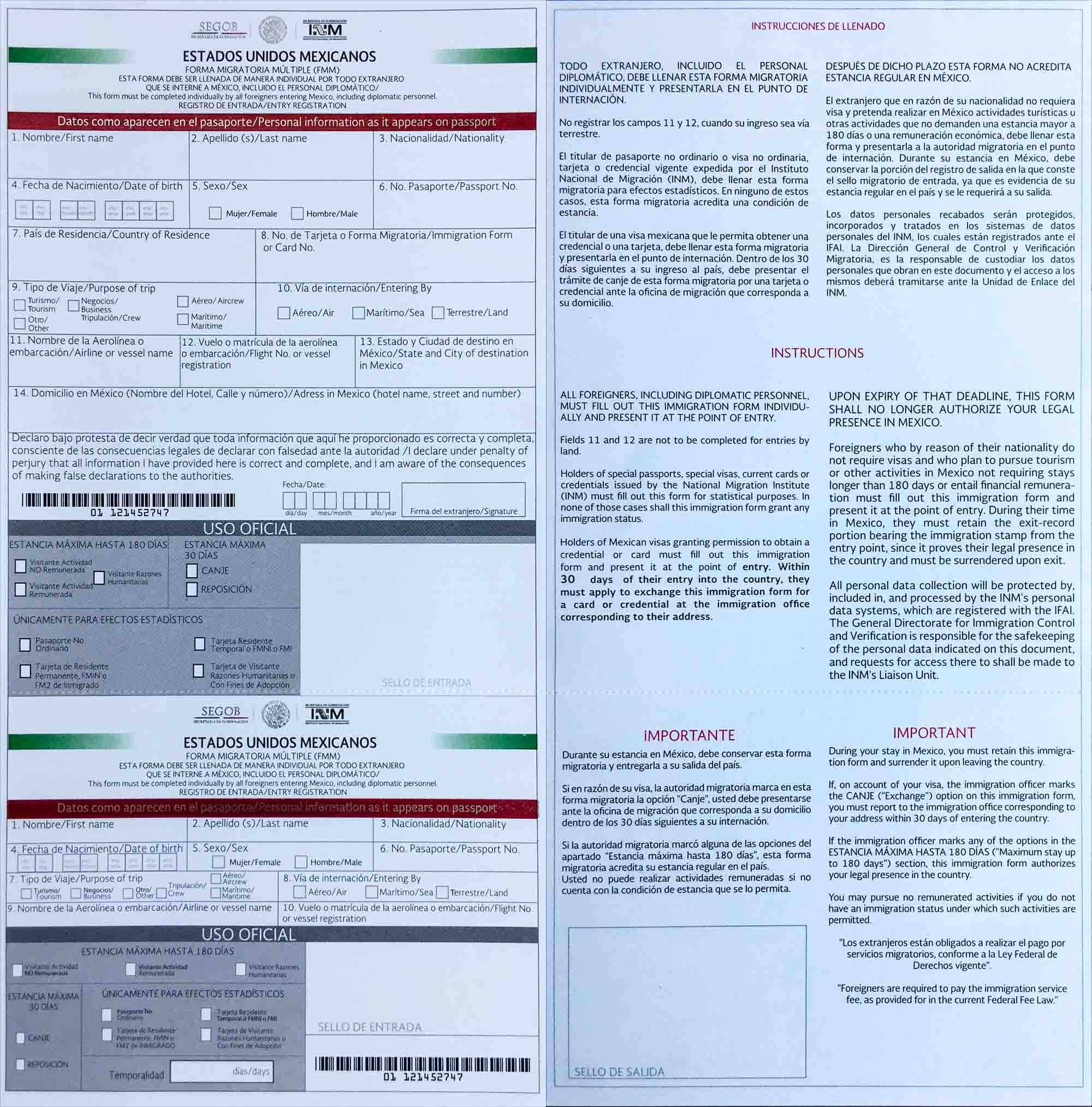
- At your port of entry, make sure the immigration officer stamps you with "Canje" (exchange) rather than FMM tourist. If they miss this you'll have to fix it at an INM office.
- Within 30 days of entry, visit the INM office in the state where you plan to live. Submit the conversion form (requires a Mexican address, passport photos, and the visa sticker in your passport).
- Pay the Canje fee (~$270-320 USD) and receive a receipt.
- Return in 2-6 weeks to collect your Residente Temporal card (a plastic ID-style card, valid 1 year initially, renewable).
Total cost for income-based temporary residency (single applicant):
- Consulate visa fee: ~$51
- INM Canje fee: ~$280
- Document prep, translations (if needed), notarized copies, photos: $50-200
- Optional immigration attorney: $300-800 (unnecessary for income cases, recommended for property cases)
- Total: $400-1,300 USD
Total timeline: typically 2-4 months from first appointment to card in hand, though processing has sped up significantly since the post-COVID backlog cleared. Property cases add 1-3 months because of consulate document review. Our broader moving to Mexico guide covers the full settling-in process.
Hire a local ' gestor'. In Mexico, bureaucratic work is often handled by gestores — paid facilitators who know which office window to go to and who can queue on your behalf. For the INM conversion step, a gestor runs $150-400 and will save you probably 2-3 trips and days of sitting in waiting rooms. Worth it. r/mexicoliving has recommendations by city.
Tax Implications of Becoming a Mexican Resident
Mexico taxes residents on worldwide income. You become a Mexican tax resident when Mexico is your "center of vital interests" — a broader test than the US 183-day rule, based on where your home, family, and economic activities primarily are. For a retiree who sells their US home and moves to Oaxaca on a resident card, tax residency kicks in quickly. For a snowbird who spends 5 months in Cabo and keeps a Florida primary residence, it's murkier.
Mexican progressive income tax rates run from 1.92% to 35%, with the 35% top bracket kicking in at around 4 million pesos/year (~$235,000 USD). Capital gains on Mexican real estate are taxed at a flat 25% on gross sale price OR 35% on net gain, whichever you elect (with a primary-residence exemption if you've lived there long enough). Foreign-source income is taxable at the same progressive rates, with a foreign tax credit for US taxes paid.

The US side. The US-Mexico tax treaty (full text on the IRS treaty page) prevents most double taxation. Social Security is generally taxable only in the US under the treaty. Pensions are taxable where you reside. Rental income from Mexican property can be taxed in Mexico at around 25% of gross. See our US rental income Mexico guide and capital gains foreign property post for the full US-tax-side picture.
The property tax bonus. Mexican property tax (predial) is extraordinarily low by American standards — typically 0.05% to 0.3% of assessed value per year, versus 1.2-2.5% in most US states. A $400,000 property generates $200-1,200/year in predial in most Mexican municipalities. The assessed value (valor catastral) is usually well below market value, so effective rates are often lower still. See our Mexico property tax vs California post for the full comparison.
FBAR and Form 8938 still apply. US citizens with Mexican bank accounts totaling more than $10,000 at any point in the year must file FBAR. If you have foreign financial assets over $200,000 (single, living abroad) at year-end or over $300,000 at any point, Form 8938 is also required. The real estate itself is not reportable on FBAR or Form 8938 directly — only the accounts and financial assets. See our FBAR foreign real estate guide for the details. Threads on r/USExpatTaxes have recent filer experiences.
Honest Verdict: Should You Use the Property Route?
After reading all of the above: should you actually use property-based residency in Mexico, or pursue the income path like most Americans?
Use property-based residency if:
- You already own (or plan to close on) a property with a clean escritura showing at least ~$280,000 USD acquisition value
- The property is not in the coastal restricted zone (no fideicomiso complications)
- Your nearest Mexican consulate is in the southwest or south (Houston, Dallas, Austin, San Diego, LA, Phoenix) and has a track record of accepting property cases
- Your monthly income is below the $4,900 threshold for income-based temporary residency, so you can't use the income path

Use income-based residency if:
- You qualify on income ($4,900+/month for 4-year temporary, $8,200+/month for permanent)
- Your consulate is known for being inconsistent on property cases
- Your property is in the coastal zone via fideicomiso
- You want the simplest, most predictable process
Both are real options. Neither is a shortcut. The "buy a house and get residency" marketing pitch oversimplifies both paths. Any residency application requires showing up in person at a consulate with full documentation, waiting weeks or months, then traveling to Mexico within 180 days to convert the visa to a resident card. Property just happens to be one of several paths, and not the easiest one.
Where to go next.
- Our moving to Mexico guide covers the full arrival process (banking, healthcare, neighborhoods, SAT tax registration).
- The US Embassy Mexico City residency overview is blunt and useful.
- Mexperience, Mexico News Daily, and Mexico Relocation Guide are the best long-running English-language expat sources.
- r/mexicoliving, r/mexpats, r/mexicocity, r/mexicofinance, and r/ExpatFIRE are where recent applicants share specific consulate experiences. Search by your home-state consulate name before you spend anything.
- A licensed Mexican immigration attorney costs $500-1,500 for a full residency application and is worth it if your case has any complexity (fideicomiso, business income, dual consulate question). Most are referred through the Barra Mexicana de Abogados or US firms like MexLaw.
Ready to explore?
Browse Destinations