
Do You Need a Visa to Buy Property in Spain as an American?

Short answer: no. You do not need a Spanish visa to buy a Spanish house. You can fly into Madrid on your 90-day Schengen visa-waiver entry, view properties for ten days, sign an arras contract, fly back to the US, and complete the closing a month later through power of attorney without ever having held a Spanish residence permit. Americans have been doing this in volume since the 1980s and the regime hasn't changed.

The longer answer is more nuanced, and it matters because most people asking this question aren't really asking about property law — they're asking whether buying a house in Spain is the fastest way to live in Spain. It used to be, through the Golden Visa program that ran from 2013 to April 2025. It isn't anymore. Organic Law 1/2025 officially ended the real estate pathway to the Spanish Investor Visa on April 3, 2025, closing the door for new applicants. If your goal is residency rather than just ownership, buying is no longer the shortest path and this article will explain what is.
This guide covers: the legal requirements for a non-visa property purchase, the NIE process, the actual closing steps, the tax consequences for non-resident owners, and the visa options that replaced the Golden Visa. For related reading see our closing timeline Spain article, our moving to Spain guide, and the countries Americans can't buy property overview. Peer sources: r/Spain, r/expats, r/GoingToSpain, and r/AmerExit.
The Legal Answer: Ownership and Visas Are Separate
Spanish property law makes a clean distinction between owning real estate and having the right to live in Spain. They are governed by different statutes, different ministries, and different procedures.
Ownership is regulated by the Spanish Civil Code, the Ley de Extranjería only insofar as it defines 'foreigner,' and the Reglamento Hipotecario that governs the property registry. The foundational rule, unchanged since the 1980s liberalization: any foreigner, regardless of visa status, can buy Spanish property on equal terms with Spanish citizens. There is no limit on the type of property, the number of properties, the geographic location (all autonomous communities are open), or the financing source. Costaluz Lawyers' American buyer guide and Lawants' buying guide both confirm this.
Residency is regulated by the Ley Orgánica sobre derechos y libertades de los extranjeros en España and the separate regime at each Spanish consulate. You need a visa to live in Spain longer than 90 days in any 180-day period. Owning property doesn't waive this, extend it, or grant any special entry privilege. The Spanish Ministry of Foreign Affairs consular page is the authoritative source for visa rules.
So an American can legally own a beautiful villa in Mallorca and still be limited to 90 days every 180 days of physical presence. The property sits there the other 90 days while you're back in the US. This is a surprisingly common arrangement — dual-residence Americans who spend roughly equal time in the US and Spain stay under the Spanish 183-day tax-resident threshold by design.
The only thing you need for the purchase itself is an NIE, which is not a visa.
The NIE Is Not a Visa — What It Actually Is
The Número de Identidad de Extranjero (NIE) is a tax identification number. Every foreigner who transacts significantly in Spain needs one — to sign a property deed, to open a bank account, to file Spanish taxes, to inherit a Spanish asset. It is issued by the Policía Nacional through its Extranjería (foreigners' office) or through Spanish consulates abroad.
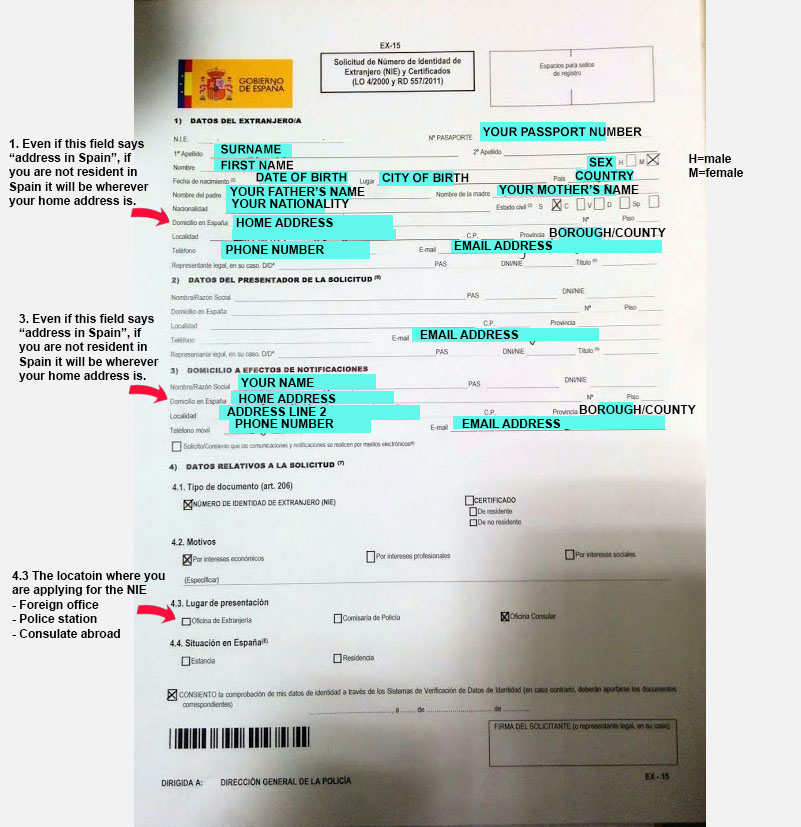
An NIE is a number, not a residence permit. Holding an NIE gives you zero additional right to enter, stay in, or live in Spain. It is roughly analogous to getting an ITIN from the IRS as a non-resident taxpayer — a tax ID, nothing more.
How Americans get an NIE in 2026:
Option 1: Apply at a Spanish consulate in the US. Consulates in NYC, Miami, LA, San Francisco, Chicago, Houston, DC, Boston, Puerto Rico (San Juan), and a few smaller posts process NIE applications. You book an appointment (some consulates have weeks-long waits), complete the EX-15 form, appear in person with a US passport and a reason for needing the NIE (property purchase intent counts), pay a small fee (usually €10-15), and receive the NIE in 2-6 weeks. NYC and Miami routinely take longer because of demand.
Option 2: Apply in Spain in person. You book an appointment at the nearest Policía Nacional Extranjería office via Spain's administrative appointment portal. Barcelona and Madrid appointments can be 4-8 weeks out; smaller cities (Valencia, Alicante, Zaragoza, Murcia) often have next-week availability. With the appointment you appear with your passport, the EX-15 form, and pay the fee at a bank via Modelo 790. You receive the NIE same-day or in a few days.
Option 3: Power of attorney to a Spanish lawyer. You grant a Spanish lawyer a poder notarial — signed in front of a US notary with an apostille — and they apply for the NIE on your behalf. This is the most expensive but least-effort route, typically €250-600 plus the notary and apostille fees. Useful if you can't travel.
Americans should start the NIE process before making any serious property offers — not after. Waiting to start the NIE until an offer is accepted has cost multiple buyers their closing timeline. See our closing timeline Spain article for the end-to-end calendar and Idealista's NIE guide for current wait times.
What Closing Actually Looks Like Without a Visa
The actual mechanics of buying Spanish property as a non-resident American are straightforward. The presence of a visa or lack of it makes no difference to any step.
- Find a property through Idealista, Fotocasa, Pisos.com, or Kyero — the four main portals. English-language options are plentiful in coastal areas where foreign buyers are common.
- Make a verbal offer, then sign a reservation contract (contrato de reserva) with a €3,000-10,000 deposit. Refundable if diligence turns up problems.
- Sign the contrato de arras (earnest money contract) within 1-3 weeks, paying 10% of the purchase price. This is where real money goes on the table.
- Due diligence — your Spanish lawyer pulls a nota simple from the Registro de la Propiedad, verifies the cédula de habitabilidad, checks for outstanding community fees and IBI tax, confirms the catastral reference, and reviews any urbanismo issues.
- Closing at the notary — you appear in person (or via power of attorney) at the notary's office. The escritura pública de compraventa is read aloud, signed, and stamped. You wire the balance of funds.
- Post-closing: tax and registration. You pay ITP (Impuesto de Transmisiones Patrimoniales) within 30 days — rates vary by autonomous community, typically 6% to 10%. Then the deed is registered at the Registro de la Propiedad.

Total elapsed time for an American non-resident buyer with the NIE already in hand: 6 to 10 weeks from arras to registered deed. Our closing timeline Spain article has the full week-by-week breakdown.
Total closing costs for a non-resident buyer run 10% to 14% of the purchase price including ITP, notary, registry, gestoría, and lawyer fees. This is a significant premium over US closing costs and is the single most common surprise for American buyers. See our hidden costs of buying in Spain article for the full breakdown. r/Spain threads on buyer closing costs have real receipts.

Taxes on a Non-Resident Owner
Here is where 'no visa required' becomes 'but here are the tax consequences you didn't expect.' Spain treats non-resident property owners differently from resident owners, and the difference is real money.
Annual IBI (Impuesto sobre Bienes Inmuebles) — municipal property tax, levied on both residents and non-residents, typically 0.4% to 1.1% of cadastral value per year. Cadastral values are usually well below market so the effective rate on market value is often 0.1-0.4%. Collected by the local ayuntamiento. Every property owner pays this.
Non-resident imputed income tax (Modelo 210). This is the Spanish tax most Americans are blindsided by. If you own Spanish property as a non-tax-resident and do not rent it out, Spain imputes an annual rental value of 1.1% or 2% of the cadastral value (depending on when the cadastral value was last revised) and taxes you on it at 24% as non-resident imputed income. For a €500K coastal apartment with a cadastral value of €200K, the imputed rental is €2,200-€4,000 and the tax is €530-€960/year. You file Modelo 210 annually whether or not you were physically in Spain. The Agencia Tributaria Modelo 210 page has the filing form.
Non-resident rental income tax. If you rent the property, the rental income is taxed at 24% for non-residents from non-EU/EEA countries (Americans), with no deductions for expenses. EU-resident non-residents get to deduct expenses at 19%; Americans do not. This is a significant penalty for Airbnb-ing a Spanish property as a US-based owner. See Blevins Franks' Spain property tax article for the current rates.
Wealth Tax (Impuesto sobre el Patrimonio). Applied at the autonomous community level, with different thresholds by region. Madrid has effectively zero wealth tax (100% exemption); Catalonia, Valencia, and Andalusia have meaningful wealth tax that applies to non-residents on Spanish-situs property only. Rates typically run 0.2% to 3.75% on the portion of net wealth above the regional threshold (often around €700K-1M). Spence Clarke's wealth tax article has current rates.
Capital Gains Tax on sale. Non-residents pay 19% on the gain. On top of that, buyers are required to withhold 3% of the purchase price when a non-resident sells, remitted to Hacienda as an advance on the seller's CGT. This catches many non-resident sellers who didn't budget for it. See our capital gains foreign property article.
Add these up for a typical American non-resident owning a €500K coastal villa: Modelo 210 ~€600/year, IBI ~€500/year, local community fees €1,500-3,000/year. Expect €3,000-5,000/year in ongoing non-resident-owner costs for a typical second home.
The End of the Golden Visa: What Changed in April 2025
For twelve years — from Law 14/2013 to April 3, 2025 — Spain offered a Golden Visa that granted residency to non-EU investors who bought Spanish property worth €500,000 or more. It was one of the most popular investor visa programs in Europe, processing thousands of Americans, Chinese, and Latin Americans annually. It is no longer available.
:max_bytes(150000):strip_icc()/freethingsmadridcongresodelosdiputados-44dacc8e707840cda6959ccac024e113.jpg)
Organic Law 1/2025 of January 2, 2025 amended the investor visa regime to remove real estate as a qualifying investment, with the change taking effect April 3, 2025. Applications filed before that date were processed under the old rules; applications after were rejected. The political motivation was to cool the housing market by removing speculative foreign demand, and it was part of the same policy bundle that included the proposed (but not yet passed) 100% tax on non-resident non-EU property purchases.
The Golden Visa was not just a residence permit — it granted access to Schengen free movement, allowed spouses and dependent children to join, and after 10 years could convert to citizenship. Losing it is a real deal for the Americans who wanted to trade capital for European residency through real estate. Investropa's Spain visa update covers the timeline. r/expats threads on Spain Golden Visa ending have personal accounts.
What replaces it for Americans who want residency-plus-property:
- Non-Lucrative Visa (NLV) — the traditional retiree/rentier visa. Requires proof of passive income of about €28,800/year for the primary applicant (400% of the IPREM) and €7,200/year per dependent. Does not allow you to work for a Spanish employer or earn Spanish income. One-year initial permit, renewable. MySpainVisa's NLV page has current income thresholds. Our moving to Spain guide walks through the full application process.
- Digital Nomad Visa — introduced December 2022. Requires proof you work remotely for non-Spanish employers and earn at least €2,762/month (200% of the Spanish minimum wage). Tax benefits: Beckham Law flat 24% for 6 years. BLS International's DNV page has documentation requirements.
- Student Visa — one-year permit tied to enrollment. Lenient and relatively easy for retirees willing to enroll in a language or cultural program.
- Family reunification / marriage to an EU citizen — if applicable.
- Entrepreneur visa — for those investing in a Spanish business (not real estate).
If your plan is 'buy a property and get residency,' none of these involve the property directly anymore. You buy the property as an owner, and separately you apply for the visa on the basis of income, remote work, or study. They are parallel tracks.
Should You Buy Now Anyway? The 2026 Calculation
With the Golden Visa dead and the 100% purchase tax on non-EU non-residents under active political debate, the 2026 calculation for American buyers is more nuanced than it was in 2024.
Arguments for buying now:
- The 100% tax is still a proposal, not law. It needs to pass both houses and has faced significant opposition from tourism-dependent autonomous communities (Balearics, Canaries, Costa del Sol).
- Spanish housing inflation continues — Banco de España data shows residential prices up 5-8% annually in 2024 and 2025 in the major markets.
- Non-resident imputed income tax is not new and is not punitive at today's rates.
- EUR/USD has moved in favor of American buyers over 2024-2025.
Arguments for waiting:
- The 100% tax, if it passes, would immediately double the purchase cost for non-residents — a €500K property would cost €1M.
- Spanish housing is widely considered expensive relative to historical averages in the major cities.
- The political environment is shifting toward more restrictions on foreign buyers, not fewer.
- If you really want Spanish residency, waiting for a DNV or NLV approval first and then buying as a resident may avoid the non-resident tax premium.
For most American buyers the right answer depends on your specific relationship to Spain. If you're buying a second home to use during visa-free visits and to visit retirees who have already moved there, 2026 is still a reasonable year to buy with eyes open to the tax cost. If you want to live in Spain full-time and the property is central to that plan, get the visa first, then buy as a resident. For the cross-country comparison of which European market makes the most sense right now, see our moving to Portugal guide, our moving to Italy guide, and our moving to France guide. And for specific listings, browse our country page for Spain and the city pages for Barcelona, Madrid, Valencia, and Málaga.
Ready to explore?
Browse Destinations